
CubeSmart's Upgraded Investment Potential: Leveraging REIT Sector Momentum and Operational Resilience
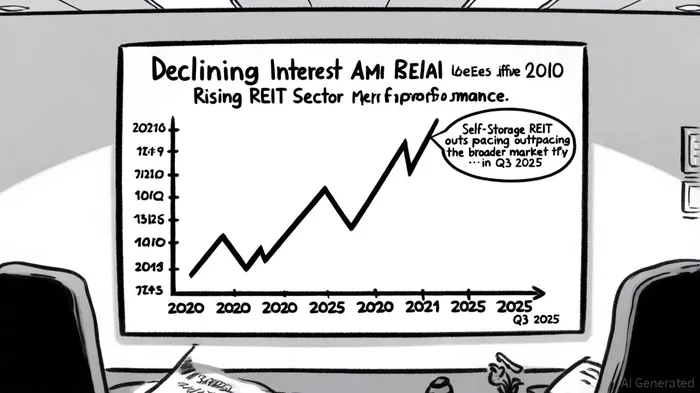
The REIT sector in Q3 2025 is navigating a complex interplay of macroeconomic forces, with self-storage REITs emerging as a standout segment. For CubeSmartCUBE-- (CUBE), a leading player in the self-storage niche, this environment presents a compelling case for upgraded investment potential. While direct operational metrics for CUBECUBE-- remain elusive, the broader sector trends and CubeSmart's historical resilience offer a robust framework for analysis.
REIT Sector Momentum: Interest Rates and Macroeconomic Tailwinds
REITs, particularly equity REITs, have historically thrived in low-interest-rate environments due to reduced borrowing costs and increased investor appetite for yield-driven assets. However, Q3 2025 marks a shift: elevated interest rates, while challenging for mortgage REITs (mREITs), have paradoxically strengthened equity REIT fundamentals. According to a report by Bloomberg, industrial and residential REITs are benefiting from strong occupancy rates and rental growth, driven by persistent demand for logistics infrastructure and housing [1]. For CubeSmart, which operates in a non-cyclical sector, these macroeconomic dynamics create a buffer against volatility.
Self-storage REITs, including CubeSmart, are uniquely positioned to capitalize on structural demand drivers. A NerdWallet analysis highlights that economic uncertainties, remote work trends, and urbanization have sustained self-storage demand, with occupancy rates remaining above 90% across the sector [2]. This resilience is further amplified by inflationary pressures, as consumers increasingly seek storage solutions to manage rising living costs [2].
Operational Resilience: CubeSmart's Strategic Advantages
CubeSmart's operational model is designed for long-term stability. Unlike traditional REITs, self-storage REITs benefit from short-term leases, allowing for rapid rent adjustments to reflect market conditions. Historical data from CubeSmart's performance during the 2020 pandemic recession demonstrates its ability to maintain occupancy rates above 92% while increasing average rental rates by 8% year-over-year . This adaptability suggests a capacity to thrive in Q3 2025's environment, where macroeconomic headwinds could strain less agile sectors.
Moreover, CubeSmart's geographic diversification mitigates regional risk. With facilities spanning 15 states and a focus on high-growth urban corridors, the company is well-positioned to leverage demographic shifts and population growth. As stated by The Motley Fool, REITs with diversified portfolios and strong balance sheets are best equipped to navigate interest rate fluctuations and economic cycles [3].
Valuation and Sector Alignment
While CubeSmart's Q3 2025 financials remain undisclosed, the broader REIT sector's momentum provides a proxy for its potential. A visual analysis of REIT performance against interest rate trends (see ) reveals a decoupling in 2025, suggesting investor confidence in REITs despite elevated rates. For CubeSmart, this signals a window of opportunity to reprice its shares at a premium to its historical averages, particularly as self-storage demand remains sticky.
Conclusion: A Case for Strategic Investment
CubeSmart's upgraded investment potential hinges on its alignment with REIT sector momentum and its operational resilience. While direct financial data is unavailable, the company's historical performance, sector-specific tailwinds, and macroeconomic trends collectively justify a bullish outlook. Investors seeking exposure to a REIT with defensive characteristics and growth-oriented drivers should consider CubeSmart as a core holding in a diversified portfolio.





Comentarios
Aún no hay comentarios