
CSX: A Decade-Long Compounding Success Story in the Freight Rail Sector
Over the past decade, CSX CorporationCSX-- (CSX) has navigated a volatile market landscape to emerge as a compelling case study in long-term compounding returns and sector resilience. From a -26.73% decline in 2015 to a 17.06% year-to-date (YTD) gain in 2025, the stock's trajectory reflects both the challenges and opportunities inherent in the U.S. freight rail industry. This analysis examines CSX's performance through the lens of its operational adaptability, strategic reinvention, and alignment with broader sector trends, offering insights for investors seeking to understand its enduring appeal.
Stock Performance: Volatility and Resilience
CSX's stock price history from 2015 to 2025 underscores its cyclical nature. After a steep -26.73% drop in 2015, the company rebounded with a remarkable +42.09% gain in 2016, followed by a +55.48% surge in 2017 according to total real returns data. These gains, however, were tempered by a -16.58% correction in 2018, illustrating the sector's sensitivity to macroeconomic shifts. By 2023, the stock had regained momentum with a +13.51% return according to total real returns data, and as of 2025, it delivered a 17.06% YTD gain according to total real returns data. While these figures highlight volatility, they also reveal a pattern of recovery driven by CSX's ability to align with sector-wide tailwinds, such as the resurgence of intermodal traffic and industrial growth in the Southeast U.S.
Sector Resilience: A Foundation for Long-Term Growth
The U.S. freight rail sector has demonstrated remarkable resilience despite headwinds like coal industry decline and regulatory pressures. From 2015 to 2025, the sector saw a 4.5% year-over-year increase in rail traffic in Spring 2025, with intermodal traffic accounting for much of the growth according to rail market analysis. This momentum was fueled by surges in port activity-such as the Port of Long Beach and Georgia Ports Authority-driven by e-commerce and global supply chain shifts according to rail market analysis.
Globally, the rail market's valuation reached USD 768 million in 2025, with projections to hit USD 1.102 billion by 2032 at a 5.4% CAGR according to market research. North American Class I railroads, including CSXCSX--, have capitalized on this trend through cost efficiencies and precision-scheduled railroading (PSR) strategies. For instance, operating ratios (ORs) for most carriers converged to the 60-65% range by 2025, with Union Pacific (UP) and Canadian National (CN) leading in operational efficiency according to industry performance insights. While CSX lagged slightly in Q2 2025, its Q3 performance showed strong improvement according to industry performance insights, underscoring its capacity to adapt.
CSX's Financial and Strategic Positioning
CSX's financials reflect a mix of growth and challenges. In 2024, the company reported $14.540 billion in revenue and $7.011 billion in EBITDA, though both figures marked declines from 2023 according to marketbeat financials. Operating income for Q2 and Q3 2025 also dipped by 11% and 16%, respectively, compared to prior-year periods. These declines were partly offset by strong performance in merchandise and coal segments in 2023 according to SEC filings, as well as strategic initiatives focused on technology adoption and sustainability.
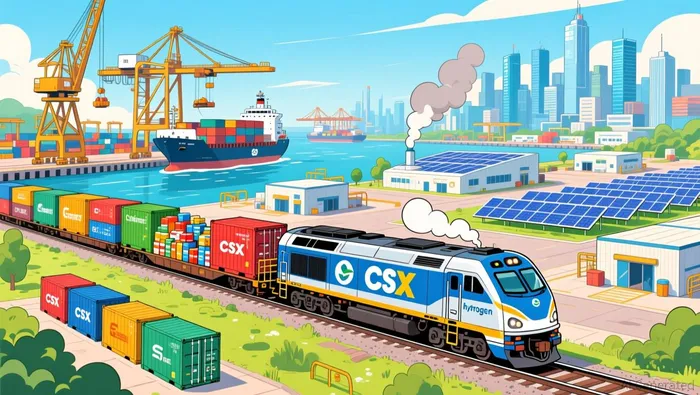
CSX's long-term strategy, centered on "sustaining a unified culture, transforming through technology, and generating profitable growth," has positioned it to capitalize on sector trends according to SEC filings. Notably, the company has invested in hydrogen-powered locomotives in collaboration with Canadian Pacific Kansas City (CPKC), producing the first hydrogen-powered freight locomotives in North America according to freight rail innovation reports. This innovation aligns with the industry's push for decarbonization, a critical factor as regulators and shippers prioritize sustainability.
Competitive Dynamics: CSX vs. Peers
Compared to peers like Union Pacific and Canadian National, CSX's strategic focus on digitalization and sustainability is distinct. While UP has prioritized hybrid battery-electric locomotives and CN has embraced AI-driven track inspection programs according to freight rail innovation reports, CSX's hydrogen initiative highlights its commitment to alternative fuels. Financially, CSX's operating ratios in Q2 2025 trailed those of UP and CN according to industry performance insights, but its Q3 improvement suggests progress. Meanwhile, UP's Q3 2025 EBITDA of $3.167 billion-a 4.94% year-over-year increase according to financial data-highlights the competitive pressures CSX faces.
Challenges and Future Outlook
The freight rail sector is not without risks. Aging infrastructure, regulatory scrutiny, and the ongoing shift away from coal remain challenges according to market research. Additionally, proposed mergers like Union Pacific-Norfolk Southern could reshape the competitive landscape, potentially prompting further consolidation. For CSX, maintaining its geographic focus on the Southeast-where industrial development and intermodal traffic are booming-will be critical according to freight market analysis. Analysts like Stephanie Moore of Jefferies have upgraded CSX to "buy," citing its potential to benefit from trade policy shifts and renewed industrial activity in the U.S. rail network according to analyst reports.
Conclusion: A Compelling Long-Term Bet
CSX's decade-long journey illustrates the interplay between sector resilience and strategic agility. While its stock has experienced volatility, its alignment with long-term trends-such as intermodal growth, sustainability, and digital transformation-positions it as a resilient long-term investment. As the U.S. rail freight market is projected to grow at a 3.39% CAGR through 2030 according to market analysis, CSX's focus on innovation and operational efficiency could drive compounding returns for patient investors.





Comentarios
Aún no hay comentarios