
Cryptomesh and the Future of Ethereum Staking: Decentralized Infrastructure as a Catalyst for Institutional-Grade Returns
The Staking Paradox: Accessibility vs. Institutional Demands
Ethereum's transition to a proof-of-stake (PoS) model in 2022 unlocked new opportunities but also exposed a critical flaw: the 32 ETH minimum requirement. This barrier excluded smaller investors and created operational complexities for institutions, which often required custodial solutions or validator-as-a-service (VaaS) providers. Traditional platforms like CoinbaseCOIN-- and Kraken, while user-friendly, introduced counterparty risks and fee structures that diluted net returns. For example, Coinbase's 15% cut of staking rewards in Q3 2025 reduced its gross APY of 3.1% to a net 2.6%, according to a Techlasi guide.
Cryptomesh's pooled staking model addresses these pain points. By allowing users to combine funds and bypass the 32 ETH threshold, the platform democratizes access while maintaining institutional-grade security. Its Tier 3 data centers, with 99.9% uptime, and seamless wallet integration position it as a hybrid solution-decentralized in governance but enterprise-ready in execution, according to a Business Insider article.
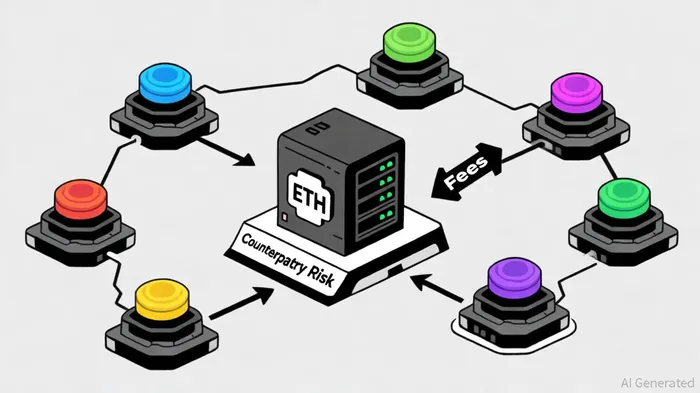
APY Showdown: Decentralized vs. Traditional Platforms
The key metric for institutional investors remains annual percentage yield (APY). In Q3 2025, traditional platforms like Kraken and Binance offered gross APYs of ~3.1%, but net returns after fees hovered around 2.5–2.9%, as reported by Techlasi. Decentralized alternatives like Rocket PoolRPL--, with its DAO-governed model, achieved a net APY of 2.9% by minimizing intermediary fees, per the same Techlasi analysis.
Cryptomesh's competitive edge lies in its ability to balance decentralization with operational efficiency. While the platform hasn't disclosed its Q3 2025 APY, its track record of managing $200 million in staked assets and emphasis on "competitive rewards" suggest it's positioned to outperform centralized peers, as Business Insider notes. The absence of a single point of control reduces systemic risks, a critical factor for institutions wary of regulatory scrutiny or platform insolvency.
Security, Uptime, and the Institutional Trust Factor
Institutional adoption hinges on trust. Cryptomesh's infrastructure, built on Tier 3 data centers and multi-layered security protocols, addresses two of the biggest concerns: uptime and theft prevention. Unlike centralized platforms, where a single breach could compromise millions in staked assets, Cryptomesh's decentralized architecture distributes risk across a network of validators.
This aligns with broader industry trends. For instance, Solana Company's recent partnerships with Twinstake and Helius highlight a growing preference for institutional-grade staking infrastructure, a Decrypt report shows. Similarly, XRP's emergence of mXRP and FXRP staking solutions-targeting 6–8% yields-demonstrates how decentralized models can scale without sacrificing security, according to a Timestabloid analysis.
The Bigger Picture: Staking as a Catalyst for DeFi Growth
Cryptomesh's impact extends beyond APYs. By lowering entry barriers, it's fostering broader participation in Ethereum's PoS ecosystem, which in turn strengthens network security and scalability. This flywheel effect mirrors the rise of liquid staking derivatives (LSDs) like stETH and rETH, which have unlocked $10 billion in liquidity for DeFi protocols, according to Techlasi.
For institutions, the implications are clear: a decentralized staking infrastructure like Cryptomesh isn't just a tool for yield-it's a strategic asset. It enables treasuries to diversify risk, access liquidity, and participate in governance without sacrificing control.
Conclusion: A New Era for Institutional Staking
The Ethereum staking market is at an inflection point. Traditional platforms are being outpaced by decentralized alternatives that prioritize security, transparency, and scalability. Cryptomesh's pooled staking model, combined with its institutional-grade infrastructure, positions it as a leader in this transition.
As the line between DeFi and traditional finance blurs, institutions that adopt decentralized staking solutions early will reap the rewards-not just in APY, but in resilience and adaptability. The future of Ethereum staking isn't centralized or decentralized-it's hybrid, and Cryptomesh is building the bridge.





Comentarios
Aún no hay comentarios