
Cryptocurrency Risks in Politically Exposed Assets: Navigating Regulatory and Geopolitical Volatility
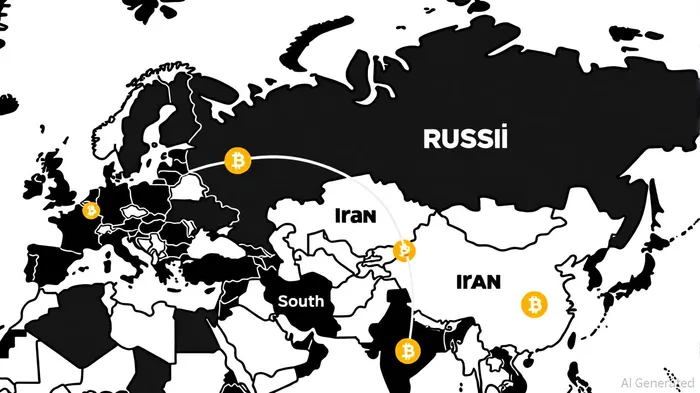
The intersection of cryptocurrency, tokenized assets, and politically exposed persons (PEPs) has become a focal point for investors and regulators alike. As digital assets evolve from speculative tools to mainstream financial instruments, their role in circumventing sanctions, evading regulatory scrutiny, and amplifying geopolitical risks has grown exponentially. This article examines the dual-edged nature of tokenized assets—how they enable innovation while simultaneously creating pathways for illicit activity—and evaluates the implications for investors navigating a landscape shaped by regulatory realignments and geopolitical turbulence.
Regulatory Shifts: DOJ and SEC Realignments
The U.S. Justice Department's April 2025 Blanche Memo marked a pivotal shift in digital asset enforcement. By prioritizing individuals and entities exploiting crypto for narcotics trafficking, terrorism, and organized crime over intermediaries, the DOJ signaled a strategic pivot to foster innovation while targeting bad actors[1]. This aligns with broader pro-crypto policies under the Trump administration, including the DOJ's directive to avoid punishing platforms for user actions[1].
Simultaneously, the SEC's Tokenization Roundtable in May 2025 underscored its intent to modernize securities laws for blockchain-based assets. Chairman Paul Atkins likened tokenization to the transition from paper to electronic records, emphasizing its potential to revolutionize capital markets[2]. However, the SEC's Project Crypto initiative, launched in July 2025, revealed a nuanced approach: while clarifying that certain staking activities fall outside securities laws, it reaffirmed that tokenized versions of traditional securities remain subject to existing regulations[2]. This duality—encouraging innovation while maintaining oversight—creates a regulatory tightrope for investors.
Geopolitical Catalysts: Crypto as a Hedge and Tool for Evasion
Geopolitical instability has accelerated the adoption of cryptocurrencies as both a hedge and a weapon. Inflationary economies, such as those in Venezuela and Argentina, have seen citizens turn to BitcoinBTC-- as a store of value[3]. Meanwhile, sanctioned regimes and PEPs leverage tokenized assets to bypass traditional financial systems. For instance, Iran's legalization of crypto for import payments and North Korea's use of platforms like Tornado Cash to launder over $1 billion in stolen funds highlight the dual-use nature of digital assets[4].
The Russia-Ukraine conflict further exemplifies this trend. Cryptocurrencies were used not only for cross-border aid but also by Russian oligarchs to retain control of U.S. real estate through shell companies and family proxies[5]. A 2025 case study revealed how Valeri Abramov and Viktor Perevalov transferred Florida condos to Delaware shell entities at nominal prices, later generating rental income while evading sanctions[5]. Such tactics exploit the pseudonymity and cross-border liquidity of tokenized assets, complicating enforcement efforts.
Case Studies: PEPs and Tokenized Assets in Action
Tokenized gold and real estate have emerged as critical tools for PEPs to navigate geopolitical and regulatory pressures. Platforms like PAX GoldPAXG-- (PAXG) and TetherUSDT-- Gold (XAUT) enable the seamless transfer of physical gold ownership via blockchain, offering a hedge against U.S. trade policies and sanctions[6]. Russia's exploration of gold-backed digital assets to bypass Western sanctions underscores this trend[6].
In real estate, tokenization platforms such as RealT and Converge facilitate fractional ownership of properties, allowing PEPs to diversify assets while maintaining anonymity[6]. A 2025 Treasury report exposed the TGR Group, a network enabling Russian elites to use U.S. dollar-backed stablecoins like Tether (USDT) to obscure real estate purchases in the UK[7]. These cases illustrate how tokenization's efficiency and accessibility can be weaponized for sanctions evasion.
Investment Risks and Mitigation Strategies
For investors, the risks are multifaceted. Regulatory arbitrage—exploiting divergent rules between the U.S., EU, and emerging markets—creates uncertainty. Tokenized assets like gold and real estate, while innovative, also introduce liquidity risks and exposure to de-dollarization trends[1]. Additionally, the rise of AI-driven fraud and ransomware attacks complicates compliance, as seen in the FBI's 2025 report on North Korean hackers stealing $1.5 billion from Bybit[8].
Mitigation requires advanced tools: blockchain analytics for tracing transactions, AI-driven transaction monitoring, and real-time sanctions screening[9]. Investors must also prioritize jurisdictions with robust regulatory frameworks, such as the U.S. and EU, while remaining wary of opaque markets in the UAE or Turkey, which serve as transit points for illicit funds[5].
Conclusion
The tokenization of assets represents a paradigm shift in finance, but its intersection with PEPs and geopolitical volatility demands caution. While regulatory clarity and technological innovation offer opportunities, the same tools that democratize access to capital can be exploited for illicit purposes. Investors must balance optimism with vigilance, leveraging compliance tools and geopolitical insights to navigate this complex landscape. As the lines between digital finance and traditional power structures blur, the risks—and rewards—of tokenized assets will only grow more pronounced.






Comentarios
Aún no hay comentarios