
Cryptocurrency Risk and Regulatory Enforcement in Australia: Investor Due Diligence in the Wake of High-Profile Crypto Scandals
The Scam Epidemic: Crypto ATMs as a Gateway for Fraud
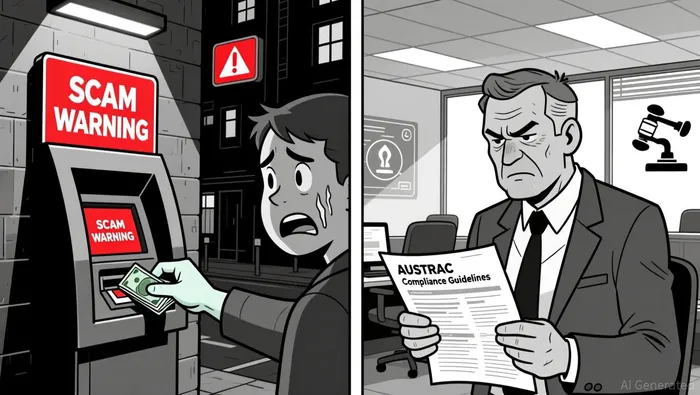
In 2024 and 2025, crypto ATMs emerged as a primary vector for scams in Australia. According to an AFP media release, Australians lost an estimated $3.1 million to crypto ATMATM-- fraud between January 2024 and January 2025, with the true figure likely much higher due to underreporting. Scammers often exploit fake tech support alerts, romance scams, or investment pitches to pressure victims into converting cash into cryptocurrencies via ATMs.
One illustrative case involves Dorothy Dyall, a 72-year-old Perth resident who lost $12,500 after responding to a fake Microsoft security alert. She was directed to a Localcoin ATM, where she deposited her savings, as reported in an ABC News report. AUSTRAC's Cryptocurrency Taskforce has since flagged that 85% of transactions by the top 90 frequent users of these ATMs are linked to fraudulent activity, the ABC report said.
The problem is compounded by the explosive growth of crypto ATMs: from 23 in 2019 to over 1,800 in 2025, AUSTRAC noted in an AUSTRAC media release. These machines, often located in high-traffic areas, have become a honeypot for illicit activity.
Regulatory Crackdowns and Investor Due Diligence
AUSTRAC's response has been twofold: enforcement and regulation. In October 2025, the regulator fined Queensland-based Cryptolink $56,340 for failing to report large cash transactions and for inadequate anti-money laundering (AML) risk assessments, according to the ABC News coverage. This marked a turning point in a broader crackdown, with AUSTRAC imposing a $5,000 daily cash limit per customer and stricter due diligence requirements for operators, as AUSTRAC's media release explained.
For investors, the lesson is clear: due diligence is no longer optional. The Australian Securities and Investments Commission (ASIC) has emphasized that crypto-asset service providers must hold an Australian Financial Services Licence (AFSL) if they exceed thresholds like $1,500 in individual holdings or $5 million in aggregate assets, according to a Chambers practice guide. Investors should verify this compliance before committing funds.
ASIC's updated Information Sheet 225 (INFO 225) also clarifies that many crypto assets-stablecoins, tokenised securities, and wrapped tokens-are now classified as financial products under Australian law, as noted in the Chambers practice guide. This means investors must scrutinize product disclosures and target market determinations to ensure alignment with their risk profiles.
Navigating the New Regulatory Framework
The Australian government is set to introduce a licensing framework for Digital Asset Platforms (DAPs) by 2025, alongside stricter rules for payment stablecoins under a new stored value facility (SVF) regime, according to Global Legal Insights. These reforms aim to balance innovation with consumer protection, but they also mean investors must stay informed about evolving compliance standards.
Key due diligence steps include:
1. Verify AFSL status: Ensure the platform is licensed for the services it offers.
2. Assess AML/CTF compliance: Check if the provider adheres to AUSTRAC's cash transaction limits and reporting obligations.
3. Review product disclosures: Scrutinize risk factors and target market determinations for transparency.
4. Monitor regulatory updates: Follow ASIC's guidance and sector-wide no-action positions (e.g., the 2026 deadline for licensing applications), as the Chambers practice guide highlights.
The recent enforcement actions against platforms like Qoin, Block Earner, and Binance underscore the risks of ignoring these steps, as the Chambers practice guide observes. Courts have clarified that even crypto platforms mimicking traditional financial services must comply with existing financial regulations.
The Road Ahead: Balancing Innovation and Protection
Australia's approach to crypto regulation is a work in progress. While consumer advocates push for a ban on crypto ATMs-similar to those in the UK and New Zealand-the government is exploring stronger AUSTRAC powers to regulate these machines, according to the ABC News coverage. Meanwhile, ASIC's 2024–28 Corporate Plan highlights digital assets as a strategic priority, with a focus on enforcing design-and-distribution obligations (DDOs) for financial products, as the Chambers practice guide notes.
For investors, the takeaway is straightforward: due diligence is the new baseline. The market's volatility and regulatory uncertainty demand a proactive approach. As one expert put it, "In crypto, the only thing more unpredictable than the price of BitcoinBTC-- is the next regulatory twist."
Conclusion
Australia's crypto landscape is at a crossroads. High-profile scams have exposed vulnerabilities in the system, but they've also catalysed regulatory action. Investors who prioritize due diligence-verifying licenses, understanding product risks, and staying abreast of regulatory shifts-will be better positioned to navigate this complex environment. As the sector matures, the line between innovation and compliance will only blur further. The question is: Are you ready to adapt?







Comentarios
Aún no hay comentarios