
Cryptocurrency Regulation and Law Enforcement Trends: How Interpol's $97M Seizure Signals a Shifting Risk Profile for Investors
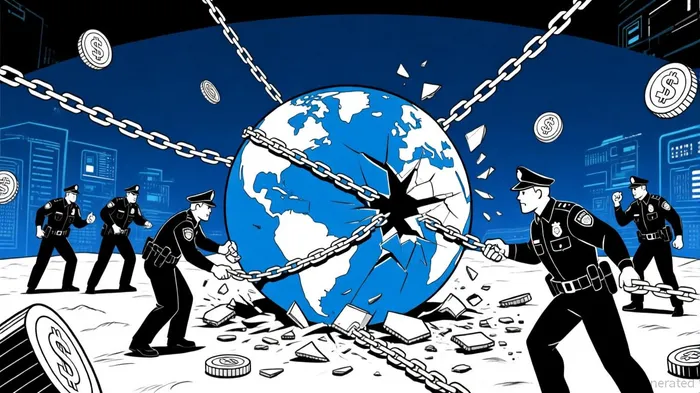
In August 2025, Interpol's Operation HAECHI VI—a 4.5-month multinational effort across 40 countries—seized $97 million in cryptocurrency and $342 million in traditional assets, marking a pivotal moment in the global crackdown on cyber-enabled financial crime [1]. This operation, which froze nearly 400 crypto wallets and blocked 68,000 bank accounts, targeted scams ranging from romance fraud to business email compromises, demonstrating law enforcement's growing ability to trace and disrupt illicit digital asset flows [2]. For crypto investors, the operation signals a profound shift: the era of perceived anonymity in digital assets is rapidly eroding, replaced by a regulatory and enforcement landscape that is both more sophisticated and more aggressive.
The New Normal: Global Coordination and Technological Precision
Operation HAECHI VI's success hinged on cross-border collaboration enabled by tools like Interpol's I-GRIP system, which allows rapid asset freezes and real-time data sharing [3]. For example, South Korean and Emirati authorities recovered $3.9 million from a steel company fraud involving forged shipping documents, while Portuguese authorities arrested 45 suspects for diverting €228,000 (USD 270,000) in social security payments from 531 victims [4]. These cases highlight how law enforcement now leverages blockchain analytics and digital forensics to trace funds across borders and jurisdictions.
The implications for investors are twofold. First, the risk of holding assets on platforms with weak compliance has escalated. Exchanges and wallets that fail to implement robust KYC/AML protocols now face heightened scrutiny, as seen in the DOJ's recent $225.3 million seizure of funds tied to a “crypto confidence scam” network [5]. Second, the rise of regulatory harmonization—exemplified by the EU's fully operational MiCAR framework and the U.S. GENIUS and CLARITY Acts—means investors must navigate a more transparent but also more restrictive environment [6].
Regulatory Trends Reshaping Investor Risk Profiles
The 2025 regulatory landscape is defined by two competing forces: market stability and innovation suppression. On one hand, frameworks like the U.S. GENIUS Act—mandating full reserves for stablecoins and regular disclosures—aim to reduce volatility and fraud [7]. On the other, stricter AML/KYC rules and the crackdown on privacy coins (e.g., Monero, Zcash) threaten to stifle decentralized finance (DeFi) and privacy-focused use cases [8].
For investors, this duality creates a paradox. While regulation reduces the risk of fraud and instability, it also narrows the pool of “uncensorable” assets, pushing illicit activity further into decentralized and unregulated corners of the market [9]. The DOJ's recent focus on pump-and-dump schemes and wash trading in crypto underscores this tension: enforcement actions are targeting bad actors, but they also raise concerns about overreach and stifling legitimate innovation [10].
The Investor's Dilemma: Compliance vs. Returns
The shifting risk profile demands a recalibration of investment strategies. Investors must now weigh regulatory compliance as heavily as financial returns. For instance, stablecoins—once seen as a safe haven—are now under intense scrutiny for reserve transparency, with the U.S. Treasury requiring real-time disclosures [11]. Similarly, DeFi platforms that fail to adapt to evolving AML rules risk being shut down or delisted by major exchanges [12].
However, the crackdown also presents opportunities. The rise of regulated crypto custodians and compliant DeFi protocols could attract institutional capital, driving long-term value. As Chainalysis and CipherTrace's expanded roles in law enforcement collaborations show, blockchain analytics is becoming a cornerstone of both compliance and market trust [13].
Conclusion: A More Transparent, Less Anonymized Future
Interpol's $97 million seizure is not an isolated event but a harbinger of a broader trend: digital assets are no longer a regulatory blind spot. For investors, the lesson is clear: the days of exploiting crypto's anonymity for high-risk, high-reward strategies are over. The future belongs to those who can navigate a landscape where compliance, transparency, and global enforcement are the new norms.
As the DOJ's record-breaking seizure of $225.3 million in scam funds and Interpol's HAECHI VI operation demonstrate, the crypto market is being reshaped by a force far more powerful than volatility or hype—the relentless march of regulation and enforcement [14].







Comentarios
Aún no hay comentarios