
Cryptocurrency Market Volatility and the Impact of Geopolitical Risk: Strategic Asset Allocation in a Rising Protectionism Environment
The cryptocurrency market has long been characterized by its volatility, but recent years have revealed a deeper, more complex relationship between digital assets and geopolitical risk. As protectionist policies and deglobalization trends reshape global economic dynamics, investors must reassess how cryptocurrencies fit into strategic asset allocation frameworks. The interplay between crypto volatility and geopolitical uncertainty is no longer a niche concern-it is a defining feature of modern portfolio management.
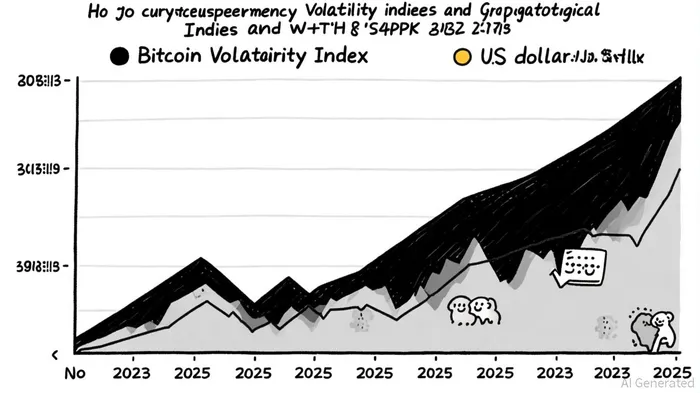
Geopolitical Shocks and Crypto Volatility: A Non-Linear Relationship
Cryptocurrencies exhibit a unique, non-linear response to geopolitical risks. In normal market conditions, they often appear uncorrelated with traditional risk indicators. However, during extreme events-such as the Russia-Ukraine war or U.S.-China trade escalations-crypto volatility spikes sharply, mirroring patterns seen in equities and bonds while diverging from safe-haven assets like gold and the U.S. dollar, as shown in a geopolitical risk and crypto volatility study. For instance, during the 2022 Russia-Ukraine conflict, BitcoinBTC-- initially served as a hedge against financial uncertainty but quickly reversed course as negative news dominated market sentiment, a dynamic discussed in a 2025 crypto-rules overview. This asymmetry-where bad news disproportionately impacts crypto-highlights the asset class's speculative nature and its susceptibility to regulatory and geopolitical headwinds.
The maturation of the crypto market in 2025 has further complicated this dynamic. Bitcoin's 24-hour correlation with the Nasdaq now stands at +0.71, as noted in a redefining risk op-ed, reflecting its growing integration into macroeconomic narratives. Yet this correlation is far from stable. Protectionist policies, such as tariff escalations and digital sovereignty initiatives, have introduced new variables that amplify volatility. For example, the U.S. and EU's regulatory frameworks (e.g., the GENIUS Act and MiCA) have created divergent compliance landscapes, forcing investors to weigh jurisdictional risks against potential returns, as outlined in the 2025 crypto-rules overview.
Protectionism and the Reshaping of Asset Correlations
Rising protectionism has disrupted traditional asset correlations, creating both challenges and opportunities for portfolio diversification. Cryptocurrencies, once seen as purely speculative, are now competing with gold and other safe-haven assets for a role in hedging against geopolitical uncertainty. However, empirical evidence suggests crypto's effectiveness as a safe haven remains inconsistent. While gold and Islamic equity indices (e.g., DJ Islamic Index) have shown positive returns under cryptocurrency policy uncertainty (UCRY Policy), Bitcoin and the U.S. dollar have underperformed, according to a hedge and safe-haven study. This divergence underscores the need for caution: the hedge and safe-haven study notes crypto's volatility often outweighs its hedging potential, particularly in bearish market states.
Meanwhile, high-performing U.S. tech stocks (FAANG) have emerged as weak safe havens for Bitcoin and EthereumETH--, offering limited diversification benefits, according to a safe-havens study. This phenomenon reflects the broader trend of tech stocks becoming "risk-on" assets in their own right, blurring the lines between traditional and digital asset classes. For investors, this means strategic allocation must account for overlapping risk factors-such as monetary policy expectations and regulatory shifts-that now influence both crypto and equities, a point also discussed in the redefining risk op-ed.
Strategic Allocation in a Deglobalizing World
The evolving geopolitical landscape demands a nuanced approach to asset allocation. Three key principles emerge from recent research:
Diversification Beyond Traditional Safe Havens: While gold and the U.S. dollar remain reliable during crises, their returns have been muted in a low-interest-rate environment. Investors may consider allocating a small portion of their portfolios to crypto assets with improving safe-haven properties, such as Bitcoin, but must balance this against its volatility, as highlighted in the hedge and safe-haven study.
Hedging Against Policy Uncertainty: Protectionist policies and regulatory fragmentation increase idiosyncratic risks. Portfolios should include assets that perform well under UCRY Policy, such as Sukuk or Islamic indices (noted in the hedge and safe-haven study), while avoiding overexposure to jurisdictions with aggressive crypto crackdowns.
Dynamic Rebalancing: The crypto market's maturation-evidenced by its growing correlation with equities-requires frequent rebalancing. For example, Bitcoin's recent +0.71 correlation with the Nasdaq, discussed in the redefining risk op-ed, suggests it may act as a proxy for tech-driven growth narratives, but this relationship could reverse during periods of monetary tightening.
Conclusion
Cryptocurrency's role in strategic asset allocation is no longer a theoretical exercise-it is a practical necessity in an era of rising geopolitical risk and protectionism. While crypto volatility remains a double-edged sword, its evolving correlations with equities, safe-haven assets, and macroeconomic indicators offer new tools for diversification. Investors who navigate this landscape successfully will balance innovation with caution, leveraging crypto's potential while mitigating its inherent risks.






Comentarios
Aún no hay comentarios