
Cryptocurrency Market Volatility and Diverging Altcoin Performance in Q4 2025
The Contrarian Case for EthereumETH-- in a Bitcoin-Consolidated Market
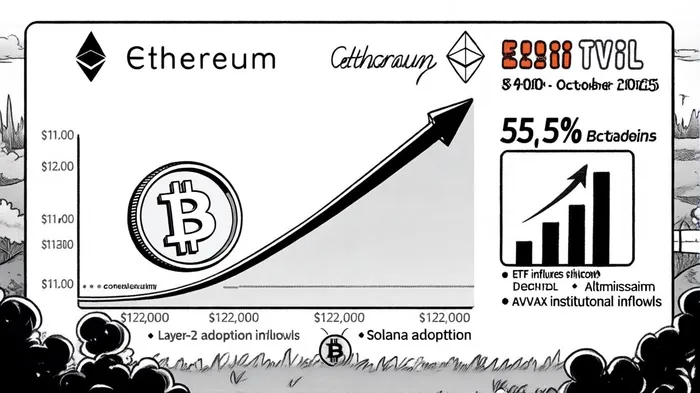
Q4 2025 has delivered a striking divergence in cryptocurrency performance. While BitcoinBTC-- (BTC) remains in a consolidation phase-trading narrowly between $121,000 and $122,000 after hitting an all-time high of $126,198 in early October-Ethereum (ETH) has surged 7.72% year-to-date, reaching $4,900 in October 2025 before correcting to $4,150, according to an OKX price outlook. This divergence creates a compelling contrarian opportunity for Ethereum, which is outperforming both Bitcoin and the broader altcoin market despite macroeconomic headwinds.
Bitcoin's Consolidation: A Structural Shift
Bitcoin's current phase reflects a maturing bull market. On-chain metrics like Accumulator Address Demand (298,000 BTC in long-term holder accumulation) and the MVRV Z-Score (comparable to May 2017 levels) suggest a structural buildup of buying pressure, according to a Bitcoin Magazine outlook. However, Bitcoin's dominance has fallen from 66% in early 2025 to 58%, as investors rotate into altcoins and Ethereum, per a Coinfomania report. This shift is driven by Bitcoin's macroeconomic sensitivity-its price remains tethered to Fed rate expectations and dollar strength-while Ethereum benefits from institutional-grade use cases in DeFi, tokenization, and Layer-2 scaling, as covered in a CoinCentral article.
Ethereum's Institutional Edge
Ethereum's outperformance is underpinned by three pillars:
1. ETF-Driven Liquidity: Spot Ethereum ETFs have attracted $468 million in net inflows during their first week, with BlackRock's iShares ETHA seeing record trading volumes, according to a Gate analysis. This liquidity has amplified Ethereum's price resilience, even during corrections.
2. Network Upgrades: The Dencun upgrade in March 2025 reduced blob space costs by 90%, while the Fusaka protocol in December 2025 further enhanced scalability, according to a CoinMarketCap analysis. These upgrades have cut gas fees by 94%, enabling broader adoption of DeFi and tokenized assets, as detailed in a Dev.to guide.
3. Deflationary Mechanics: Ethereum's fee-burning mechanism is projected to reduce its supply by 1–2% annually, creating scarcity-driven tailwinds, per a Cryptsy projection.
Ethereum's institutional adoption is also accelerating. Companies like Bit Digital are reallocating capital from Bitcoin to Ethereum, recognizing its role as the backbone of decentralized finance, according to an OKX analysis. Meanwhile, Ethereum's TVL in DeFi has surged to $223 billion, representing 55.5% of the sector's total, as reported in a CryptoFiy report.
Altcoin Divergence: Ethereum's Unique Position
While altcoins like AvalancheAVAX-- (AVAX) and SolanaSOL-- have gained traction, Ethereum remains the dominant infrastructure layer for tokenized assets and DeFi. For example:
- AVAX benefits from real-world asset tokenization but lacks Ethereum's developer ecosystem and institutional trust, a dynamic noted by CoinCentral.
- Solana has seen a 30% rise in DeFi TVL but faces scalability risks due to its centralized validator model, according to a Coindoo forecast.
Ethereum's deflationary supply model and Layer-2 innovations (e.g., ArbitrumARB--, Optimism) provide a competitive edge. As of August 2025, Ethereum processed 48 million transactions and 15 million active addresses, with daily transaction volume hitting $320 billion, per a CryptoNews report. This utility-driven demand contrasts with Bitcoin's store-of-value narrative, making Ethereum a more attractive bet in a market prioritizing real-world adoption.
Risks and Mitigants
Ethereum is not without risks. Whale selling (e.g., 640,000 ETHETH-- dumped in a bearish period) and regulatory scrutiny in the U.S. and EU could pressure its price, as discussed in a BeInCrypto analysis. However, Ethereum's institutional adoption and on-chain improvements mitigate these risks. For instance, the Network Value to Transactions (NVT) ratio has dropped to 29.2, indicating Ethereum's valuation is aligning with its utility, per a CoinAlert analysis. Additionally, Ethereum's role in tokenized finance-projected to grow to $1.5 trillion by 2026-provides a long-term growth catalyst, according to an Analytics Insight piece.
Conclusion
Bitcoin's consolidation phase and Ethereum's institutional-driven outperformance create a rare contrarian opportunity. While Bitcoin remains a foundational asset, Ethereum's technological upgrades, deflationary mechanics, and DeFi dominance position it as a superior play on the crypto bull case. Investors who allocate to Ethereum now are betting on a future where tokenized assets and decentralized finance redefine global finance-a narrative Bitcoin alone cannot capture.







Comentarios
Aún no hay comentarios