
Cryptocurrency Market Recovery: Strategic Entry Points for Institutional Investors in 2025
The cryptocurrency market in 2025 is undergoing a profound transformation, marked by institutional adoption, technical resilience, and on-chain fundamentals that signal a strategic inflection point for investors. With BitcoinBTC-- stabilizing around $114,000 and altcoins like EthereumETH--, SolanaSOL--, and BNBBNB-- Chain surging in performance, the interplay of market sentiment, technical indicators, and on-chain data paints a compelling case for institutional entry.
Institutional Adoption: A Catalyst for Market Stability
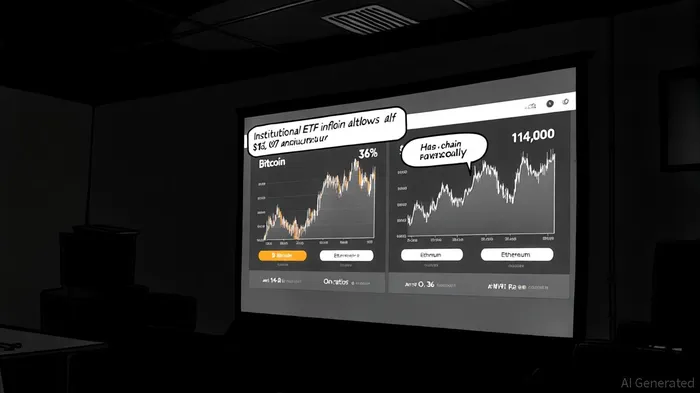
Institutional investors have become the bedrock of the 2025 crypto recovery. According to Coinbase's 2025 survey, 59% of surveyed institutions plan to allocate more than 5% of their assets under management (AUM) to digital assets, with U.S. spot Bitcoin and Ethereum ETFs attracting $65 billion in net inflows by April 2025. BlackRock's iShares Bitcoin Trust (IBIT) alone captured $18 billion in AUM by Q1 2025, underscoring the shift toward regulated, liquid exposure, according to a Pinnacle Digest report.
Ethereum's institutional appeal has surged as well. Binance Research notes that Ethereum's 36% annual gain outperformed Bitcoin's 18%, driven by the Pectra upgrade, which boosted validator efficiency and staking yields. Meanwhile, 170 public companies now hold 1.07 million BTC, with corporate Ethereum holdings rising sharply, reflecting a broader trend of corporate treasuries treating crypto as a strategic asset, according to a CME Group mid-year report. Sovereign wealth funds (SWFs) are also accumulating Bitcoin as a hedge against geopolitical instability, reshaping its market structure, per an OnTheNode analysis.
Technical Indicators: Momentum and Consolidation
Bitcoin's technical profile in 2025 reveals a market in consolidation. While it pulled back from all-time highs above $124,000, its price stabilized around $114,000, with key support and resistance levels holding firm, per Binance Research. On-chain metrics like the Relative Strength Index (RSI) near 42 and a MACD histogram losing bearish momentum suggest the downtrend is weakening, as shown on the CryptoQuant NVT chart. Binance Research highlights that Bitcoin's MVRV Z-Score mirrors early bull market conditions of 2017, indicating significant upside potential, according to a Bitcoin Magazine outlook.
Ethereum's technical strength is equally notable. Its NVT ratio of 37 in Q3 2025-historically low-signals undervaluation relative to transaction volume, as detailed in an Ethereum NVT analysis. This aligns with a 30% surge in total value locked (TVL) to $30.5 billion and a 33% inflow into Ethereum ETFs during the same period, per the CryptoRank Q3 recap. For altcoins, Bitcoin's declining dominance from 65.1% to 57.2% has triggered capital rotation into high-performing ecosystems like Solana and BNB Chain, noted in a Capwolf report.
On-Chain Metrics: Supply Dynamics and Network Utility
On-chain data reinforces the bullish narrative. Bitcoin's Pi Cycle Oscillator is trending upward, according to TheBlockchain article, while 74% of circulating BTC remains illiquid, with 75% dormant for over six months, per an XT.com analysis. This supply squeeze, combined with a post-halving cooldown, suggests a potential exponential phase could push Bitcoin toward $140,000–$210,000, as noted by OnTheNode.
Altcoin on-chain activity is equally robust. Solana's DEX volume hit $365 billion in Q3 2025, driven by a 20% block capacity upgrade and 30% TVL growth to $30.5 billion, according to Capwolf. BNB Chain reported 1.22 billion transactions and a 57% surge in active addresses to 47.3 million, bolstered by the AsterASTER-- DEX launch, per a FinanceFeeds report. Avalanche's TVL rebounded to $4.4 billion, with DEX volume surging 185%, as reported in a FinancialContent report. These metrics highlight altcoins' growing utility in DeFi, AI-driven applications, and institutional staking.
Strategic Entry Points for Institutional Investors
The convergence of institutional adoption, technical strength, and on-chain fundamentals creates a unique entry window. For Bitcoin, the NVT Golden Cross at 1.51 and stable RSI suggest a base-building phase ahead, with institutions able to capitalize on ETF-driven liquidity while monitoring macro risks like regulatory fragmentation and dollar index volatility, as noted by Pinnacle Digest.
Altcoins offer complementary opportunities. Ethereum's undervalued NVT ratio and Pectra-driven staking yields make it a core holding, according to a Bitget analysis. Solana and BNB Chain, with their high transaction volumes and institutional partnerships (e.g., Franklin Templeton), present high-conviction plays in a diversified portfolio, per an InvestingHaven roundup. However, investors must balance growth potential with volatility, as altcoins remain more susceptible to liquidity shocks.
Conclusion
The 2025 crypto recovery is no longer a speculative narrative but a structural shift driven by institutional capital, regulatory clarity, and network utility. Bitcoin's stabilization and altcoin rotation reflect a maturing market where fundamentals outweigh short-term volatility. For institutions, the data is clear: strategic entry points exist in both Bitcoin and altcoins, supported by robust on-chain metrics and a $65 billion ETF tailwind. As the year progresses, the key will be balancing exposure to Bitcoin's store-of-value narrative with altcoins' innovation-driven growth.





Comentarios
Aún no hay comentarios