
Cryptocurrency Market Divergence: Why 75% of Top Coins Below Key Averages Signals a Unique Correction
The cryptocurrency market in November 2025 is experiencing a profound correction, marked by a stark divergence between macroeconomic pressures and on-chain fundamentals. With 75% of the top 100 cryptocurrencies trading below their 50-day moving averages and 6.71% below the 200-day benchmark, the market is signaling widespread bearish momentum. This divergence-driven by U.S. government shutdown anxieties, S&P 500 volatility, and crypto-specific headwinds like ETF outflows-has created a unique inflection point for contrarian investors. While the broader market grapples with oversold conditions and weak sentiment, a subset of undervalued altcoins with robust fundamentals and favorable technical indicators may offer asymmetric upside potential.
Bearish Technical Signals and Market Sentiment
The current bearish narrative is underscored by deteriorating technical indicators. BitcoinBTC--, the bellwether of the crypto market, has seen its 30-day RSI plummet to ~32, the lowest level since June 2022, while Ethereum's price has fallen over 20% in November alone. These declines reflect a broader risk-off environment, where high-beta assets like crypto and AI equities are being sold off amid macroeconomic uncertainty. On-chain data exacerbates the bearish case: decentralized exchange (DEX) volumes and blockchain revenues have contracted and DeFi total value locked (TVL) has collapsed.
The 50-day and 200-day moving averages, critical benchmarks for momentum traders, have become death crosses for most of the top 100 coins. The 75% figure below the 50-day average suggests a market in consolidation or decline, while the 6.71% below the 200-day average highlights a deeper structural bearishness. This divergence between short-term and long-term indicators is often a precursor to prolonged sideways trading or further downside. However, for contrarian investors, such extremes can also signal overcorrection and entry opportunities in assets with durable fundamentals.
Divergence from Traditional Markets
What sets this correction apart is its divergence from traditional markets. While equities and bonds have shown resilience amid central bank interventions, crypto remains a laggard. The U.S. government shutdown and fears of a S&P 500 correction have amplified risk-off sentiment, but crypto's underperformance is also tied to internal factors. ETF outflows-$3.5B for Bitcoin and $1.4B for Ethereum reflect a loss of institutional confidence, while the absence of new narratives (e.g., AI integration, CBDCs) has left the market without a catalyst for optimism.
This divergence creates a unique dynamic: crypto is being priced as a speculative asset in a risk-averse environment, despite its role as a hedge against fiat devaluation. The disconnect between macroeconomic fundamentals and crypto's technical breakdown suggests that the market is pricing in a worst-case scenario, potentially creating mispricings in assets with real-world utility.
Contrarian Opportunities: Undervalued Altcoins with Strong Fundamentals
Amid the bearish backdrop, certain altcoins stand out for their robust fundamentals and favorable technical setups. These projects, operating in infrastructure and real-world use cases, are less correlated to speculative cycles and more resilient to macro shocks.
1. Filecoin (FIL): Decentralized Storage for AI and Research
Filecoin, a decentralized storage network, is gaining traction in data-intensive applications like AI training and scientific research. Its price is currently trading within a falling wedge pattern, with analysts projecting a potential breakout to $1.75–$4.20 by year-end. The RSI is descending but shows signs of a pullback to key support levels, aligning with institutional adoption trends. Filecoin's utility in storing and retrieving large datasets positions it as a critical infrastructure layer for the AI economy.
2. Toncoin (TON): Consumer-Focused Payments Ecosystem
Integrated with Telegram's 900 million monthly active users, ToncoinTON-- is emerging as a payments layer for a consumer-facing blockchain ecosystem. Despite trading below its 50-day average, TON's weekly RSI has hit oversold levels and shows a bullish divergence. Price projections range from $1.825 to $10, depending on Telegram's expansion into decentralized apps and cross-border payments. The token's utility in microtransactions and social media monetization makes it a compelling play on blockchain adoption in the consumer sector.
3. Hedera (HBAR): Enterprise-Grade Blockchain Solutions
Hedera's focus on enterprise applications-such as real-world asset (RWA) tokenization and ESG reporting-has driven institutional interest. Its price has reached crucial support levels, with a small bullish divergence in RSI and on-balance volume. Analysts project a rebound beyond $0.16, driven by partnerships with Fortune 500 companies and its energy-efficient consensus mechanism. Hedera's alignment with regulatory frameworks and corporate use cases makes it a durable asset in a risk-averse environment.
Strategic Entry Points and Risk Management
For contrarian investors, the key is to balance risk with asymmetric upside. While the market's bearish technicals suggest caution, the oversold conditions in FILFIL--, TONTON--, and HBAR-coupled with their real-world utility-justify selective entry. However, position sizing and stop-loss strategies are critical. Investors should prioritize projects with clear revenue models, active development, and growing enterprise partnerships, avoiding speculative tokens that lack tangible use cases.
The current correction also highlights the importance of macroeconomic hedging. As the U.S. government shutdown and S&P 500 volatility persist, crypto's role as a hedge against fiat devaluation may reemerge. Investors should monitor central bank policies and inflation trends, as these could drive a re-rating of crypto's risk profile.
Conclusion
The November 2025 correction, marked by 75% of top coins trading below key moving averages, is a rare opportunity for contrarian investors. While the bearish technicals and macroeconomic headwinds are undeniable, the market's overcorrection has created mispricings in infrastructure-focused altcoins like FilecoinFIL--, Toncoin, and HederaHBAR--. These projects, with their real-world utility and favorable technical indicators, offer a path to asymmetric returns in a market that has priced in pessimism. For those willing to navigate the volatility, this divergence may signal the beginning of a new cycle-one where value, not hype, drives crypto's next leg higher.
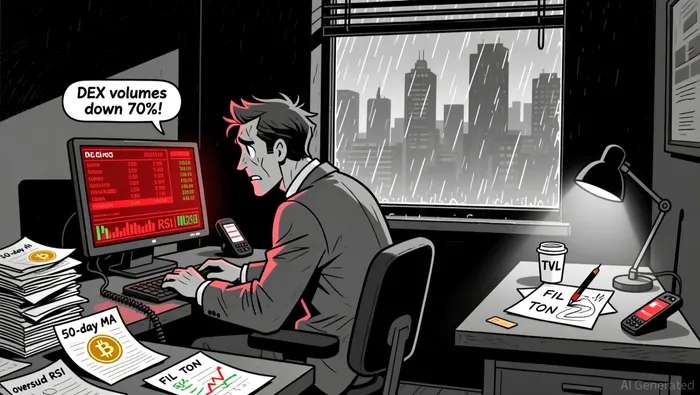
The bearish technical signals in the crypto market are deepening as institutional investors reassess exposure amid macroeconomic uncertainty. Bitcoin’s RSI hitting 32—its lowest since 2022—reflects deteriorating momentum, while Ethereum’s 20% drop in November underscores its vulnerability in a risk-off environment. On-chain metrics like DEX volume and TVL have also collapsed, signaling a loss of retail and institutional liquidity. However, some altcoins, such as Filecoin, Toncoin, and Hedera, are showing signs of stabilization, with RSI levels and volume patterns hinting at potential rebounds.
This divergence from traditional markets raises questions about crypto’s role in a risk-averse macroeconomic environment. While equities are holding up due to central bank interventions, crypto is being priced as a speculative asset rather than a store of value. The recent ETF outflows—$3.5B for Bitcoin and $1.4B for Ethereum—highlight a loss of institutional confidence. Meanwhile, the absence of new narratives like AI integration or CBDCs has left the market without a catalyst for optimism. The U.S. government shutdown and fears of a S&P 500 correction have further amplified the bearish sentiment, but these factors also create a compelling case for contrarian entry into well-positioned altcoins.
For investors seeking asymmetric opportunities, the focus should be on altcoins with real-world utility and robust fundamentals. Filecoin’s growing adoption in AI data storage, Toncoin’s integration with Telegram’s massive user base, and Hedera’s enterprise-grade solutions are examples of projects that are less correlated to macroeconomic cycles. These assets are beginning to show signs of stabilization, with RSI levels and volume divergences indicating potential for a reversal. However, as with any market downturn, position sizing and risk management are critical to preserving capital while capturing long-term value.






Comentarios
Aún no hay comentarios