
Cryptocurrency Exchange Reliability and Market Confidence: Assessing Long-Term Investment Implications
The cryptocurrency market of 2025 has been defined by a paradox: unprecedented institutional adoption juxtaposed with systemic vulnerabilities exposed by operational outages and trust erosion. From the April 2025 AWS outage that paralyzed Binance, KuCoin, and MEXC to the October crash triggered by geopolitical shocks, the sector's fragility has become impossible to ignore. These events have not only disrupted trading but also forced a reevaluation of risk management, regulatory alignment, and the long-term viability of centralized platforms. For investors, the implications are clear: reliability and trust are no longer abstract concepts but critical variables in portfolio construction and market strategy.
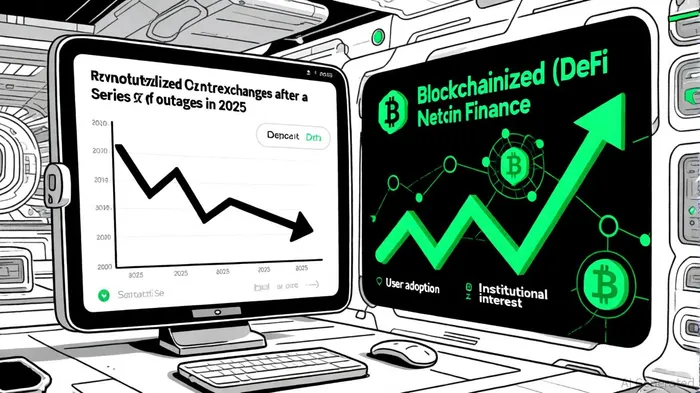
Operational Outages: A Catalyst for Reassessment
The April 2025 AWS outage, which froze withdrawals and trading for nearly an hour, underscored the existential risks of centralized infrastructure. With $40 billion in open interest during a critical expiry event, the outage amplified counterparty risk and left leveraged positions exposed to cascading liquidations, according to a DeFi stress test. Binance's swift response-assuring fund safety while acknowledging systemic flaws-highlighted the tension between operational efficiency and user confidence. Similarly, the October 2025 crash, triggered by Trump's 100% tariff announcement on China, revealed how geopolitical shocks interact with fragile liquidity and hidden leverage to create self-reinforcing sell-offs. Over $30–40 billion in liquidations occurred within minutes, with BitcoinBTC-- plummeting below $110,000 and altcoins losing up to 80% of their value, as described in an October crash analysis.
These incidents have shifted investor sentiment. A July 2025 CoinShares report noted that 72% of institutional investors now prioritize robust governance and operational discipline, mirroring traditional finance standards, and aligning with XBTO guidance. The AWS outage, in particular, accelerated interest in decentralized finance (DeFi) solutions, which offer 24/7 operability and reduced counterparty risk, according to a Cointribune analysis. Protocols like UniswapUNI-- and AaveAAVE-- demonstrated resilience during September's DeFi stress testTST--, with transparent smart contract-based liquidations outperforming centralized counterparts, as that DeFi stress test showed.
Trust Erosion and the Rise of Institutional Caution
Trust in crypto exchanges has eroded amid a string of breaches and outages. Q2 2025 saw $2.47 billion in losses, driven by the $1.5 billion Bybit cold wallet exploit and the $225 million Cetus ProtocolCETUS-- hack, as highlighted in the DeFi stress test mentioned above. By Q3, while total hack losses declined by 37%, the frequency of smaller attacks surged, with North Korean groups accounting for nearly half of all losses, a trend detailed in the Cointribune analysis. These events have prompted institutional investors to adopt stricter risk frameworks. For example, 84% of surveyed investors now prioritize regulatory compliance, with 73% diversifying beyond Bitcoin and EthereumETH-- into altcoins and stablecoins, per XBTO's findings.
The regulatory landscape has also evolved. The U.S. SEC's shift under Paul Atkins-removing barriers like SAB 121 and approving spot Bitcoin and Ethereum ETFs-has normalized crypto as an institutional asset class, according to the Coinbase outlook. Meanwhile, the EU's Markets in Crypto-Assets (MiCA) framework has introduced unified rules on custody and AML compliance, enhancing institutional confidence, consistent with XBTO's guidance. These developments signal a maturing market, but they also highlight the need for continuous adaptation. As one expert notes, "Regulatory clarity is a tailwind, but it cannot offset operational incompetence," a point echoed in the CoinbaseCOIN-- outlook.
Long-Term Investment Implications
For long-term investors, the 2025 outages and trust erosion have reshaped strategic priorities. Diversification across asset types-60–70% in core assets like Bitcoin and Ethereum, 20–30% in altcoins, and 5–10% in stablecoins-has become standard, per XBTO's recommendations. Additionally, on-chain derivatives and synthetic assets are now integral to managing downside risk, enabling exposure to DeFi and NFTs without direct ownership, again in line with XBTO's guidance.
Institutional-grade custody solutions have also emerged as a cornerstone of risk management. With $16 billion spent annually on crypto custodial infrastructure in 2025, investors demand full asset segregation through multi-party computation and hardware security modules, a trend covered in the Cointribune analysis. Regulatory alignment further supports this shift, with frameworks like MiCA and the U.S. GENIUS Act providing clarity on custody and compliance, as XBTO highlights.
However, challenges persist. The October 2025 crash revealed vulnerabilities in leveraged positions and altcoin liquidity, prompting calls for stricter leverage caps and stress-testing protocols, as the October crash analysis noted. Moreover, while DeFi protocols have shown resilience, their reliance on opaque smart contracts remains a concern. A July 2025 report found that 60% of institutions plan to integrate AI-driven risk assessment tools by early 2026 to address these gaps, according to the Cointribune analysis.
Conclusion: Balancing Innovation and Resilience
The 2025 crypto landscape is a testament to the sector's duality: innovation and fragility coexist. While operational outages and trust erosion have exposed systemic weaknesses, they have also catalyzed advancements in risk management, regulatory clarity, and decentralized alternatives. For investors, the path forward lies in balancing exposure to high-growth opportunities with disciplined risk mitigation. As one analyst concludes, "The market is not broken-it's evolving. The winners will be those who adapt to the new normal of volatility, regulation, and technological reinvention," a perspective reflected in the Coinbase outlook cited above.







Comentarios
Aún no hay comentarios