
Crypto Winter as a Buying Opportunity: Navigating Bear Markets with Strategic Resilience
The cryptocurrency market, like any nascent asset class, is defined by its cycles-periods of euphoria followed by despair, and then rebirth. For long-term investors, bear markets are not just challenges to endure but opportunities to refine strategies and accumulate value at discounted prices. History has shown that those who remain disciplined during crypto winters often reap outsized rewards when the market rebounds.
The Nature of Crypto Cycles: Lessons from 2018 and 2022
Bitcoin's journey through bear markets is a masterclass in volatility. In 2018, the asset plummeted from a record $19,100 to $3,200-a 83% drawdown-over the course of a year. Similarly, the 2022 "crypto winter" saw BitcoinBTC-- collapse from $69,000 to $17,000, a 75% loss, driven by macroeconomic headwinds, regulatory uncertainty, and high-profile collapses like TerraUSD as per the analysis. These periods of extreme fear, as measured by the Fear & Greed Index, often precede multi-month rallies. For instance, Bitcoin's price rebounded to $34,154 by October 2023, signaling the market's resilience.
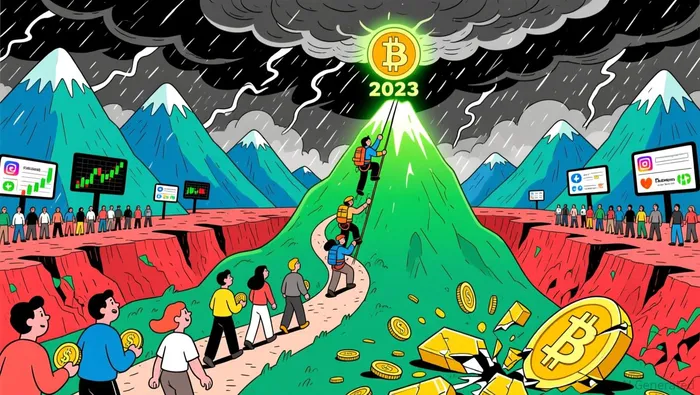
The key takeaway? Bear markets are inevitable, but they are also temporary. Investors who recognize this cyclical pattern can position themselves to buy low when panic-driven selling creates undervalued opportunities.
Strategic Resilience: Dollar-Cost Averaging and Sector Rotation
Academic research underscores the efficacy of disciplined, long-term strategies during downturns. Dollar-cost averaging (DCA)-investing fixed amounts at regular intervals-has proven particularly effective in volatile markets. A 2023 analysis found that while lump-sum investing outperformed DCA in 66% of simulations, DCA excelled during bear markets like 2018 by allowing investors to accumulate more Bitcoin at lower average prices. The frequency of DCA matters: daily purchases outperformed monthly ones by 1-3%, while monthly DCA lagged by 25-75% due to volatility clustering as the research shows.
For those seeking active strategies, sector rotation offers another avenue. A 2023 study demonstrated that trend-following models using Donchian channels-applied to the top 20 liquid cryptocurrencies-generated a Sharpe ratio above 1.5 and an annualized alpha of 10.8% versus Bitcoin. By rotating into assets showing upward momentum and exiting underperforming ones, investors can mitigate risk while capitalizing on market trends.
Behavioral Insights and the Power of Fundamentals
Crypto markets are not just driven by numbers-they are shaped by human psychology. A 2022 literature review revealed that investor behavior is heavily influenced by social media sentiment and public narratives. During bear markets, fear often dominates, leading to irrational selling. However, long-term value accumulation requires ignoring short-term noise and focusing on fundamentals.
Institutional adoption and innovation in tokenized real-world assets (RWAs) are two such fundamentals. Companies like MicroStrategy and Tesla have continued to build Bitcoin reserves despite market downturns. Meanwhile, RWAs-such as tokenized real estate and treasuries-are expanding crypto's utility beyond speculation. These developments suggest that the sector's long-term trajectory remains upward, even as short-term volatility persists.
Conclusion: Embrace the Winter, Prepare for Spring
Bear markets test the resolve of even the most seasoned investors. Yet history and academic evidence both affirm that strategic resilience-through DCA, sector rotation, and a focus on fundamentals-can transform these periods of pain into opportunities for growth. For those with a multi-year horizon, the current crypto winter is not a reason to flee but a chance to buy into the future of finance at a discount.
As the market cycles continue, the question is not whether crypto will recover, but who will be positioned to benefit when it does.






Comentarios
Aún no hay comentarios