
Crypto Winter 2025: 4 Structural Weaknesses Exposed by the Recent Crash
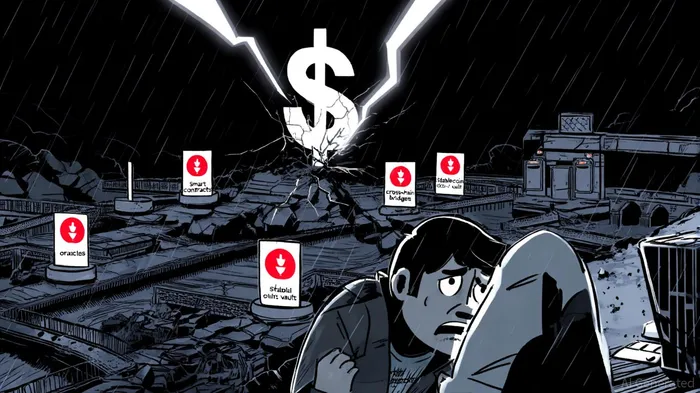
The crypto winter of 2025 has laid bare the fragility of decentralized finance (DeFi), even as it underscores the sector's potential for resilience and innovation. Amid a $300 billion market wipeout, regulatory crackdowns, and a $50 million exchange hack, four structural weaknesses have emerged as critical vulnerabilities. These flaws—smart contract risks, oracleADA-- dependencies, cross-chain fragility, and stablecoin instability—highlight the urgent need for systemic upgrades. Below, we dissect these issues and their implications for the future of DeFi.
1. Smart Contract Vulnerabilities: The Unseen Achilles' Heel
Despite advancements in auditing and formal verification, smart contracts remain a prime attack vector. In 2025 alone, over $2 billion was stolen through exploits, with market stress during the crash amplifying the frequency and severity of these breaches [1]. For instance, a single vulnerability in a lending protocol's reentrancy logic triggered a $150 million loss in September 2025 [4].
The problem lies in the complexity of DeFi codebases, which often integrate third-party libraries and experimental features. A report by Binance's 2025 Mid-Year Crypto Report notes that “even protocols with rigorous audits are susceptible to novel attack vectors, such as flash loan arbitrage and governance token manipulation” [4]. This underscores the need for standardized security frameworks and real-time monitoring tools.
2. Oracle Dependencies: The Fragile Link to Reality
DeFi protocols rely on oracles—external data feeds—to price assets and trigger actions like liquidations. However, the 2025 crash exposed how manipulated or delayed oracle inputs can destabilize entire ecosystems. For example, a malicious actor exploited a centralized oracle to artificially inflate the price of a stablecoin, triggering cascading liquidations worth $300 million [2].
Data from the Decentralized Finance (DeFi): Review and Challenges 2025 report highlights that “over 60% of DeFi platforms use oracles with no redundancy or decentralization, creating single points of failure” [2]. This vulnerability is compounded during market volatility, when oracle latency or collusion can lead to incorrect asset valuations and systemic collapses.
3. Cross-Chain Interoperability: A Double-Edged Sword
The promise of cross-chain bridges to connect fragmented blockchains has been overshadowed by their role in amplifying risks. During the 2025 crash, a failure in a popular bridge's consensus mechanism caused a $75 million loss and triggered liquidity freezes across multiple chains [3].
According to a Forbes analysis, “cross-chain bridges often act as honeypots for hackers, as they handle high-value transfers between disparate systems with varying security models” [2]. The lack of standardized protocols exacerbates this issue, limiting the ability of DeFi platforms to scale securely. For instance, Ethereum-based protocols struggled to migrate liquidity to more efficient chains due to incompatible smart contract standards [3].
4. Stablecoin Instability: The Illusion of Pegs
Algorithmic and crypto-backed stablecoins were hit hardest during the 2025 crash, with depeg events cascading through the DeFi ecosystem. A $500 million algorithmic stablecoin collapsed after a sudden loss of confidence, triggering a domino effect of margin calls and insolvencies [4].
Even fiat-backed stablecoins faced challenges. The Stablecoin Security Risks in 2025 guide by Elliptic notes that “reserve management errors and credit risk in underlying assets led to temporary depegs for major stablecoins, eroding user trust” [4]. This fragility is compounded by regulatory scrutiny, as the U.S. GENIUS Act now mandates stricter reserve audits for stablecoin issuers [1].
Regulatory Headwinds: A New Era of Compliance
The 2025 crash coincided with a global regulatory reckoning. In the U.S., the SEC's aggressive use of the Howey Test to classify DeFi tokens as securities led to lawsuits like SEC v. Coinbase, Inc., creating legal uncertainty [1]. Meanwhile, the DOJ's April 2025 memo shifted focus from broad enforcement to prosecuting illicit activities, signaling a nuanced approach [4].
Globally, the EU's MiCA framework and Hong Kong's licensing regimes are setting new benchmarks for compliance. However, these efforts clash with DeFi's permissionless ethos. As the PWC Global Crypto Regulation Report 2025 observes, “regulators are now demanding AML/KYC compliance from protocols that were designed to operate without identity verification” [5]. Solutions like zero-knowledge proofs (ZKPs) and decentralized identity (DID) are emerging, but adoption remains nascent.
The Path Forward: Innovation Meets Resilience
While the 2025 crash exposed critical flaws, it also accelerated the development of solutions. For example, the rise of RegTech—projected to exceed $22 billion in value—offers tools to automate compliance without sacrificing decentralization [1]. Similarly, advancements in multi-oracle systems and cross-chain security audits are addressing interoperability risks.
Investors must now weigh these innovations against the regulatory landscape. As the DeFi TVL stabilizes at $151.5 billion [4], the sector's long-term potential hinges on its ability to balance innovation with institutional-grade security.






Comentarios
Aún no hay comentarios