
Crypto Whale Behavior and Market Implications in Late-Cycle Bitcoin Dynamics
In late 2025, Bitcoin's market dynamics have become increasingly shaped by the divergent behaviors of institutional whales and retail investors. As the crypto ecosystem matures, understanding these patterns is critical for strategic positioning. This article unpacks the implications of whale activity, retail apathy, and macroeconomic signals for institutional and large-cap investors navigating Bitcoin's late-cycle environment.
Divergence in Positioning: Whales vs. Retail
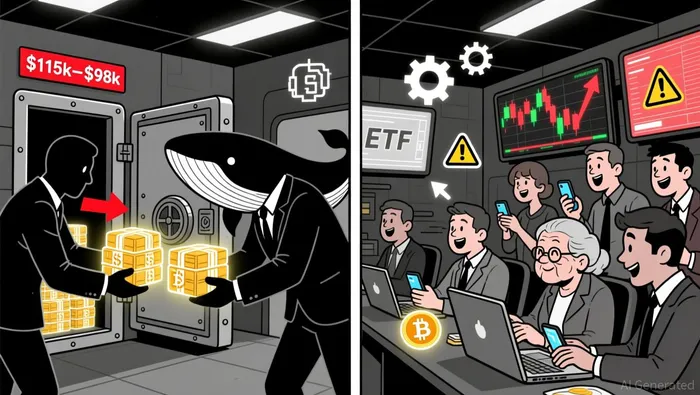
Bitcoin's Q3 2025 price action revealed a stark split between whale and retail behavior. Large whale holders (10–10,000 BTC) offloaded approximately 32,500 coins during a 15% price correction from $115,000 to $98,000, while retail investors continued to accumulate during dips. This divergence, often interpreted as a bearish signal, suggests whales may be hedging or reallocating capital amid uncertainty. For instance, a major whale moved 4,357 BTC ($380 million) from Coinbase Institutional to an unknown wallet, signaling potential long-term holding or strategic reallocation. Conversely, another whale transferred 5,152 BTC ($438 million) to Binance, raising questions about short-term selling or OTC desk coordination.
By late November, the trend shifted: whale inflows to exchanges like Binance surged as BitcoinBTC-- fell below $90,000, while retail activity remained flat. This pattern reversed again in late November, with whales accumulating while retail investors accelerated selling, creating lopsided flow dynamics. These shifts highlight the evolving maturity of the Bitcoin market, where institutional actors respond to volatility with strategic precision, while retail behavior remains reactive.
Institutional Strategies: Accumulation Amid Downturns
Despite retail panic, institutional investors have been quietly accumulating Bitcoin during Q3 2025's drawdowns. Sovereign funds, such as those in Abu Dhabi, tripled their Bitcoin ETF holdings amid AI bubble fears and tech sector weakness. Large whale wallets (1,000+ BTC) expanded from 1,350 to 1,450 during this period, indicating a strategic buy opportunity. Institutions are also diversifying into infrastructure-focused blockchains like SolanaSOL-- and XRPXRP--, which offer utility for real-world applications.
On-chain analytics and AI-driven tools have become central to institutional strategies. Hedge funds leverage blockchain data to monitor liquidity, wallet activity, and market sentiment, enabling dynamic risk management. Techniques like delta-neutral trading, options hedging, and futures basis arbitrage are now standard. Additionally, AI models optimize volatility surfaces and predict liquidity issues, allowing institutions to act preemptively in volatile markets.
Macroeconomic and On-Chain Integration
Bitcoin's role as a macro hedge has gained traction as geopolitical tensions and economic uncertainties persist. Institutions are incorporating Bitcoin into portfolios as an uncorrelated asset with asymmetric upside during macro-uncertain times. Regulatory clarity, including the approval of spot Bitcoin ETFs, has further legitimized the asset.
Macroeconomic signals, such as ETF inflows and AI/tech sector trends, are now intertwined with on-chain analytics. For example, tokenized money market funds holding U.S. treasuries saw assets under management quadruple to $7 billion by August 2025. Institutions are also using real-time financial data streams to refine risk modeling and portfolio decisions. The integration of these signals allows for adaptive strategies that balance growth and hedging.
Case Study: The Late 2025 Crash and Institutional Response
Bitcoin's price fell below $100,000 in late 2025 due to AI bubble fears, tech sector weakness, and ETF outflows. While ETFs recorded $3.2 billion in inflows in early October, they shifted to $1.3 billion in outflows over four consecutive days. This marked a critical turning point, revealing Bitcoin's correlation with risk-off sentiment in the tech sector. Institutions, however, remained resilient, with Abu Dhabi's sovereign funds and other large players increasing exposure during the downturn.
Strategic Positioning for 2026
For institutional and large-cap investors, the key takeaway is to align with long-term structural trends while navigating short-term volatility. Whale activity and retail apathy signal a market in transition, where institutional demand and strategic hedging dominate. Investors should prioritize:
1. On-chain analytics to monitor whale movements and liquidity shifts.
2. AI-driven tools for dynamic risk management and predictive modeling.
3. Diversification into infrastructure blockchains and tokenized assets.
4. Regulatory alignment with evolving frameworks like the GENIUS Act and MiCA according to research.
As 2025 closes, Bitcoin's trajectory into 2026 will likely hinge on the interplay between institutional accumulation, macroeconomic stability, and technological innovation. Those who adapt to these dynamics will be best positioned to capitalize on the next phase of the crypto cycle.







Comentarios
Aún no hay comentarios