
The Crypto Wealth Divide: Bitcoin's 2025 Boom and the Rise of Digital Oligarchs
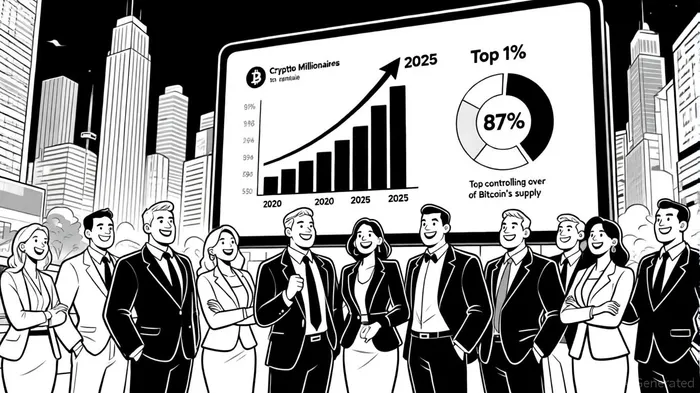
The BitcoinBTC-- boom of 2025 has catalyzed an unprecedented surge in crypto millionaires and billionaires, reshaping the global wealth landscape. According to a report by Henley & Partners, the number of crypto millionaires globally reached 241,700 in 2025, a 40% increase from the prior year[1]. This growth is largely attributable to Bitcoin's meteoric rise, with Bitcoin millionaires now numbering 145,100—a 70% annual increase[2]. The total crypto market valuation hit $3.3 trillion as of June 2025, reflecting a 45% year-over-year surge[3]. At the apex of this wealth pyramid, 36 crypto billionaires now exist, up 29% from 2024, while 450 individuals hold crypto portfolios exceeding $100 million[4].
The Concentration of Power: Whales, Corporations, and Sovereigns
The crypto boom has not merely expanded the ranks of the wealthy—it has concentrated power among a minuscule elite. Blockchain analytics reveal that the top 1% of crypto addresses control over 87% of all circulating Bitcoin[5], a level of wealth centralization rivaling traditional financial systems. The top 100 Bitcoin addresses alone hold 28% of the total supply, with the top 10 addresses controlling 6%[6]. These “whales” wield outsized influence over price stability and liquidity, as their strategic buying or selling can trigger market volatility[7].
Corporate and institutional players have further entrenched this concentration. Public companies collectively hold 3.3% of Bitcoin's supply, with MicroStrategy (now Strategy) leading the pack with 597,325 BTC—valued at over $42.4 billion[8]. Binance, the world's largest exchange, holds 248,600 BTCBTC-- in its cold wallet, equivalent to 1.25% of Bitcoin's circulating supply[9]. Meanwhile, sovereign entities like the United States, which seized 207,189 BTC from criminal activities, have created a “digital Fort Knox”[10]. These entities, alongside institutional funds such as BlackRock's Bitcoin ETF, now dominate the market, blurring the lines between corporate, state, and individual power.
Long-Term Strategies: HODLing, Reinvestment, and Institutional Adoption
For those navigating this hyper-concentrated landscape, long-term strategies have crystallized around two pillars: HODLing and reinvestment. Bitcoin and EthereumETH-- remain the bedrock of HODL portfolios, with investors viewing them as hedges against fiat currency devaluation[11]. Institutional adoption has accelerated this trend: BlackRock's iShares Bitcoin Trust (IBIT) attracted $94.17 billion in assets under management by May 2025, signaling mainstream acceptance[12].
Reinvestment strategies, meanwhile, emphasize diversification across market caps and sectors. While large-cap assets like Bitcoin and Ethereum provide stability, mid- and small-cap tokens such as SolanaSOL-- (SOL) and CardanoADA-- (ADA) offer growth potential[13]. Passive income mechanisms—staking and yield farming—have also gained traction, enabling investors to generate returns on proof-of-stake blockchains[14].
The Paradox of Decentralization
The 2025 boom underscores a paradox: a technology designed to decentralize finance has instead created a new class of digital oligarchs. While 4% of the global population holds Bitcoin[15], the top 1% control over 87% of its value[16]. This concentration raises questions about governance, market fairness, and the sustainability of crypto's “parallel financial system.”
Moreover, the rise of crypto-friendly jurisdictions—Singapore, Switzerland, and the UAE—highlights the global mobility of crypto wealth. High-net-worth individuals are increasingly leveraging regulatory arbitrage to optimize tax efficiency and asset protection[17]. This trend could exacerbate wealth inequality, as access to crypto's upside becomes contingent on geographic and regulatory privilege.
Future Outlook: A Tipping Point?
The 2025 Bitcoin boom has set the stage for a pivotal moment in crypto's evolution. While institutional adoption and technological advancements (e.g., Ethereum 2.0) provide a foundation for growth, the extreme concentration of wealth poses systemic risks. If the top 1% continue to dominate price movements and governance, the dream of a decentralized financial system may remain elusive.
For investors, the path forward demands a nuanced approach: balancing HODLing with strategic diversification, while remaining vigilant to the risks of over-concentration. As the crypto ecosystem matures, the challenge will be to reconcile its revolutionary ideals with the realities of a market increasingly shaped by whales, corporations, and sovereigns.






Comentarios
Aún no hay comentarios