
Crypto Wallet Security Risks and Binance's SAFU Fund: A Critical Evaluation for Institutional Investors
In the rapidly evolving crypto landscape, institutional investors face a critical choice: custodial or self-custodial wallet solutions. The post-hack environment has exposed stark vulnerabilities in both models, while Binance's Secure Asset Fund for Users (SAFU) has emerged as a focal point for assessing institutional trust in centralized platforms. This analysis evaluates the long-term viability of these solutions, drawing on recent breaches, regulatory shifts, and institutional risk management trends.
The Custodial Conundrum: Convenience vs. Centralized Risk
Custodial wallets, managed by third-party services, offer institutional investors streamlined operations, insurance, and regulatory compliance. However, the 2025 Bybit hack-where $1.5 billion was stolen through a compromised external wallet platform-exposed systemic flaws. Attackers exploited commingled assets and exploited staff to sign malicious transactions, leaving clients as unsecured creditors. This mirrors the 2022 FTX collapse, where centralized mismanagement wiped out billions in user funds.
Institutional adoption of custodial solutions remains strong, projected annual spending on crypto custodial services reaching $16 billion in 2025. Yet, the Bybit incident underscores a critical risk: custodians with inadequate oversight or liquidity buffers can become single points of failure. For institutions, this necessitates rigorous due diligence on custodians' use of multi-party computation (MPC), geographically distributed cold storage, and real-time monitoring according to industry experts.
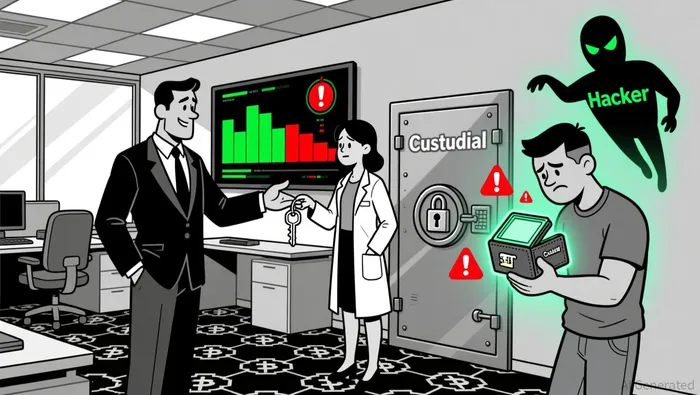
Self-Custodial Solutions: Control at the Cost of Complexity
Self-custodial wallets, by contrast, grant institutions full control over private keys and funds. However, this autonomy introduces operational challenges. Key management, employee error, and insider threats remain persistent risks, particularly for institutions lacking dedicated security teams. The 2023-2025 period saw 60% of institutions adopt AI-driven risk assessment tools and 48% implement DeFi risk management protocols to mitigate these issues.
While self-custody aligns with regulatory trends-such as the Basel Committee's 2025 reassessment of crypto prudential rules-it demands significant technical and operational overhead. For institutions prioritizing autonomy, the trade-off between control and complexity is non-trivial.
Binance's SAFU Fund: A Safety Net or a Mirage?
Binance's SAFU Fund, established in 2018 after a $41 million hack, has become a cornerstone of its security narrative. The fund, funded by 10% of trading fees, was used to reimburse users in 2019 after a 7,000 BTC breach. In 2024, Binance shifted the fund to USDC to stabilize its value amid market volatility and regulatory pressures. This move, however, drew criticism for forgoing potential gains from appreciating assets like BitcoinBTC--.
Post-2023, the fund's reliability has faced scrutiny. An independent audit by Hacken in 2023 revealed a critical vulnerability in Binance's Proof of Reserves (PoR) system, allowing for fake debt creation. While Binance claims to have patched the issue, the audit raised questions about the transparency of its reserves. Additionally, leaked data indicated that Binance failed to block 13 suspicious accounts post-2023, which moved $144 million in illicit funds.
Despite these challenges, Binance has recovered over $73 million in stolen funds as of July 2024, demonstrating the fund's utility in mitigating losses. For institutional investors, the SAFU Fund's effectiveness hinges on its ability to withstand regulatory and operational scrutiny-a test it has yet to fully pass.
Institutional Investor Priorities: Balancing Risk and Innovation
Institutional adoption of crypto custody solutions is increasingly shaped by regulatory clarity and technological innovation. Over 70% of jurisdictions advanced stablecoin frameworks in 2025, while 48% of institutions adopted DeFi risk protocols. These trends highlight a growing emphasis on compliance-driven security.
For custodial models, institutions must weigh the convenience of insurance and compliance against the risks of centralized failure. For self-custodial models, the challenge lies in balancing control with operational complexity. Binance's SAFU Fund, while a notable innovation, remains a work in progress-its long-term viability depends on third-party audits and regulatory alignment.
Conclusion: A Path Forward for Institutional Investors
The post-hack environment demands a nuanced approach to crypto custody. Custodial solutions offer scalability and insurance but require robust oversight. Self-custodial models prioritize control but demand operational rigor. Binance's SAFU Fund, while a critical component of its security infrastructure, must address transparency gaps and regulatory concerns to earn institutional trust.
As the market evolves, institutions must adopt hybrid strategies-leveraging custodial solutions for liquidity and compliance while deploying self-custodial tools for high-value assets. The future of crypto custody lies in innovation that bridges the gap between convenience, security, and regulatory compliance.






Comentarios
Aún no hay comentarios