
Crypto Wallet Security and Institutional Adoption: Systemic Risks and Investment Opportunities Post-Trust Wallet Hack
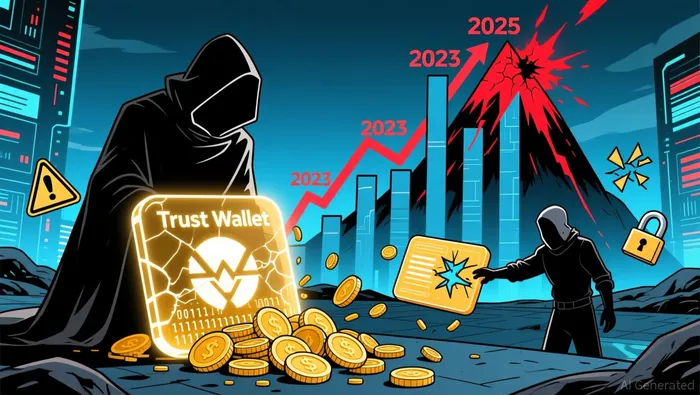
The December 2025 Trust Wallet hack, which exploited a compromised Chrome extension to steal $4–7 million in user funds, has become a watershed moment for crypto wallet security. This incident, part of a broader $3.4 billion in crypto thefts for the year, underscores systemic vulnerabilities in blockchain infrastructure and highlights a critical inflection point for institutional adoption. As attackers increasingly target operational weaknesses-such as supply chain compromises and social engineering-rather than code-level flaws, the market is responding with a surge in investment in security infrastructure. For investors, this creates both cautionary lessons and compelling opportunities.
Systemic Risks in Crypto Wallet Security
The Trust Wallet breach, which affected version 2.68 of its browser extension, exposed a critical flaw: the reliance on browser-based wallets for storing sensitive cryptographic keys. Attackers embedded malicious code in the extension, which captured users' seed phrases as they were entered, enabling unauthorized withdrawals. This method bypassed traditional smart contract vulnerabilities, instead exploiting human and operational errors. According to the Hacken 2025 TRUST Report, 58% of crypto thefts in the year were attributed to access-control exploits, while 21% stemmed from phishing and social engineering. These figures signal a shift in threat vectors, where attackers prioritize infiltrating user workflows rather than exploiting code.
The incident also revealed the fragility of software supply chains in the crypto space. Trust Wallet's delayed response-users were not publicly informed until two days after the breach-raised concerns about transparency and accountability. For institutions, this highlights the risks of adopting third-party tools without rigorous verification of update processes and audit trails.
Institutional Adoption and Risk Mitigation
Institutional investors, already wary of crypto's volatility, are now prioritizing security as a non-negotiable component of adoption. A 2025 report by SQ Magazine found that 84% of institutions cited regulatory compliance as their top priority in crypto risk management, while 60% integrated AI-driven risk assessment tools into their strategies. These trends reflect a growing recognition that security is not just a technical issue but a regulatory and reputational one.
The breach has also accelerated the adoption of multi-signature wallets and hardware-based key storage. For example, 48% of institutions had adopted DeFi risk management protocols by early 2025, a 20% increase from 2024. These measures reduce reliance on single points of failure and align with institutional demands for auditable, tamper-resistant systems. Additionally, the rise of stablecoins in payroll and asset management-despite their own risks-demonstrates confidence in blockchain's utility, provided robust security frameworks are in place.
Investment Opportunities in Blockchain Security Infrastructure
The Trust Wallet hack has catalyzed a surge in funding for blockchain security startups. Astra Security, a cybersecurity SaaS company, specializing in AI-driven penetration testing, raised $2.7 million in February 2025 to enhance its platform for detecting vulnerabilities in real time. Similarly, Hacken and Trail of Bits-both leaders in blockchain auditing-have seen increased demand for their services, particularly in smart contract and supply chain security according to market analysis. These companies are addressing the growing need for continuous monitoring, multi-layered authentication, and rapid incident response.
Investors are also turning to infrastructure projects that prioritize decentralized but secure key management. For instance, modular blockchain architectures and zero-knowledge proofs are gaining traction for their ability to enhance privacy and scalability while minimizing attack surfaces. According to Q3 2025 venture capital data, $4.59 billion was invested in the broader crypto space, with a significant portion allocated to infrastructure security firms. This trend is further supported by regulatory clarity, such as the GENIUS Act passed in July 2025, which has created a more stable environment for institutional capital.
The Path Forward
For institutions, the Trust Wallet hack serves as a cautionary tale: security must be embedded into every layer of crypto infrastructure, from wallet design to update protocols. The incident also underscores the importance of user education-hardware wallets, two-factor authentication, and regular software updates remain foundational defenses.
For investors, the post-hack landscape offers a clear thesis: security is no longer a peripheral concern but a core component of value creation in crypto. Startups addressing operational risks, supply chain vulnerabilities, and human-centric threats are well-positioned to benefit from the industry's shift toward institutional-grade security. As the market matures, those who prioritize security will not only mitigate risks but also capture the trust-and capital-of a rapidly evolving ecosystem.







Comentarios
Aún no hay comentarios