
Crypto Volatility and Macroeconomic Triggers in Q3 2025
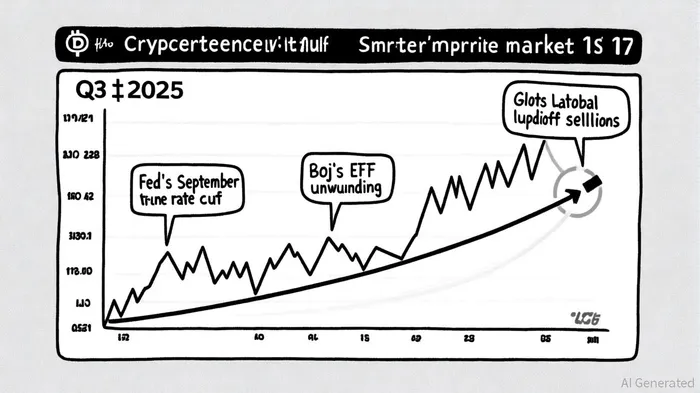
In Q3 2025, the cryptocurrency market became a barometer for global macroeconomic shifts, with central bank policies and risk-off sentiment driving sharp price swings. Bitcoin's price oscillated between $108,000 and $118,000, while altcoins like EthereumETH-- and SolanaSOL-- lagged, reflecting divergent investor behavior. This volatility was not random—it was a direct response to monetary policy adjustments, geopolitical tensions, and evolving regulatory frameworks.
The Fed's Dovish Pivot and Bitcoin's Rally
The U.S. Federal Reserve's September 2025 rate cut—reducing the benchmark rate to 4%-4.25%—marked a pivotal moment. Lower rates weakened the U.S. dollar, historically boosting demand for BitcoinBTC-- as a hedge against inflation and currency devaluation. According to a report by CNBC, Bitcoin spiked to $117,000 immediately after the announcement, but a classic “buy the rumor, sell the news” dynamic led to a short-term pullback as investors took profits[2]. This pattern underscored Bitcoin's sensitivity to liquidity shifts: with global liquidity reaching $176.2 trillion in early 2025, easier monetary policy created a tailwind for risk-on assets[5].
However, the Fed's cautious approach—projecting only two rate cuts in 2025—introduced uncertainty. Analysts at Equiti noted that Bitcoin's resilience during tightening cycles, compared to altcoins, highlighted its role as a “safe haven” within crypto, even as smaller tokens struggled with liquidity constraints[5].
ECB Tightening and the Altcoin Struggle
While the Fed eased, the European Central Bank (ECB) continued its tightening cycle, raising rates by 350 basis points since July 2022. This restrictive policy supported the euro and the U.S. dollar, creating headwinds for cryptocurrencies. A model-based assessment by the ECB found that tightening monetary policy typically exerts downward pressure on inflation and economic growth, indirectly weakening crypto markets[2].
Ethereum, for instance, fell 5.2% in Q3 2025 as investors shifted to lower-risk assets[5]. Yet, institutional demand for Ethereum-based products, such as staking and DeFi, provided a counterbalance. By July 2025, Ethereum ETFs had attracted $9.46 billion in net inflows, compared to $5.39 billion for Bitcoin, signaling a strategic reallocation toward utility-driven tokens[2].
BOJ and PBOC: Mixed Signals and Market Reactions
The Bank of Japan (BOJ) and the People's Bank of China (PBOC) introduced mixed signals. The BOJ's decision to unwind its ETF and JREIT holdings—a move expected to take over a century—triggered a selloff in traditional markets and a dip in Bitcoin below $116,000[1]. Meanwhile, the PBOC signaled a potential rate cut in 2025 to modernize its policy framework, though unchanged loan prime rates in September 2025 left markets cautious[4].
Japan's core CPI rising to 2.7% in August 2025 heightened expectations of further BOJ rate hikes, creating a tug-of-war between inflation control and economic growth. Analysts at OKX noted that if the BOJ delays quantitative tightening (QT), it could boost risk assets like Bitcoin, but the immediate market reaction to policy changes was muted due to pre-announced expectations[5].
Risk-Off Sentiment and Geopolitical Tensions
Risk-off sentiment in Q3 2025 was amplified by geopolitical tensions, particularly the Trump administration's reintroduction of tariffs on Swiss and Chinese goods. These tariffs, historically linked to risk-averse behavior, triggered a $200 billion selloff in the crypto market in late September 2025, with Bitcoin dropping below $112,000[5].
The Swiss National Bank's (SNB) decision to maintain its key rate at zero—a policy unchanged since March 2024—further complicated the landscape. While zero rates typically support crypto markets by increasing liquidity, the SNB's move was driven by deflationary pressures and trade uncertainties, not a bullish outlook for risk assets[1].
The Road Ahead: Institutional Adoption and Regulatory Clarity
Despite volatility, Q3 2025 saw significant progress in institutional adoption. The U.S. Securities and Exchange Commission's (SEC) approval of generic listing standards for crypto ETFs on major exchanges like NYSE and Nasdaq lowered barriers for new products, potentially unlocking broader adoption[5]. Bitcoin's market dominance of 64.6% suggested that altcoins could stage a recovery if Bitcoin dominance fell below 60%, a threshold often signaling an “altcoin season”[5].
Conclusion
Q3 2025 demonstrated that crypto markets are increasingly intertwined with global macroeconomic forces. While the Fed's rate cuts and accommodative policies in Japan and China provided tailwinds, tightening by the ECB and geopolitical tensions introduced headwinds. Investors who navigated this volatility by prioritizing Bitcoin's resilience and institutional-grade altcoins like Ethereum were better positioned to capitalize on the quarter's opportunities. As central banks continue to recalibrate their policies in 2026, the crypto market's ability to decouple from traditional risk-off dynamics will be a key determinant of its long-term trajectory.






Comentarios
Aún no hay comentarios