
Crypto Supply Dynamics and Validator Scalability: Evaluating Bitcoin, Pepenode, and BlockDAG in 2025
The crypto landscape in 2025 is defined by two critical forces: supply dynamics and validator scalability. As institutional demand outpaces issuance and macroeconomic pressures tighten liquidity, projects that balance scarcity with scalable infrastructure are poised to outperform. This analysis evaluates BitcoinBTC--, Pepenode, and BlockDAG through these lenses, focusing on how their unique approaches to supply control and validator architecture influence value accrual in a constrained environment.
Bitcoin: Scarcity as a Long-Term Hedge
Bitcoin's supply model is a masterclass in scarcity engineering. With a hard cap of 21 million coins and halving events every four years, the protocol ensures a predictable reduction in new supply. The 2024 halving reduced block rewards from 6.25 to 3.125 BTC, slashing daily issuance to ~900 coins[1]. By 2028, the next halving will cut this to 1.5625 BTC per block[3].
This deflationary schedule, combined with hoarding behavior (74% of Bitcoin has not moved in ≥2 years[5]), creates a supply shock that drives upward price pressure. Institutional adoption further amplifies this effect: 28 new Bitcoin treasury firms added 140,000 BTC to their reserves in July–August 2025 alone[2]. However, Bitcoin's scalability remains a bottleneck. Full nodes require 20+ GB of storage and hours of synchronization, limiting accessibility[1]. While SPV wallets mitigate this, they sacrifice security—a trade-off that could hinder mass adoption.
Pepenode: Gamified Deflation and Modular Scalability
Pepenode, a meme-inspired project, leverages a hybrid PoS-DAG architecture to merge scalability with deflationary mechanics. Its 210 billion token supply is designed to shrink via a 70% burn rate on node upgrade costs[3], with additional burns from transaction fees. Early data shows 21 trillion tokens burned by 2023, and a $1 billion burn planned for 2025[5]. This aggressive supply reduction mirrors Bitcoin's scarcity but with a programmable twist.
Validator scalability is addressed through a modular node system, where users stake virtualCYBER-- mining rigs to earn rewards. The platform's dynamic sharding auto-adjusts to network load, surpassing Ethereum's layer-2 inefficiencies[1]. By 2026, Pepenode plans to transition to on-chain mechanics, aligning rewards with real-world crypto value. While its presale price of $0.0010242 is modest, analysts project a 2030 price of $0.0244[3], driven by token scarcity and meme-driven demand.
BlockDAG: Hybrid Architecture for Scalability and Flexibility
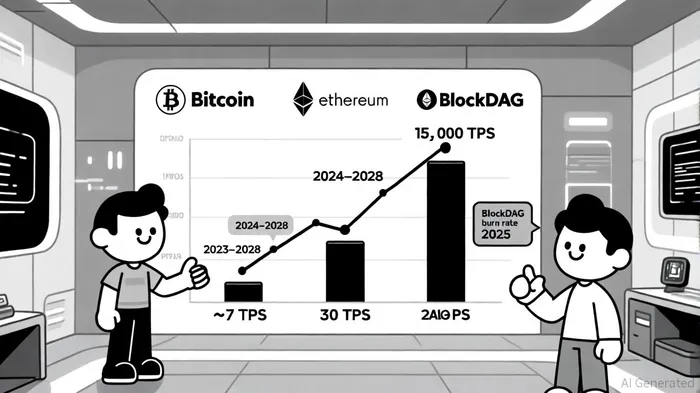
BlockDAG's DAG-PoW hybrid redefines the blockchain trilemma. By layering a DAG for asynchronous transaction processing (10 blocks/second, 15,000 TPS[4]) with a PoW layer secured by 18,000 ASIC miners and 2.5 million mobile app users[4], it achieves both speed and decentralization. This design outpaces Bitcoin's 7 TPS and Ethereum's 30 TPS, making it a contender for enterprise-grade use cases.
Supply dynamics are equally innovative. Unlike Bitcoin's fixed supply or Pepenode's deflationary model, BlockDAG employs dynamic minting and burning to adjust to market conditions[4]. This flexibility supports ecosystem growth while maintaining scarcity through strategic burns. The project's $383 million presale[1] and 4,500+ developers[3] underscore its potential to dominate the DAG space. Early investors could see a 3,746% ROI if the $0.05 listing price is reached[1], a testament to its capital efficiency.
Comparative Value Accrual in a Tightening Environment
In a world where supply constraints dominate, each project's approach to value accrual diverges:
- Bitcoin relies on inherent scarcity and institutional adoption. Its 2025 halving and 690,000 BTC absorbed by treasuries[2] create a supply-demand imbalance, with price targets ranging from $145,000 to $1 million[4].
- Pepenode combines programmable deflation with meme-driven virality. Its 70% burn rate[3] and modular scalability position it for rapid adoption, though its reliance on speculative demand introduces volatility.
- BlockDAG balances scalability with adaptive supply control. Its 15,000 TPS[4] and hybrid security model make it a technical standout, while dynamic tokenomics cater to both growth and scarcity.
Conclusion: Strategic Allocation in a Fragmented Market
For investors, the key lies in aligning risk profiles with each project's strengths. Bitcoin remains the ultimate store of value, with its halving-driven scarcity and institutional tailwinds. Pepenode offers high-growth potential for those comfortable with meme-driven volatility, while BlockDAG's technical prowess and capital efficiency make it a compelling long-term play.
As the crypto market matures, projects that harmonize supply dynamics with scalable infrastructure—like BlockDAG—will likely outperform. However, Bitcoin's foundational role as a scarcity benchmark ensures its dominance in a tightening supply environment. The winner may not be a single project but a diversified portfolio that captures the strengths of each.






Comentarios
Aún no hay comentarios