
Crypto.com's Strategic Pursuit of a U.S. Banking Charter: A Catalyst for Institutional Adoption and Regulatory Normalization
A Federal Charter: Strategic Ambition Meets Regulatory Pragmatism
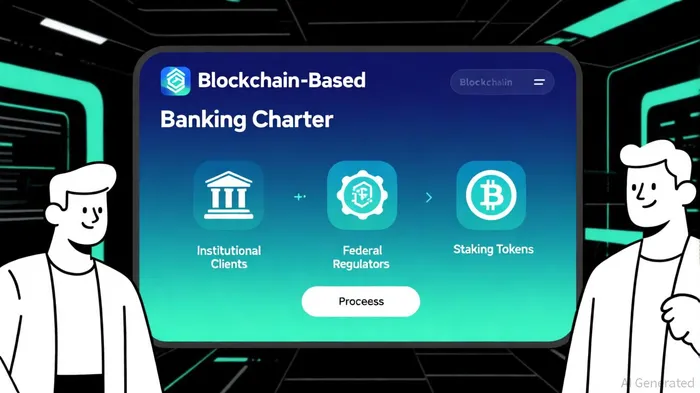
In October 2025, Crypto.com submitted its application for a National Trust Bank Charter, a strategic pivot aimed at operating under a unified federal regulatory framework. This move allows the company to offer custody and staking services for digital assets-including ETFs and corporate treasuries-while maintaining its existing trust services under New Hampshire's oversight, according to Blockonomi. CEO Kris Marszalek has framed this as a commitment to "regulatory compliance and institutional credibility," a critical differentiator in an industry still haunted by FTX-era volatility and skepticism.
The application is part of a broader trend: crypto firms like Ripple, CoinbaseCOIN--, and Stripe are also pursuing federal charters. This collective push reflects a calculated bet on a regulatory environment that, under the Trump administration, has shown increasing openness to crypto innovation. Fed Governor Christopher Waller's recent comments on "skinny" accounts-limited access to federal systems for non-traditional institutions-further underscore this shift, as reported by Cryptopolitan. For Crypto.com, securing a charter isn't just about compliance; it's about creating a blueprint for how crypto can coexist with legacy finance.
Navigating Regulatory Hurdles: A Test of Resilience
The path to a federal charter is anything but straightforward. Crypto.com's application will face rigorous scrutiny from the OCC, which must balance innovation with systemic risk. Critics argue that granting a charter to a crypto firm could inadvertently legitimize unproven technologies, while proponents counter-according to StreetInsider-that federal oversight is the only way to weed out bad actors and establish trust.
Yet the company's dual-regulatory approach-maintaining New Hampshire's oversight while seeking federal approval-demonstrates a pragmatic understanding of the current landscape. By avoiding operational disruption, Crypto.com can continue serving its existing clients while building a parallel infrastructure for institutional-grade services, as noted by Blockonomi. This bifurcated strategy mirrors the approach taken by early fintech disruptors, who leveraged state-level innovation to test models before scaling nationally.
Institutional Adoption: The Next Frontier
The implications for institutional adoption are profound. A federal charter would enable Crypto.com to offer services that meet the stringent compliance demands of pension funds, endowments, and corporations. These entities, which collectively manage trillions in assets, have been hesitant to allocate capital to crypto due to regulatory ambiguity. By operating under a federal framework, Crypto.com reduces counterparty risk and provides a clear audit trail-two critical factors for institutional onboarding, as reported by StreetInsider.
Moreover, the company's focus on custody and staking aligns with a growing demand for yield-generating solutions in a low-interest-rate environment. As traditional treasuries underperform, institutional investors are increasingly eyeing crypto as an alternative. Crypto.com's ability to offer secure, regulated staking services could position it as a key infrastructure player in this transition, according to Blockonomi.
A Broader Industry Shift: From Wild West to Main Street
Crypto.com's application is not an isolated event but part of a larger industry-wide push for normalization. The Trump administration's regulatory stance-marked by a focus on innovation-friendly policies-has created a window of opportunity for crypto firms to integrate into the financial system. This is evident in the Fed's recent openness to "skinny" accounts, which could allow crypto firms to hold reserves without full banking privileges, as noted by Cryptopolitan.
However, the road ahead remains fraught with challenges. Lawmakers are still debating a cohesive framework for digital assets, and the OCC's approval process could take months. Yet the mere act of applying sends a powerful message: crypto is no longer a fringe asset class but a legitimate contender for institutional portfolios.
Conclusion: A Win-Win for Innovation and Compliance
Crypto.com's pursuit of a U.S. banking charter is a masterclass in strategic foresight. By navigating regulatory complexity with a dual-regulatory approach, the company is not only safeguarding its growth but also paving the way for broader crypto adoption. For investors, this represents a unique opportunity to back a firm that's actively shaping the future of finance-one charter at a time.
As the crypto industry inches closer to mainstream acceptance, the firms that thrive will be those that embrace regulation as a tool, not a barrier. Crypto.com's application is a testament to that vision.





Comentarios
Aún no hay comentarios