
Crypto's Sharp Decline Amid Macroeconomic Downturn: Investor Psychology and Central Bank Policy Impact on Digital Assets
The cryptocurrency market's recent volatility underscores a critical shift in how digital assets interact with traditional financial systems. As macroeconomic downturns and central bank policy maneuvers reshape global markets, cryptocurrencies have become increasingly sensitive to liquidity conditions, fiscal uncertainty, and investor sentiment. This article examines the interplay between investor psychology and central bank policy in driving crypto price movements during the 2023–2025 period, drawing on empirical data and behavioral insights to explain the sector's sharp declines and rebounds.
Central Bank Policy: A Double-Edged Sword for Crypto Markets
The Federal Reserve's monetary policy has been a primary driver of cryptocurrency price dynamics in recent years. Between 2023 and 2025, the Fed executed an aggressive tightening cycle, , which culminated in a peak for risk assets like crypto in November 2021. As rates climbed in 2022, both equities and cryptocurrencies faced valuation pressures, with BitcoinBTC-- and EthereumETH--
amid rising borrowing costs and risk-off sentiment.
Conversely, the Fed's pivot to rate cuts in late 2024 and early 2025 injected optimism into crypto markets. Lower interest rates reduced the opportunity cost of holding non-yielding assets like Bitcoin, while expectations of accommodative policy spurred demand for risk-on investments. For instance, the NEAR Protocol's price
following Fed signals of rate cuts, . This sensitivity to central bank signals highlights crypto's growing integration into traditional financial systems, where digital assets now react to the same macroeconomic cues as stocks and commodities.
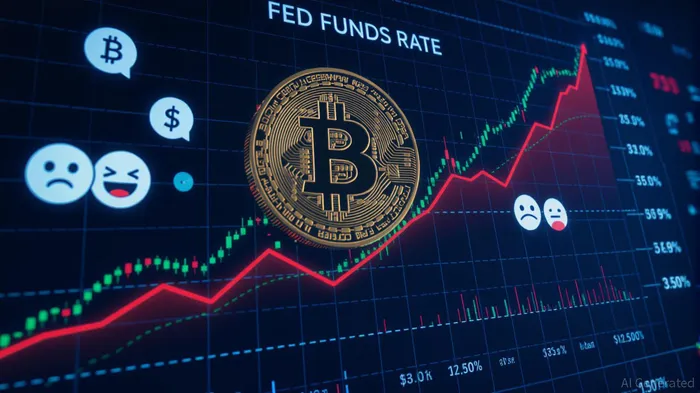
Investor Psychology: Herding, Sentiment, and Behavioral Biases
Beyond policy mechanics, investor psychology has played a pivotal role in amplifying crypto's volatility. During macroeconomic downturns, behavioral patterns such as and the disposition effect intensify.
A 2025 study revealed that retail investors in crypto markets often follow social media trends and geopolitical narratives, leading to overreactions and speculative bubbles. For example, during the , some investors viewed Bitcoin as a hedge against geopolitical risk, while regulatory crackdowns-such as China's 2021 mining ban-triggered panic-driven sell-offs.
The disposition effect, where investors cling to losing positions and sell winners, further exacerbates crypto's price swings. In 2025, the U.S. government shutdown-a fiscal crisis caused by congressional gridlock-exemplified this dynamic. , with Ethereum and altcoins suffering even steeper declines.
The shutdown froze economic data releases and spending, triggering a liquidity crunch and risk-off sentiment that disproportionately impacted crypto, which lacks the institutional safeguards of traditional markets.
The Role of Sentiment and Social Media
Social media platforms like X (formerly Twitter) have amplified crypto's sensitivity to sentiment shifts.
A 2025 analysis found that investor attention, measured by search volume and social media activity, had a short-lived but pronounced impact on crypto prices, particularly for volatile coins like Bitcoin and Ethereum. High-profile figures, such as , have also influenced market psychology, with tweets or public statements triggering rapid price movements.
Moreover, technological developments and institutional adoption announcements have acted as psychological catalysts.
in 2023 and 2024, for instance, bolstered investor confidence, driving prices upward despite ongoing macroeconomic headwinds. These events illustrate how crypto markets are increasingly shaped by narratives rather than pure fundamentals, a trend that heightens their vulnerability to sentiment-driven corrections.
Conclusion: A Maturing Market with Persistent Risks
The 2023–2025 period has demonstrated that cryptocurrencies are no longer isolated speculative assets but integral components of a broader, interconnected financial system. Central bank policies and investor psychology now exert outsized influence on crypto prices, with Bitcoin evolving into a macro hedge asset and Ethereum retaining its high-beta, innovation-driven profile
according to analysis. However, the sector's susceptibility to liquidity shocks and behavioral biases-exacerbated by social media and geopolitical uncertainty-means volatility will persist.
For investors, the lesson is clear: crypto's future performance will depend not only on technological advancements but also on macroeconomic stability and the ability to navigate the psychological pitfalls of a market still dominated by retail speculation. As central banks continue to recalibrate policy and fiscal uncertainty lingers, digital assets will remain a barometer for global economic health-and a testing ground for the resilience of investor psychology.






Comentarios
Aún no hay comentarios