
Is the Crypto Sell-Off Ending? A Strategic Look at Bitcoin ETF Flows and Market Stability
The crypto market's late 2025 turbulence has left investors grappling with a critical question: Is the sell-off ending, or is this merely a pause in a deeper bearish trend? To answer this, we must dissect the interplay between BitcoinBTC-- ETF flows, market stability indicators, and investor sentiment. The data suggests a nuanced picture-one where structural strength and institutional demand are countering short-term volatility, but risk-on behavior remains cautious and conditional.
ETF Flows: A Barometer of Institutional Confidence
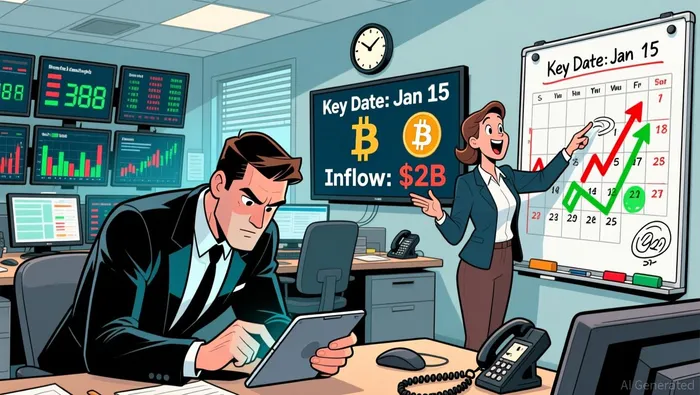
Bitcoin and EthereumETH-- ETFs in late 2025 exhibited a dramatic reversal in December, ending a seven-day outflow streak with inflows of $354.8 million and $67.8 million on December 30. This followed a $1.13 billion outflow between December 15 and 19, driven by year-end de-risking and tax-loss harvesting. Yet, despite these fluctuations, 2025's ETF inflows absorbed 5.2% of Bitcoin's supply increase, a critical factor in stabilizing prices during market rallies.
This pattern underscores a broader trend: institutional adoption is creating a more predictable demand structure. Unlike retail-driven speculation, institutional buyers are less prone to panic selling, acting as a buffer during downturns. By December 2025, U.S. spot Bitcoin ETFs had attracted nearly $26 billion in inflows for the year, with total 2025 inflows surpassing $34 billion. This capital absorption has tightened Bitcoin's available float, reducing the likelihood of panic-driven sell-offs.
Market Stability: Volatility Amid Structural Resilience
Bitcoin's price closed 2025 at $87,000–$88,000, down 6% for the year and 30% from its October peak of $126,000, signaling a bear market. However, this decline was tempered by structural factors. The end of global liquidity expansion-marked by tighter monetary policies from the Federal Reserve and Bank of Japan-increased funding costs and amplified volatility. Yet, Bitcoin's price remained above key valuation metrics, like the Cumulative Value Days Destroyed (CVDD) model, suggesting it had not yet reached deep undervaluation.
Notably, Bitcoin's volatility in 2025, while significant, was lower than many S&P 500 stocks, including members of the "Magnificent Seven". This maturation of Bitcoin as an asset class, driven by institutional capital, has smoothed price swings compared to earlier cycles. Furthermore, corporate and sovereign holdings of Bitcoin acted as a backstop, reducing liquid supply and preventing panic selling.
Investor Sentiment: Fear, Neutral, and the Road to Risk-On
The CoinMarketCap "Crypto Fear and Greed Index" shifted to "neutral" in late 2025, the first time since October, indicating cautious indecision rather than strong bullish or bearish conviction. This stabilization coincided with Bitcoin stabilizing near the $88,000–$92,000 range, a critical support level. However, macroeconomic risks continued to weigh on sentiment.
A striking divergence emerged between retail fear and institutional action. The Fear and Greed Index plummeted to 20 in late December 2025, reflecting extreme fear, yet Bitcoin ETFs continued to attract inflows. By December 2025, institutional demand absorbed new Bitcoin issuance at over 100%, reinforcing a long-term bullish structural setup. This suggests that while retail investors retreated, traditional financial institutions and regulated vehicles remained active, signaling a shift in market dynamics.
The Path Forward: Structural Strength vs. Tactical Uncertainty
The core question for 2026 is whether ETF buyers will aggressively add to positions during weakness and if new funds targeting digital asset income or structured products can attract incremental demand. The data from late 2025 indicates that institutional demand is robust enough to absorb sell pressure from long-term holders cashing in gains. However, the market remains sensitive to macroeconomic signals, such as U.S. interest rate policy and geopolitical events .







Comentarios
Aún no hay comentarios