
Crypto Security Risks and Financial Impact: Evaluating Exchange Vulnerabilities and Investor Protection Strategies in 2025
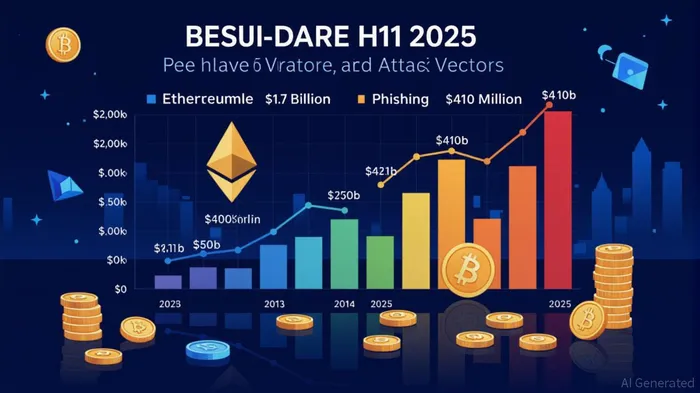
In the first half of 2025, cryptocurrency investors faced a staggering $2.47 billion in losses due to hacks, scams, and exploits—a figure surpassing the total losses recorded in 2024[1]. This surge in financial damage underscores the persistent vulnerabilities in the crypto ecosystem, particularly within centralized exchanges (CEX) and decentralized protocols. Two of the most significant incidents—the Bybit exchange breach ($1.5 billion in losses) and the Cetus Protocol exploit ($225 million stolen)—exemplify the scale of risks confronting investors[1].
The Anatomy of 2025's Major Breaches
Wallet compromises emerged as the primary attack vector, accounting for $1.7 billion in losses across 34 incidents. Phishing campaigns, meanwhile, siphoned $410 million from victims through 132 separate attacks[1]. EthereumETH-- remained the most targeted blockchain, suffering $1.5 billion in losses across 164 incidents, while BitcoinBTC-- lost $373 million[1]. These figures highlight a troubling trend: attackers are increasingly exploiting human error and weak authentication protocols rather than directly breaching blockchain networks.
The second quarter of 2025 saw a 52% drop in total losses, falling to $801 million, suggesting some progress in mitigating risks[1]. However, phishing attacks remain a persistent threat, with attackers leveraging social engineering tactics to bypass even advanced security measures.
Exchange Vulnerabilities: Centralized vs. Decentralized
Centralized exchanges, which hold user funds in custodial wallets, remain prime targets for hackers. The Bybit breach, for instance, exploited vulnerabilities in the platform's hot wallet infrastructure, exposing the risks of centralized fund management[1]. To counter such threats, exchanges have adopted multi-factor authentication (MFA) and cold storage solutions, where the majority of funds are kept offline[2].
Decentralized exchanges (DEX), by contrast, eliminate the need for custodial wallets, allowing users to retain control of their assets. While DEX platforms like UniswapUNI-- and SushiSwapSUSHI-- have gained traction, they are not immune to risks. Smart contract vulnerabilities and liquidity pool exploits continue to plague decentralized protocols, as seen in the Cetus Protocol incident[1].
Investor Protection Strategies: From Cold Storage to Regulation
Investors are increasingly turning to hardware wallets—physical devices that store private keys offline—as a safeguard against exchange breaches[2]. Platforms like Ledger and Trezor have seen a surge in adoption, with users prioritizing self-custody solutions over leaving funds on exchanges.
Regulatory measures are also playing a critical role in enhancing security. Governments are introducing stricter compliance requirements, such as know-your-customer (KYC) checks and anti-money laundering (AML) protocols, to hold exchanges accountable[2]. The European Union's MiCA (Markets in Crypto-Assets) framework, set to take effect in 2026, exemplifies this trend by mandating robust security standards for crypto platforms[2].
However, regulatory progress lags behind the speed of innovation. As of mid-2025, only 30% of exchanges globally have implemented real-time transaction monitoring systems, leaving significant gaps in fraud prevention[1].
The Road Ahead: Innovation and Education
The path to a more secure crypto ecosystem hinges on two pillars: technological innovation and user education. Advances in zero-knowledge proofs and threshold signatures could soon offer users enhanced privacy and security. Meanwhile, platforms like Binance and CoinbaseCOIN-- are investing in AI-driven fraud detection systems to identify phishing attempts and suspicious transactions in real time[1].
Yet, technology alone is insufficient. A 2025 Chainalysis report found that 68% of victims in phishing attacks lacked basic knowledge of secure crypto practices[3]. Educational initiatives—such as wallet security tutorials and phishing simulation programs—are essential to closing this gap[3].
Conclusion
The $2.47 billion in losses recorded in H1 2025 serves as a stark reminder of the risks inherent in the crypto space. While centralized exchanges and decentralized protocols face distinct vulnerabilities, the onus of protection increasingly falls on investors to adopt robust security practices. As the industry evolves, a combination of regulatory oversight, technological innovation, and user education will be critical to mitigating risks and fostering trust in digital assets.







Comentarios
Aún no hay comentarios