
Crypto Salary Diversification Strategies in a Volatile Market: Risk Mitigation Through Multi-Chain and Stablecoin Integration
The Stablecoin Payroll Revolution
Stablecoins have become the backbone of crypto-based compensation, with 9.6% of blockchain professionals receiving salaries in digital assets in 2024, a threefold increase from 2023, according to the Pantera survey. USDC, pegged to the U.S. dollar and backed by institutional-grade reserves, dominates this space with a 63% market share, outpacing even USDTUSDT-- (28.6%) despite the latter's larger trading volume, as shown in a RiseWorks report. This dominance is driven by regulatory compliance and infrastructure support: major payroll platforms like Deel and Remote exclude USDT, while USDC's monthly attestation process and partnership with Intercontinental Exchange (ICE) bolster trust, as noted in the RiseWorks payroll report.
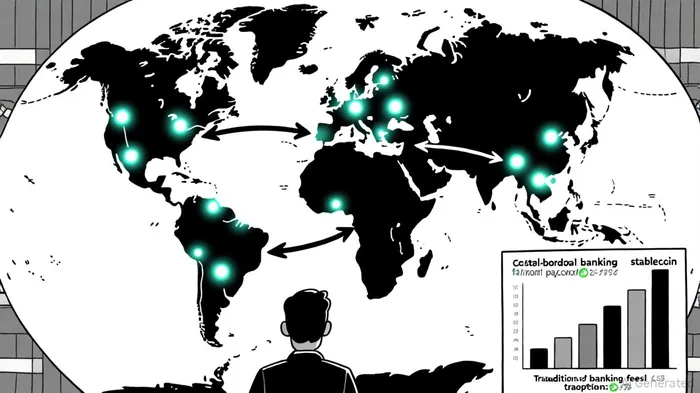
The benefits are tangible. Companies adopting stablecoin payroll report cost reductions of up to 98% compared to traditional banking, with transactions settling in minutes rather than days, as reported in a DeFi Planet article. For firms with distributed teams, this eliminates currency conversion fees and banking delays, while also offering inflation hedging in regions like Latin America and cross-border efficiency in Southeast Asia, according to the Ecoinimist article.
Regulatory Tailwinds and Generational Shifts
Regulatory clarity has accelerated adoption. The July 2025 signing of the GENIUS Act, a bipartisan U.S. law providing a framework for stablecoin oversight, has reduced legal ambiguity and boosted institutional confidence, as reported in a Cointelegraph report. Similarly, the EU's MiCA regulation has created a harmonized environment for cross-border crypto operations.
Meanwhile, generational preferences are reshaping corporate finance. A striking 75% of Gen Z workers now prioritize stablecoin compensation, valuing its speed, transparency, and alignment with digital financial habits, according to a Rebelfi blog. Hybrid models-where employees split pay between fiat and crypto-are gaining traction, allowing companies to balance volatility risk with employee satisfaction.
Case Studies: Real-World Implementation
Rise Payroll has emerged as a leader in this space, leveraging its partnership with CircleCRCL-- (USDC's issuer) and Arbitrum's low-cost blockchain infrastructure to process over $700 million in payroll transactions, according to a Currency Analytics piece. By integrating USDC, the platform enables instant global payments while complying with MiCA and the GENIUS Act.
In Asia, YPay, a regulated Australian platform, allows employees to allocate portions of their salaries directly into crypto, bypassing brokers and fees. Regulated by ASIC and AUSTRAC, YPay's model emphasizes compliance and accessibility, reflecting the broader trend of embedded finance, as described in a GlobeNewswire release. Meanwhile, Bitwage in the U.S. facilitates USDT and USDC payroll for global teams, ensuring tax and audit compliance through blockchain transparency, as explained on the Bitwage blog.
Strategic Implications for Investors
For investors, the shift to stablecoin payroll signals a maturation of crypto's role in corporate infrastructure. Platforms like Rise and YPay represent high-growth opportunities, while stablecoin issuers like Circle stand to benefit from increased institutional demand. However, risks remain: regulatory shifts, particularly in the U.S., could disrupt adoption, and full-crypto payrolls (still rare) face volatility challenges.
Hybrid models and multi-chain integration-where salaries are distributed across EthereumETH--, ArbitrumARB--, and BNBBNB-- Chain-offer a balanced approach. These strategies reduce reliance on single networks while capitalizing on each chain's strengths (e.g., Ethereum's security, Arbitrum's low fees).
Conclusion
Crypto salary diversification is no longer speculative-it's a pragmatic response to global financial instability. By integrating stablecoins and multi-chain infrastructure, companies mitigate risk, reduce costs, and future-proof their compensation models. As Gen Z's influence grows and regulatory frameworks solidify, this trend is poised to redefine corporate finance. For investors, the key lies in identifying platforms and stablecoins that align with both institutional trust and technological scalability.





Comentarios
Aún no hay comentarios