
Crypto's Role in Geopolitical Resilience and Economic Decentralization: Strategic Investment in Blockchain Infrastructure Amid EU-Russia Dynamics
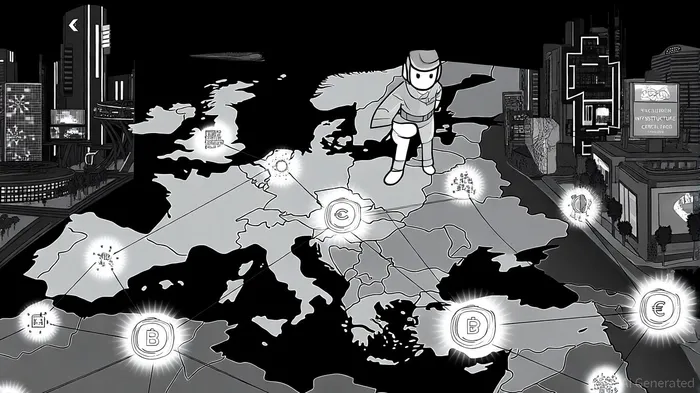
In 2025, the European Union's strategic pivot toward blockchain infrastructure has become a cornerstone of its geopolitical resilience strategy, particularly in response to escalating tensions with Russia. As hybrid threats—ranging from cyberattacks to cryptocurrency-driven sanctions evasion—intensify, the EU is leveraging blockchain to fortify digital sovereignty, disrupt adversarial financial tactics, and build a decentralized economic framework. For investors, this represents a unique confluence of technological innovation, regulatory evolution, and geopolitical necessity.
The EU's Blockchain-Driven Resilience Playbook
The EU's 19th sanctions package against Russia, introduced in 2025, marked a watershed moment by explicitly targeting Russian cryptocurrency platforms and transactions[1]. This move aimed to block financial loopholes Russia had exploited to sustain its economy, such as using BitcoinBTC-- and TetherUSDT-- for large-scale transactions[2]. According to a report by CoinCentral, the EU's sanctions now prohibit Russian residents from engaging in cryptocurrency transactions and restrict dealings with foreign banks tied to Russia's alternative payment systems[3]. These measures reflect a broader regulatory shift: the EU is no longer merely reacting to crypto's role in geopolitics but proactively shaping it.
Simultaneously, the EU is investing heavily in blockchain infrastructure to reduce dependency on foreign systems. The European Blockchain Services Infrastructure (EBSI), supported by the Connecting Europe Facility (CEF), is a flagship project aimed at creating a cohesive, interoperable blockchain platform for public services[4]. By 2025, EBSI has expanded to include 10 EU member states under the EUROPEUM-EDIC consortium, focusing on cross-border cooperation in decentralized identity, eHealthEHTH--, and supply chain transparency[4]. These initiatives align with the EU's broader goal of technological sovereignty, as outlined in its 2025 International Digital Strategy[5].
The Digital Euro: A Geopolitical Weapon or a Strategic Liability?
The EU's digital euro project, initially planned as a private ledger, has undergone a dramatic pivot. The U.S. passage of the GENIUS Act in July 2025—requiring 100% dollar or Treasury-backed stablecoins—has forced the European Central Bank (ECB) to reconsider public blockchain options like EthereumETH-- and Solana[6]. This shift aims to accelerate development timelines and integrate the digital euro into decentralized finance (DeFi) ecosystems[6]. However, the move raises critical questions: Will public blockchains, with their inherent transparency, expose the digital euro to surveillance risks? Or will they enable the euro to compete with dollar-backed stablecoins in global trade?
The ECB's technical trials, expected to conclude in October 2025, will determine the digital euro's design[6]. If issued, it could complement cash, reduce merchant transaction costs, and serve as a tool for financial inclusion. For investors, the digital euro's adoption hinges on its ability to balance privacy with regulatory compliance—a challenge that could redefine the EU's role in global finance.
Funding the Future: EU Blockchain Investments and Opportunities
The EU's 2025 funding landscape underscores blockchain's strategic importance. Horizon Europe and the Recovery and Resilience Facility (RRF) have allocated €347 million for blockchain-related research and innovation[7]. Additionally, the AI/Blockchain Investment Fund, backed by the European Investment Fund (EIF), is scaling equity investments for blockchain startups and SMEs[7]. These funds are not just about technological advancement—they're about building infrastructure to counter hybrid threats.
For example, the JRC's HYCER team is leveraging blockchain to enhance collaboration between policymakers and critical infrastructure operators, mitigating risks from cyberattacks and disinformation campaigns[8]. Similarly, the EU's €17 billion infrastructure modernization plan includes blockchain-enabled systems for securing transportation networks, which are vulnerable to Russian hybrid tactics[9]. Investors in blockchain security firms, supply chain transparency platforms, and decentralized identity solutions stand to benefit from these initiatives.
Risks and Rewards: Navigating the Crypto-Geopolitical Landscape
While the EU's blockchain strategy offers clear opportunities, it also presents risks. The EU's MiCA regulation, effective since December 2024, imposes bank-like requirements on crypto assets, potentially stifling innovation[10]. Moreover, the U.S.-EU regulatory divergence—exemplified by the GENIUS Act—could fragment global crypto markets, creating compliance challenges for cross-border projects.
However, the geopolitical imperative to counter Russian influence provides a strong tailwind. As noted in a 2025 report by the Atlantic Council, blockchain's resilience in crises—evidenced by its use in Ukraine and Afghanistan—positions it as a strategic asset for the EU[11]. For investors, this means prioritizing projects that align with EU resilience goals, such as decentralized energy grids, secure communication networks, and CBDC infrastructure.
Conclusion: A Decentralized Future in a Multipolar World
The EU's blockchain investments are not just about technology—they're about redefining economic and geopolitical power. By 2025, the EU has moved from a values-based digital diplomacy to a security-driven strategy, with blockchain at its core[5]. For investors, the key is to align with initiatives that address both immediate hybrid threats and long-term strategic autonomy. Whether through EBSI, the digital euro, or EU-funded startups, blockchain is becoming the bedrock of a decentralized, resilient Europe.






Comentarios
Aún no hay comentarios