
Crypto Risk and Geopolitical Volatility: Navigating Investment Safety in High-Conflict Regions
In 2025, cryptocurrencies have become both a lifeline and a lightning rod in high-conflict regions. From Ukraine's war-torn cities to Venezuela's hyperinflationary economy, digital assets are reshaping how individuals and governments navigate financial instability. Yet, the same tools enabling economic survival are also amplifying geopolitical risks. For investors, the question is no longer if crypto operates in conflict zones but how to assess its dual role as a utility and a vulnerability.
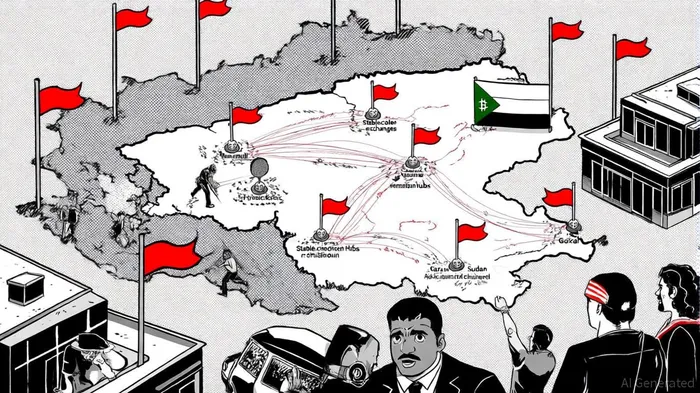
The Dual Edge of Crypto in Conflict Zones
Cryptocurrencies have proven their utility in regions where traditional banking systems collapse. In Ukraine, the government leveraged BitcoinBTC-- and stablecoins to fund military drones and medical supplies during the Russia-Ukraine war, bypassing sanctions and frozen bank accounts, according to a CryptoNews analysis. By 2025, Ukraine ranked fifth on Chainalysis' Global Crypto Adoption Index, with the Lightning Network facilitating everyday purchases during blackouts, Grayscale research found. Similarly, in Sudan, Grayscale reported that Bitcoin remittances surged to $20 million in Q1 2025, offering a lifeline to civilians amid a collapsed banking system.
However, this utility comes with risks. The decentralized nature of crypto makes it a target for geopolitical manipulation. In April 2025, Iranian crypto infrastructure was attacked, with a major exchange hacked and millions drained, according to a FinancialContent review. On the flip side, Israel used stablecoins to distribute emergency aid in missile-attacked regions, though the same review noted such applications remain limited by broader geopolitical tensions. These examples underscore crypto's duality: it empowers individuals but also exposes them to cyber warfare and regulatory crackdowns.
Drivers of Adoption and Systemic Risks
Economic instability and institutional distrust are primary drivers of crypto adoption in conflict zones. A 2024 MDPI study found that corruption and unemployment were stronger predictors of crypto use than inflation or exchange rate volatility (MDPI). In Venezuela, for instance, Bitcoin peer-to-peer trading hit $15 million weekly in 2025 as citizens fled the bolívar's collapse, according to Grayscale. Meanwhile, the U.S. GENIUS Act of June 2025 accelerated stablecoin adoption by providing regulatory clarity, pushing their market supply past $290 billion by Q3, per Grayscale.
Yet, systemic risks loom large. The October 2025 crypto crash-triggered by a 100% U.S. tariff on Chinese imports-exposed the market's fragility. Bitcoin plummeted 12%, and EthereumETH-- followed, erasing $35 billion in market cap within hours, Grayscale reported. This volatility, coupled with the potential for sanctions evasion (e.g., Russia's Garantex handling 82% of global crypto transactions tied to sanctioned entities in 2023, as noted in the MDPI study), has prompted regulatory overhauls. The EU's MiCA framework, effective December 2024, and U.S. regulatory uncertainty under a Trump administration highlight the growing scrutiny, according to CryptoNews.
Geopolitical Tensions and Market Implications
The interplay between crypto and global conflicts has created a volatile investment landscape. The U.S.-China trade war, for example, caused Bitcoin to swing 16% in April 2025 when tariffs escalated, a FinancialContent review observed. Meanwhile, BRICS nations' push for de-dollarization introduced new dynamics: analysts predict 10–15% price swings in Bitcoin and Ethereum around major announcements, with XRPXRP-- gaining 12% year-to-date as cross-border payment demand rose, per the same review.
Investors must also grapple with the ethical dimension. While crypto enables humanitarian aid, it also facilitates illicit finance. Russia's legalizing of crypto mining in 2024 and Iran's use of digital assets to fund military operations were highlighted in the MDPI analysis and demonstrate how regimes exploit decentralized systems. This duality complicates investment safety, as assets tied to conflict zones risk reputational and regulatory backlash.
Investment Safety: A Pragmatic Framework
For investors, navigating crypto in high-conflict regions requires a nuanced approach:
1. Diversification: Avoid overexposure to region-specific tokens. Stablecoins like USDTUSDT-- or USDCUSDC--, which are less volatile than Bitcoin, may offer safer havens in unstable economies, according to Grayscale.
2. Regulatory Vigilance: Monitor evolving frameworks like MiCA and U.S. policy shifts. Assets compliant with emerging regulations (e.g., post-GENIUS Act stablecoins) are better positioned to withstand scrutiny, Grayscale suggests.
3. Risk Mitigation: Hedge against geopolitical shocks by allocating to crypto infrastructure (e.g., Lightning Network nodes) rather than speculative tokens.
4. Ethical Due Diligence: Avoid projects linked to sanctioned entities or conflict financing, as regulatory penalties could erase gains, a CryptoNews analysis warns.
Conclusion
Cryptocurrencies in high-conflict regions are neither a panacea nor a pariah. They offer unprecedented financial resilience but come with inherent risks-volatility, cyber threats, and geopolitical manipulation. For investors, the path forward lies in balancing innovation with caution. As the lines between traditional finance and decentralized systems blurBLUR--, the key to safety will be adaptability: leveraging crypto's utility while mitigating its vulnerabilities in an increasingly fragmented world.






Comentarios
Aún no hay comentarios