
U.S. Crypto Regulatory Uncertainty: A Double-Edged Sword for Institutional Investment and Asset Valuations
The U.S. crypto regulatory landscape in 2025 has undergone a seismic shift, marked by landmark legislative efforts and agency initiatives aimed at clarifying jurisdictional boundaries and fostering innovation. However, this progress has been accompanied by lingering uncertainties that continue to shape institutional investment flows and crypto asset valuations. This analysis examines how recent regulatory developments-such as the SEC's Project Crypto, the CLARITY Act, and the GENIUS Act-have catalyzed institutional adoption while also highlighting unresolved conflicts that pose risks to market stability.
Regulatory Clarity as a Catalyst for Institutional Adoption
The introduction of Project Crypto by the SEC in July 2025 has been a cornerstone of regulatory modernization. By clarifying the classification of crypto assets and streamlining custody frameworks, the initiative has reduced ambiguity around the Howey testTST-- and enabled institutions to engage with digital assets more confidently, according to a FinanceFeeds explainer. For instance, the SEC's shift toward written compliance guidelines-rather than enforcement-driven regulation-has lowered compliance risks for financial institutions, prompting major asset managers like BlackRockBLK-- and Fidelity to integrate BitcoinBTC-- ETFs into retirement accounts, according to a Datos Insights analysis.
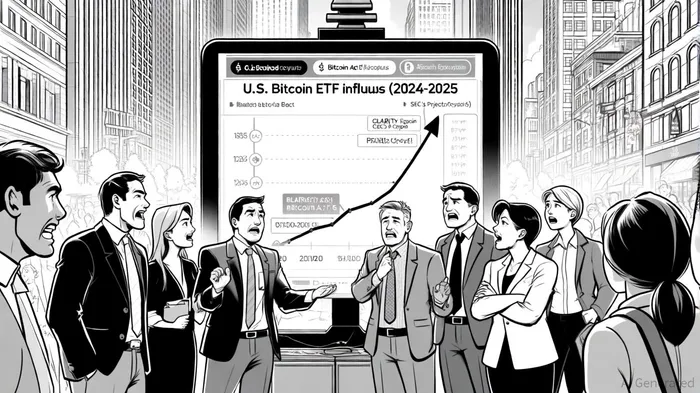
Legislative milestones, such as the GENIUS Act (regulating stablecoins) and the CLARITY Act (defining jurisdictional boundaries between the SEC and CFTC), have further bolstered institutional confidence. The CLARITY Act's categorization of digital assets into "digital commodities" and "investment contract assets" has provided a structured framework for secondary market trading, reducing regulatory overlap, according to an Arnold & Porter advisory. This clarity has directly translated into capital inflows: U.S. spot Bitcoin ETFs alone accumulated $110 billion in assets under management (AUM) by late September 2025, with BlackRock's iShares Bitcoin Trust ETF (IBIT) reaching $87.2 billion in AUM, per a FinancialContent report.
Quantitative data underscores the transformative impact of these reforms. Bitcoin ETFs saw $46.6 billion in net inflows in 2025, while EthereumETH-- ETFs attracted $3.9 billion, contributing to Bitcoin's price surge past $100,000, according to a WealthManagement analysis. Analysts attribute this growth to the SEC's approval of in-kind creation and redemption mechanisms, which enhanced liquidity and efficiency for institutional investors.
Persistent Uncertainties and Institutional Hesitations
Despite these advancements, unresolved regulatory conflicts and enforcement actions continue to hinder institutional adoption. The CLARITY Act, while passed by the House, faces delays due to competing Senate drafts, such as the Responsible Financial Innovation Act of 2025, which introduces a new category of "ancillary assets" not present in the House version, according to a CoinDesk analysis. This legislative fragmentation has created ambiguity, with institutional investors delaying decisions until a unified framework emerges.
Moreover, the certification process for "mature" blockchains under the CLARITY Act introduces operational risks. Regulators retain discretion to reassess a blockchain's maturity as governance structures evolve, complicating long-term planning for institutions, as noted in a CoinDesk opinion. For example, blockchains like Ethereum and CardanoADA--, though decentralized, still face challenges in scalability and uptime reliability, raising questions about their eligibility for "mature" status.
Legal battles also loom large. The SEC v. Ripple Labs and SEC v. Coinbase cases are reshaping how securities laws apply to digital assets. The Second Circuit's review of SEC v. Ripple Labs could redefine the Howey test's application to token sales, while SEC v. Coinbase may clarify jurisdiction over secondary market transactions, as discussed in a National Law Review article. These cases highlight the tension between regulatory clarity and enforcement actions, as institutions navigate evolving legal precedents.
Valuation Dynamics and Market Implications
The interplay of regulatory clarity and uncertainty has directly influenced crypto asset valuations. Bitcoin's market capitalization has surged, supported by a potential $3 trillion institutional demand pool from 401(k) and IRA allocations, as detailed in the earlier Datos Insights analysis. However, supply constraints-such as Bitcoin's halving event in 2024-have amplified price volatility, creating a supply-demand imbalance that institutions are cautiously navigating.
Stablecoins, regulated under the GENIUS Act, have also seen increased adoption, with dollar-backed tokens providing liquidity for crypto trading and institutional settlements, according to a Hodder report. Yet, the DOJ's ongoing prosecutions of privacy-focused tool developers (e.g., Monero, Zcash) introduce compliance risks, deterring some institutions from engaging with privacy-centric assets, as the Hodder report also notes.
Conclusion: A Tipping Point for U.S. Crypto Markets
The U.S. crypto market stands at a critical juncture. Regulatory clarity has unlocked unprecedented institutional participation, with Bitcoin ETFs and stablecoin frameworks reshaping asset valuations. However, lingering uncertainties-such as legislative gridlock, certification ambiguities, and enforcement actions-pose risks to sustained growth. Institutions are adopting a wait-and-see approach, prioritizing stability over speed until a cohesive regulatory framework emerges.
For investors, the key takeaway is clear: while U.S. regulatory developments are fostering a more structured crypto ecosystem, the path to full institutional adoption remains fraught with challenges. The coming months will test whether policymakers can reconcile divergent legislative proposals and enforcement priorities, ultimately determining the trajectory of crypto asset valuations in 2026 and beyond.





Comentarios
Aún no hay comentarios