
Crypto Regulatory Rollbacks and Their Implications for Market Volatility and Investment Risk
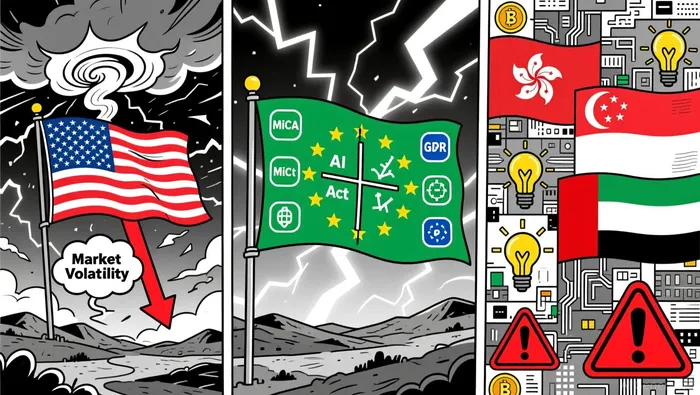
The global crypto regulatory landscape in 2025 has undergone a seismic shift, marked by both tightening frameworks and strategic rollbacks. These changes, while often framed as efforts to foster innovation or reduce bureaucratic burdens, have introduced new layers of complexity for traditional investors. As institutional participation in digital assets grows, so too does the exposure of conventional portfolios to crypto's inherent volatility. This article examines how regulatory rollbacks in key jurisdictions-particularly the United States, the European Union, and the Asia-Pacific region-have amplified market instability and reshaped risk profiles for traditional investors.
The U.S. Dilemma: Clarity or Chaos?
The Trump administration's executive order of January 23, 2025, and the subsequent passage of the CLARITY Act represent a deliberate pivot toward deregulation in the U.S. crypto sector. By categorizing crypto assets into distinct regulatory buckets-digital commodities, investment contracts, and stablecoins-the CLARITY Act aimed to resolve jurisdictional conflicts between the SEC and CFTC. While this legislative clarity has encouraged banks to enter the crypto custody space and hedge funds to increase digital asset allocations, it has also created a paradox: regulatory certainty in one domain often masks systemic fragility in another.
For instance, the rescission of SEC Staff Accounting Bulletin 121-a rule that previously barred banks from offering crypto custody services-has led to a surge in institutional participation. Over 55% of traditional hedge funds now hold digital assets, up from 47% in 2024. However, this influx of capital has not eliminated volatility. A case in point is the October 2025 market crash, triggered by a confluence of geopolitical tensions and regulatory uncertainty in Asia. The crash saw cascading liquidations and thinning order books, underscoring how even well-capitalized institutions remain vulnerable to crypto's liquidity risks.
The EU's Double-Edged Sword: MiCA and the Rollback of Digital Protections
The European Union's Markets in Crypto-Assets (MiCA) regulation, fully implemented by December 2024, initially appeared to stabilize the region's crypto markets. By mandating 53 licenses for stablecoin issuers and crypto-asset service providers, MiCA sought to enhance transparency and consumer protection. Yet, the EU's broader "digital omnibus" initiative-intended to streamline regulations-has sparked controversy. Proposed rollbacks to the AI Act and GDPR, which would allow AI training on personal data without explicit consent and reduce cookie consent prompts, have raised alarms about privacy erosion.
These changes, coupled with the EU's Digital Operational Resilience Act (DORA), have created a fragmented regulatory environment. While MiCA has driven institutional adoption-EU-based crypto businesses achieved 65% compliance by Q1 2025-market volatility persists. For example, abnormal price swings were observed around key MiCA milestones, such as its publication in the EU Official Journal. Traditional investors, now more exposed to crypto due to MiCA's investor protections, face a dilemma: regulatory harmonization in one area may inadvertently fuel instability in another.
Asia-Pacific: A Patchwork of Innovation and Risk
The Asia-Pacific region has emerged as a battleground for crypto regulation, with countries like Hong Kong, Singapore, and the UAE introducing stringent yet innovation-friendly frameworks. Hong Kong's Stablecoins Ordinance, effective August 1, 2025, mandates full asset-backed reserves for stablecoin issuers, while Singapore's FIMA Act expanded MAS's oversight of crypto-derivatives. These measures have attracted institutional capital, but they have also exposed traditional investors to jurisdictional arbitrage.
For example, regulatory divergence has led EU-based DeFi traders to migrate to offshore platforms in Switzerland and the UAE, where decentralization is less constrained. Meanwhile, Japan's crackdown on insider trading and South Korea's penalties for non-compliant exchanges have introduced abrupt market corrections. The October 2025 sell-off, which saw Asian markets bear the brunt of the downturn, highlights how fragmented regulations can amplify contagion risks. Traditional investors, now more reliant on cross-border crypto exposure, must navigate a labyrinth of conflicting rules and enforcement priorities.
The Growing Exposure of Traditional Investors
The data is unequivocal: traditional investors are increasingly entangled in crypto's volatility. Over 55% of hedge funds now allocate capital to digital assets, with 47% citing regulatory clarity as a key driver. However, this exposure is not without cost. Cybersecurity threats, compliance challenges, and the lack of standardized insurance products have forced institutions to adopt novel risk management strategies. For example, banks offering crypto custody services have had to develop bespoke insurance solutions to mitigate the risks of hacks or regulatory penalties.
The October 2025 liquidity crisis further illustrates this vulnerability. As Asian markets grappled with regulatory rollbacks and geopolitical tensions, traditional investors faced margin calls and forced liquidations. The incident underscored a critical truth: regulatory rollbacks, while intended to spur innovation, often outpace the development of risk mitigation tools.
Conclusion: Navigating the New Normal
The 2025 regulatory landscape has created a paradox: while clearer rules have lowered entry barriers for traditional investors, they have also amplified systemic risks. The U.S. CLARITY Act, EU MiCA, and Asia-Pacific's patchwork of regulations have all contributed to a market where volatility is not just a byproduct of speculation but a structural feature. For traditional investors, the path forward lies in balancing innovation with caution-leveraging regulatory clarity to access new opportunities while hedging against the instability that rollbacks inevitably introduce.
As the crypto sector matures, the challenge will be to align regulatory frameworks with the realities of a globally interconnected market. Until then, traditional investors must remain vigilant, recognizing that the very policies designed to foster growth may also be the source of their greatest risks.







Comentarios
Aún no hay comentarios