
Crypto Regulatory Evolution and Market Stability: How U.S. Clarity Paves the Way for Institutional Capital
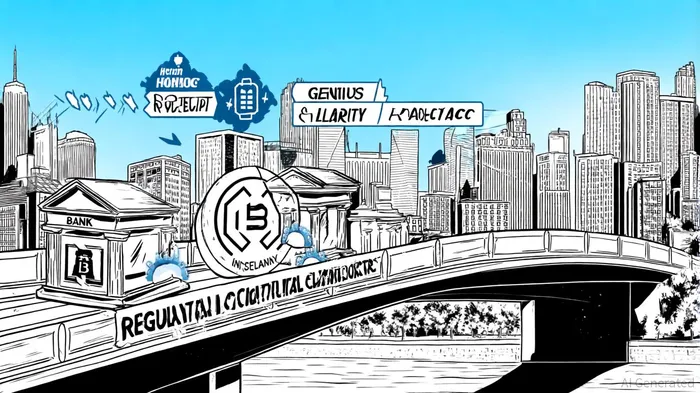
The U.S. crypto landscape in 2025 is undergoing a seismic shift. For years, institutional investors hesitated to allocate capital to crypto markets due to regulatory ambiguity. Now, a confluence of legislative and regulatory advancements—most notably the GENIUS Act, the CLARITY Act, and the SEC's Project Crypto—is dismantling barriers and creating a foundation for institutional participation. These developments are not just incremental; they represent a paradigm shift toward a technology-neutral, market-friendly framework that balances innovation with investor protection.
The Genesis of Clarity: GENIUS and CLARITY
The GENIUS Act, signed into law in 2025, has redefined the regulatory status of payment stablecoins. By explicitly excluding them from the definitions of “security” and “commodity,” the act has provided a clear legal pathway for stablecoins to function as a medium of exchange while imposing reserve requirements and anti-money laundering (AML) compliance standards. This clarity addresses a critical pain point for institutional investors, who previously avoided stablecoins due to fears of regulatory overreach or sudden reclassification.
Complementing this, the CLARITY Act—which passed the House and is now under Senate review—seeks to categorize digital assets into three distinct classes: digital commodities, digital asset securities, and permitted payment stablecoins. This tripartite framework ensures that the SEC and CFTC have clear jurisdictional boundaries, reducing the risk of overlapping or conflicting regulations. For institutions, this means a predictable compliance environment, where the rules of engagement are no longer subject to interpretation.
Project Crypto: Modernizing Securities Law for the Digital Age
The SEC's Project Crypto initiative is another cornerstone of this regulatory evolution. Launched to modernize securities regulations, the project aims to tailor the Howey test—a framework for determining whether an asset qualifies as an “investment contract”—to the unique characteristics of crypto assets. By doing so, the SEC is moving away from a one-size-fits-all approach and toward a nuanced understanding of crypto's economic and technological properties.
A key component of Project Crypto is the introduction of in-kind creation and redemption mechanisms for crypto ETPs (exchange-traded products). This innovation reduces the cost and complexity of creating ETPs, making them more accessible to institutional investors. For example, a hedge fund can now directly deposit BitcoinBTC-- into an ETP provider without converting it to fiat, preserving liquidity and minimizing transaction costs. Such efficiency gains are critical for scaling institutional adoption.
The Institutional Imperative: Why Clarity Drives Capital
Regulatory clarity is the linchpin for institutional capital flows. Institutions are risk-averse by nature, and the absence of clear rules has historically made crypto a “too big to fail, too small to matter” asset class. Now, with frameworks like the GENIUS and CLARITY Acts, the playing field is leveling.
Consider the implications of defined reserve requirements for stablecoins. Institutions can now assess the solvency and stability of stablecoins with greater confidence, reducing the risk of “black swan” events like the 2022 collapse of major stablecoins. Similarly, the SEC's Crypto Task Force, led by Commissioner Hester Peirce, is actively engaging with market participants to craft tailored disclosure frameworks. This collaborative approach signals to institutions that regulators are not merely policing the space but co-creating solutions with industry stakeholders.
State Regulators: The Unseen Pillar of Stability
While federal efforts dominate headlines, state regulators are also playing a pivotal role. The North American Securities Administrators Association (NASAA) has advocated for preserving state antifraud enforcement authority, ensuring that federal regulations do not erode local oversight. This dual-layered approach—federal clarity paired with state-level enforcement—creates a robust ecosystem where innovation can thrive without sacrificing investor protection.
The Road Ahead: From Frameworks to Flows
Despite these advancements, the ultimate test lies in execution. The GENIUS Act's reserve requirements must be rigorously enforced, and the CLARITY Act's classification system must be applied consistently. Institutions will watch closely for signs of regulatory stability, such as the SEC's finalization of in-kind ETP rules or the CFTC's guidance on digital commodity trading.
For now, the market is responding with cautious optimism. While direct data on institutional inflows post-2025 regulations remains scarce (likely due to the nascent stage of these laws), the structural conditions for capital flows are undeniably improving. As one industry analyst noted, “The U.S. is finally building a crypto regulatory framework that mirrors the transparency and accountability of traditional markets—this is the bridge to mainstream adoption.”
Conclusion
The U.S. is at an inflection point in its crypto journey. By prioritizing clarity over control, regulators are unlocking the door for institutional capital—a force that could transform crypto from a speculative niche into a cornerstone of global finance. The question is no longer if institutions will enter, but how quickly they will once the frameworks are fully operationalized.
Source:
[1] Mid-Summer Developments in Crypto Legislation and..., [https://www.chapman.com/publication-mid-summer-developments-in-crypto-legislation-and-regulatory-guidance]
[2] 2025 regulatory preview: Understanding the new US..., [https://www.statestreet.com/us/en/insights/digital-digest-march-2025-digital-assets-ai-regulation]
[3] State Securities Regulators Stake a Claim in Crypto Asset Markets | Insights | Sidley Austin LLP, [https://www.sidley.com/en/insights/newsupdates/2025/08/state-securities-regulators-stake-a-claim-in-crypto-asset-markets]
[4] Mid-Summer Developments in Crypto Legislation and..., [https://www.chapman.com/publication-mid-summer-developments-in-crypto-legislation-and-regulatory-guidance]
[5] Crypto Task Force, [https://www.sec.gov/about/crypto-task-force]
[6] SEC and CFTC Launch Crypto Initiatives to Revamp..., [https://www.fintechanddigitalassets.com/2025/08/sec-and-cftc-launch-crypto-initiatives-to-revamp-regulations-and-promote-innovation/]






Comentarios
Aún no hay comentarios