
Crypto Regulatory Convergence and Market Stability: Strategic Investment in Firms Benefiting from Unified Oversight
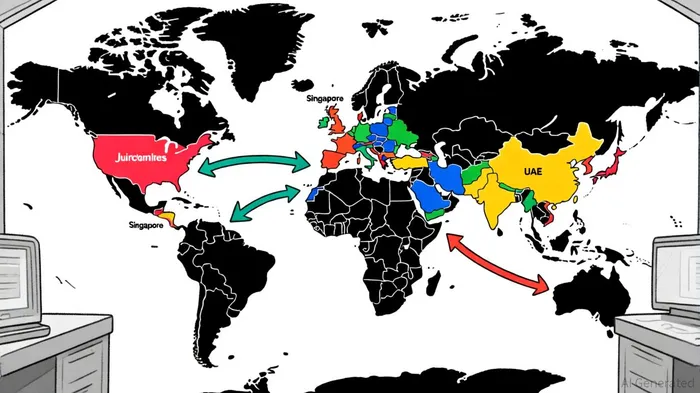
The crypto industry is undergoing a seismic shift as regulatory frameworks converge globally, reshaping market dynamics and investor priorities. The U.S. GENIUS Act and the European Union's MiCA regulation, enacted in 2025, have established a unified approach to stablecoin oversight, AML/KYC compliance, and cross-border operational standards. These frameworks are not merely bureaucratic hurdles but catalysts for a more stable, transparent, and institutional-grade crypto ecosystem. For investors, this convergence creates clear winners: firms that align with regulatory expectations, leverage compliance as a competitive edge, and capitalize on the influx of institutional capital.
Stablecoin Issuers: Circle and JPMorgan Lead the Charge
The GENIUS Act and MiCA have redefined stablecoins as regulated financial instruments, mandating 1:1 reserve backing and bankruptcy-protected structures. This has elevated compliance-focused issuers like Circle and Coinbase to dominant positions. Circle's USDCUSDC-- surged in market share after the GENIUS Act's passage, with its stock climbing 126% in the following month as transparency and reserve audits became non-negotiable for institutional adoption [5]. Similarly, Coinbase's stock rose 17% post-GENIUS Act, reflecting investor confidence in its regulated infrastructure [5].
Traditional financial giants are also entering the space. JPMorgan and Amazon are exploring stablecoin issuance for cross-border payments, leveraging their existing compliance frameworks to meet MiCA and GENIUS Act requirements [3]. Conversely, non-compliant players like Tether face existential risks. Its lack of transparency under the new rules has eroded trust, with regulators threatening delisting in the EU and U.S. [5]. This regulatory-driven consolidation favors firms that prioritize transparency, positioning stablecoin issuance as a high-margin, institutional-grade asset class.
Compliance-Focused Exchanges: A New Era of Institutional Access
Crypto exchanges are now gatekeepers of regulatory compliance. The GENIUS Act restricts access for non-compliant issuers, while MiCA's passporting system allows EU-licensed exchanges to operate across member states [1]. This has elevated platforms like Coinbase and Kraken, which have invested heavily in compliance infrastructure. For example, Coinbase's adherence to MiCA's whitepaper and licensing requirements has enabled it to expand into EU markets without redundant regulatory hurdles [4].
The U.S. SEC and CFTC's Joint Statement on spot crypto products, issued in Q3 2025, further solidified institutional participation by clarifying listing rules [2]. This has spurred the launch of crypto-backed ETFs and increased liquidity, with Bitcoin's Q3 2025 uptrend partly attributed to regulatory clarity [4]. Smaller exchanges lacking compliance resources, however, face obsolescence, accelerating market concentration among well-capitalized players.
AML/KYC Providers: The Unsung Heroes of Regulatory Convergence
As compliance becomes a baseline requirement, AML/KYC technology providers are experiencing explosive demand. The GENIUS Act's mandate for stablecoin issuers to operate under the Bank Secrecy Act has created a $2 billion market for compliance tools [1]. Firms like KYC-Chain and Shufti Pro are leading the charge. KYC-Chain's blockchain analytics and real-time sanctions screening have become essential for exchanges navigating MiCA and GENIUS Act obligations [4]. Shufti Pro's AI-driven identity verification, supporting 2,500 ID types and biometric checks, is now a standard for global onboarding [3].
The Financial Action Task Force's (FATF) updated guidelines on beneficial ownership transparency have further amplified demand for advanced solutions. LemonWay and KyrosAML are capitalizing on this, with LemonWay's OCR technology streamlining KYC processes and KyrosAML's AI-powered alerts enabling real-time compliance [3][6]. These providers are not just compliance tools but strategic assets for crypto platforms aiming to scale in a regulated world.
Conclusion: Investing in the New Crypto Normal
The convergence of global crypto regulations is not a temporary trend but a structural shift. Investors should prioritize firms that align with this new normal:
1. Stablecoin issuers with transparent reserves and institutional partnerships (e.g., CircleCRCL--, JPMorgan).
2. Compliance-focused exchanges with cross-border licensing capabilities (e.g., CoinbaseCOIN--, Kraken).
3. AML/KYC providers with AI-native solutions and global reach (e.g., KYC-Chain, Shufti Pro).
While regulatory complexity persists in Asia and the U.S.-EU enforcement differences, the overall trajectory is toward stability. As institutional capital flows into compliant ecosystems, early adopters of these frameworks will outperform peers, turning regulatory convergence into a tailwind for long-term value creation.







Comentarios
Aún no hay comentarios