
U.S. Crypto Regulation and the Geopolitical Shift: Why Global Capital Is Fleeing to Blockchain-Friendly Jurisdictions
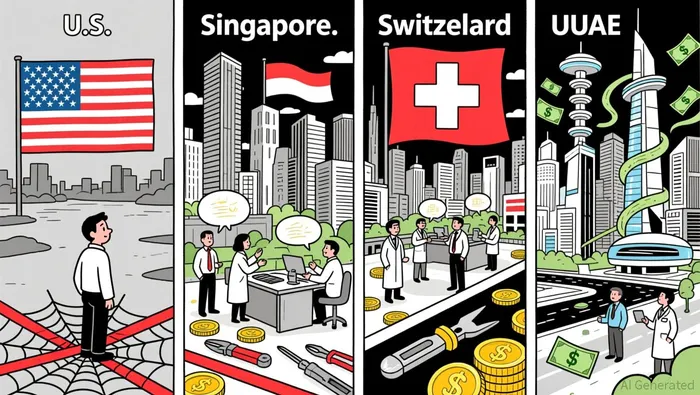
The United States has long positioned itself as a global leader in technological innovation, yet its approach to regulating crypto assets has created a paradox: while bipartisan efforts to clarify digital asset frameworks have gained momentum, political entanglements and regulatory uncertainty continue to erode the nation's competitive edge. From 2023 to 2025, the U.S. has seen a surge in legislative activity, including the CLARITY Act and the GENIUS Act, which aim to harmonize jurisdictional disputes between the SEC and CFTC and establish stablecoin frameworks. However, these efforts have been accompanied by enforcement-driven strategies, overlapping regulatory mandates, and a legacy of ambiguity that has driven capital and innovation to more stable jurisdictions. As global markets increasingly prioritize clarity and innovation-friendly policies, the U.S. risks ceding its leadership role in the crypto economy to jurisdictions like Singapore, Switzerland, and the UAE.
Bipartisan Momentum and the Illusion of Clarity
The U.S. has made strides in creating a unified regulatory framework for crypto assets, with bipartisan support for legislative clarity. The Senate Agriculture Committee's 2025 discussion draft, for instance, granted the CFTC exclusive authority over spot digital commodity markets, requiring brokers and custodians to adhere to market-integrity standards like asset segregation and cybersecurity protocols. Meanwhile, the House's CLARITY Act sought to categorize digital assets into distinct classes-digital commodities, investment contracts, and permitted payment stablecoins-to resolve jurisdictional disputes. These efforts reflect a growing consensus on the need for a structured approach to digital assets, particularly as the SEC's enforcement-driven strategy under Chair Gary Gensler had previously caused market volatility, with asset returns plummeting by up to 12% following regulatory announcements.
However, the illusion of clarity persists. While the CLARITY Act and GENIUS Act have introduced foundational frameworks, overlapping responsibilities between agencies and unclear definitions of tokens continue to create friction. For example, the SEC's Project Crypto initiative, under Chair Paul Atkins, hinted at an "innovation exception" to securities laws in 2026, but such exceptions remain unimplemented. Similarly, the Trump administration's 2025 executive order emphasized responsible innovation but also underscored the U.S. dollar's sovereignty, potentially limiting the adoption of decentralized models. These contradictions highlight the tension between regulatory caution and the need to foster innovation-a tension that international competitors are exploiting.
Industry Self-Censorship and the Cost of Uncertainty
The U.S. crypto sector has experienced a wave of self-censorship driven by regulatory ambiguity. Prior to the 2025 legislative breakthroughs, companies operated in a de facto self-regulatory environment, avoiding high-risk innovations to mitigate enforcement exposure. Even after the CLARITY Act's passage, challenges remain: overlapping jurisdiction, unclear token classifications, and the SEC's enforcement-heavy legacy continue to stifle creativity. For instance, while the IRS's 2025 safe harbor for staking crypto in trusts provided some relief, innovators still face compliance costs that deter experimentation.
This self-censorship has had tangible economic consequences. A 2025 report by the World Federation of Exchanges warned that overly broad regulatory exemptions could distort competition and dilute investor protections. Meanwhile, tokenized assets under management grew to $3.5 billion in 2025, but this growth was concentrated in jurisdictions with clear frameworks, such as the EU and Singapore. The U.S. has not fully capitalized on this trend, as its regulatory environment remains fragmented compared to the EU's MiCA or Singapore's MAS.
Capital Migration and the Rise of Global Competitors
The most significant geopolitical implication of U.S. regulatory uncertainty is the migration of crypto capital and talent to more stable jurisdictions. From 2023 to 2025, Singapore, Switzerland, and the UAE emerged as crypto-friendly hubs, offering tax incentives, clear regulatory frameworks, and innovation-friendly policies. For example, Singapore's MAS introduced a Stablecoin Issuance Framework and clear rules for digital asset service providers, while the UAE's VARA offered zero taxes on crypto trading, staking, and mining. Switzerland's Zug, or "Crypto Valley," further solidified its reputation with favorable tax policies and a thriving blockchain ecosystem.
Domestically, U.S. blockchain businesses have also migrated to crypto-friendly states like Wyoming, Texas, and Florida. Wyoming's recognition of DAOs and exemptions from money transmission regulations, combined with Texas's tax abatements for crypto mining, has attracted entrepreneurs seeking regulatory clarity. However, these domestic shifts pale in comparison to the global exodus. By 2025, global crypto ownership surpassed 580 million people, with a significant portion of this growth occurring in jurisdictions outside the U.S.
Strategic Investment in International Blockchain-Friendly Markets
For investors, the migration of capital to pro-blockchain jurisdictions presents a clear opportunity. Singapore's MAS framework, for instance, has attracted over 650 blockchain companies to the DMCC Crypto Centre in Dubai, while Switzerland's Zug hosts a growing number of tokenized asset platforms. These markets offer not only regulatory clarity but also infrastructure and talent pools that are critical for scaling innovation.
Investors should also consider the geopolitical implications of this shift. The U.S. and UK's Transatlantic Taskforce for Markets of the Future aims to address cross-border regulatory gaps, but international competitors are moving faster. The EU's MiCA, despite implementation challenges, has already created a unified market for digital assets, while Singapore's MAS and the UAE's VARA are setting global benchmarks. By investing in these jurisdictions, stakeholders can hedge against U.S. regulatory stagnation and position themselves at the forefront of the next wave of blockchain innovation.
Conclusion: The Path Forward
The U.S. remains a critical player in the global crypto economy, but its regulatory approach must evolve to retain leadership. While bipartisan efforts like the CLARITY and GENIUS Acts have laid a foundation, political entanglements and enforcement-driven strategies continue to erode confidence. As global competitors offer clearer frameworks and innovation-friendly policies, the U.S. risks losing its edge. For investors, the message is clear: strategic capital must flow to jurisdictions that prioritize regulatory clarity, tax incentives, and technological sovereignty. The future of crypto is not confined to any one nation-it belongs to those who can adapt.







Comentarios
Aún no hay comentarios