
U.S. Crypto Policy Shifts and Market Implications: Strategic Opportunities in Regulated Crypto Assets
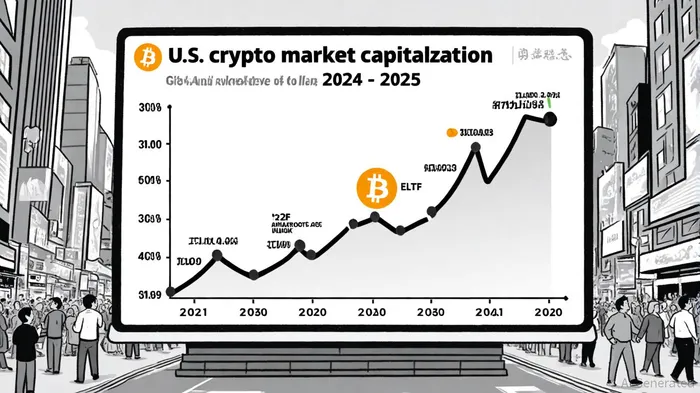
The U.S. cryptocurrency landscape is undergoing a seismic transformation. Under the Trump administration, regulatory clarity has emerged as a cornerstone of policy, reshaping the market's trajectory and unlocking strategic opportunities for investors. From the dissolution of the SEC's aggressive enforcement stance to the creation of a federal framework prioritizing innovation, the 2024–2025 policy shifts are redefining the rules of the game. For those who understand the nuances of these changes, the path to capitalizing on regulated crypto assets is clearer than ever.
A New Era of Regulatory Clarity
President Trump's January 23, 2025, Executive Order 14178, “Strengthening American Leadership in Digital Financial Technology,” marks a pivotal departure from the regulatory ambiguity that stifled growth for years. By establishing the President's Working Group on Digital AssetDAAQ-- Markets—led by David Sacks—the administration has signaled its intent to create a unified, pro-innovation framework. This group's mandate includes rescinding outdated regulations and proposing a system that assigns the CFTC authority over non-security tokens while retaining SEC oversight for securities [1].
Simultaneously, the SEC's Crypto Task Force, under Hester Peirce, has shifted from enforcement to clarity. Notable examples include the dismissal of charges against CoinbaseCOIN--, RobinhoodHOOD--, and OpenSea, as well as the reclassification of meme coins as non-securities [2]. These moves reflect a broader strategy to attract institutional capital by reducing legal uncertainty. As Brian Armstrong of Coinbase noted, “Regulatory clarity is the missing piece for global crypto adoption,” and the U.S. is now positioning itself as the standard-bearer [5].
Market Implications: From Volatility to Institutional Adoption
The 2024–2025 bull run, fueled by BitcoinBTC-- ETF approvals and a surge in institutional interest, has already demonstrated the market's potential under a stable regulatory environment. According to a report by TRM Labs, global crypto adoption increased by 40% in 2024, with U.S.-based platforms capturing a significant share of this growth [1]. The approval of spot Bitcoin ETFs alone drove a $1.2 trillion increase in crypto market capitalization, validating the asset class's mainstream appeal [3].
For investors, this environment creates opportunities in three key areas:
1. Stablecoins and CBDC Alternatives: The GENIUS Act's support for U.S. dollar-backed stablecoins, while banning federal CBDCs, positions stablecoins as a critical infrastructure layer. Platforms like CircleCRCL-- and Paxos stand to benefit from increased demand for programmable money.
2. Crypto Lending and Staking: With the SEC's Task Force clarifying the regulatory status of staking and lending, platforms like BlockFi and Celsius Network are poised for a resurgence. The closure of the SEC's OpenSea investigation also signals a green light for NFT-based lending protocols.
3. Institutional Infrastructure: The modernization of banking regulations—such as aligning capital rules with actual risk exposure—will enable traditional financial institutionsFISI-- to integrate crypto services. Firms like Fidelity and Grayscale are already expanding their offerings to meet this demand.
Navigating Legal Uncertainty: The Role of Court Cases
While the regulatory environment is improving, legal battles like SEC v. Ripple and SEC v. Coinbase will continue to shape the market. These cases are not just about enforcement; they are about defining the boundaries of securities law in the digital age. As Katten Muchin's 2025 report notes, the outcomes of these cases could determine whether tokens are classified as securities, commodities, or a new asset class altogether [4]. Investors must monitor these developments closely, as rulings could trigger short-term volatility but ultimately lead to long-term stability.
Global Context: The U.S. as a Crypto Hub
The U.S. is not alone in its regulatory evolution. Countries like Argentina and Brazil have introduced crypto-friendly policies, while others, such as China and Russia, have accelerated CBDC development [2]. However, the U.S. advantage lies in its ability to balance innovation with consumer protection. By avoiding the pitfalls of overregulation, the country is attracting global talent and capital. As the World Economic Forum highlighted in its 2025 Davos session, “The U.S. is now the de facto leader in shaping the future of digital finance” [5].
Conclusion: Positioning for the Future
The 2024–2025 policy shifts are more than bureaucratic adjustments—they are a foundation for sustained growth. For investors, the key is to focus on regulated assets that align with the new framework. Stablecoins, institutional infrastructure, and staking protocols are no longer speculative bets; they are strategic plays in a market primed for mainstream adoption. As the dust settles on enforcement actions and court cases, the U.S. is proving that crypto can coexist with a robust regulatory environment. The question is no longer if crypto will matter—it's how quickly investors can adapt to the new reality.





Comentarios
Aún no hay comentarios