
Why Crypto Is Missing Out on Global Liquidity Booms: A Structural Shift in Capital Allocation?
Macroeconomic Divergence and the Fed's Shadow Over Crypto
Central bank policies have diverged sharply since 2023, creating uneven investment landscapes. The U.S. Federal Reserve's aggressive monetary expansion-marked by low real interest rates and a ballooning monetary base-has historically favored high-risk assets like cryptocurrencies. Studies confirm this dynamic, according to an MDPI study an MDPI study. However, this relationship is now fraying.
Institutional investors, once drawn to crypto's volatility as a hedge against inflation, are recalibrating. For example, CBRE Group-a real estate giant-paused its share repurchase program in Q3 2025 to prioritize M&A and resilient business segments, as reported by a Simply Wall St report a Simply Wall St report. Similarly, Southwest Airlines allocated capital to global expansion and debt issuance rather than crypto exposure, according to another Simply Wall St report another Simply Wall St report. These moves reflect a broader trend: investors are favoring tangible assets with predictable cash flows over crypto's speculative allure.
Structural Barriers in Crypto Infrastructure
Improved custody solutions, such as KuCoin's partnership with Cactus Custody, have addressed some institutional concerns; this development was covered in a Cryptopolitan article a Cryptopolitan article. The Cactus Oasis framework allows $7.76 billion in daily trading volume while keeping assets in regulated, segregated custody, reducing counterparty risk and enhancing capital efficiency. Yet, these innovations have not translated into sustained inflows.
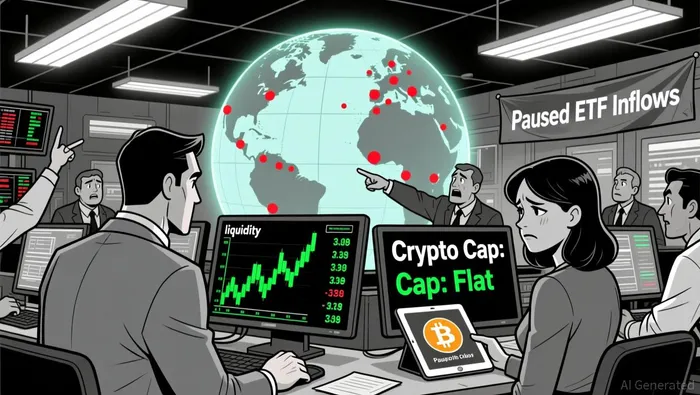
A key issue is capital flow dynamics. Despite global liquidity booms, crypto markets have seen stalled ETF inflows and muted investment activity, as noted in a Wintermute analysis a Wintermute analysis. Geopolitical events like the Russia–Ukraine war and Israel–Palestine conflict briefly boosted Bitcoin's trading volume, highlighting its role as a digital safe haven, according to a ScienceDirect study a ScienceDirect study. However, macroeconomic uncertainty and regulatory ambiguity continue to deter long-term commitments. For instance, Natural Health Trends-a wellness sector player-cut dividends and relocated manufacturing to Asia to preserve cash, illustrating how companies prioritize operational efficiency over speculative bets, as reported by Finimize a Finimize article.
The Role of Regional Divergence and Regulatory Hurdles
Macroeconomic divergence extends beyond monetary policy. While the U.S. and Europe grapple with inflation, emerging markets face capital outflows and currency instability. This fragmentation has led to asymmetric capital allocation, with investors favoring regional opportunities over global crypto exposure. For example, South Korean exchanges have seen user outflows, prompting institutions to seek localized solutions, as noted in the ScienceDirect study.
Regulatory headwinds further complicate crypto's appeal. Unlike traditional assets, cryptocurrencies lack a unified global framework, creating compliance risks. Even as KuCoin's Trust Project aims to rebuild trust through transparency (a point also discussed in the ScienceDirect study), institutional investors remain cautious. Wintermute has highlighted how shifts in global liquidity are outpacing crypto's ability to adapt, leaving the sector in a "structural limbo."
Conclusion: A Missed Opportunity or a Strategic Pause?
Crypto's underperformance relative to global liquidity booms underscores a structural shift in capital allocation. While improved infrastructure and custody solutions are critical, they alone cannot overcome macroeconomic fragmentation and institutional risk aversion. For crypto to reclaim its role as a liquidity beneficiary, it must address regulatory clarity, volatility, and alignment with macroeconomic cycles. Until then, investors will continue to favor assets with clearer value propositions-whether in real estate, aviation, or even dividend-cutting wellness firms.






Comentarios
Aún no hay comentarios