
Crypto Mining Deregulation and State-Level Energy Policy: Strategic Implications for U.S. Crypto Infrastructure Investment
New Hampshire's Legislative Deadlock: A Microcosm of Regulatory Fragmentation
New Hampshire's proposed HB 639 aims to eliminate local restrictions on crypto mining, prohibit taxes on digital assets, and establish a specialized blockchain docket in state courts. However, the bill has faced significant hurdles in the Senate Commerce Committee, where a 4-2 tie in late 2025 sent it for an interim study, delaying its progress until 2026, according to Markets.com. This delay reflects a broader national debate: while some states, like Texas and North Dakota, embrace crypto mining as a low-regulation, high-growth industry, according to a CNN report, others, such as New York, impose tiered excise taxes on energy consumption.
The New Hampshire case underscores how regulatory ambiguity can stifle investment. According to Markets.com, the bill has generated the largest volume of public feedback in the state legislature, with stakeholders ranging from environmental advocates to energy providers voicing concerns. This scrutiny has forced lawmakers to refine the bill's language, but the prolonged process leaves operators in limbo.
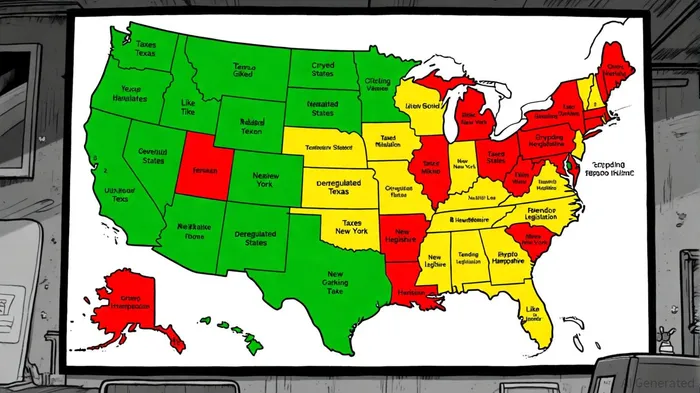
Energy Policy as a Double-Edged Sword
The energy source powering crypto mining operations is a pivotal factor in regulatory decisions. While the U.S. as a whole has seen a 5.8% annual increase in renewable energy adoption for mining, Markets.com reports, states with abundant fossil fuel resources-such as North Dakota and Wyoming-remain attractive due to low electricity costs. Conversely, states with strict environmental policies, like California, have imposed moratoriums on new mining operations, as reported by a CNN report.
New Hampshire's energy grid, which relies heavily on natural gas and nuclear power, complicates its position. HB 639 does not address energy consumption limits, leaving local municipalities to grapple with potential grid strain. This contrasts with New York's approach, where Senator Liz Krueger's tiered tax targets large-scale operations while sparing smaller ones. The divergence in strategies reflects a national struggle to balance economic growth with sustainability goals.
Capital Allocation Shifts: From Uncertainty to Strategic Reallocation
The regulatory uncertainty in New Hampshire and other states has directly influenced where capital flows. By 2025, Texas and Georgia accounted for over 60% of new U.S. crypto mining infrastructure investments, driven by their deregulated energy markets and access to stranded natural gas, a trend highlighted in the CNN piece. Companies like MARA HoldingsMARA-- have even pivoted to renewable energy, acquiring wind farms to power operations and reduce costs, according to the same CNN report.
Conversely, states with unresolved policy debates-like New Hampshire-see capital redirection. A 2025 analysis by FinancialContent noted that prolonged legislative delays, such as those surrounding the Responsible Financial Innovation Act (RFIA), pushed innovation offshore to jurisdictions like the EU's MiCA-compliant markets. While the U.S. has since enacted the GENIUS Act to stabilize the stablecoin sector, the earlier uncertainty left a lasting impact on infrastructure investment.
2026 Projections: Policy Clarity or Continued Stalemate?
Experts project that New Hampshire's HB 639 will resurface in 2026, with its eventual passage dependent on refining language to address environmental and grid stability concerns, Markets.com reports. If passed, the bill could position the state as a crypto-friendly jurisdiction, attracting operators displaced by New York's taxes or California's moratoriums. However, failure to resolve energy policy ambiguities may perpetuate capital flight to states with clearer frameworks.
The broader U.S. landscape also suggests a shift toward sustainability. By 2025, 54.5% of crypto mining operations utilized renewable energy, the CNN report finds, driven by both regulatory pressures and the economic advantages of low-cost renewables. This trend is likely to accelerate as federal agencies push for mandatory emissions disclosures, further aligning the industry with climate goals.
Conclusion: Navigating the Energy-Regulation Nexus
For investors, the key takeaway is clear: crypto mining infrastructure value is increasingly tied to the interplay of energy policy and regulatory clarity. States that harmonize low-cost energy access with sustainable practices-like Texas and Georgia-will dominate capital flows, while those mired in legislative delays risk falling behind. New Hampshire's 2026 policy outcome will be a litmus test for how effectively states can balance these competing priorities.
As the industry evolves, the winners will be those who can navigate the energy-regulation nexus with agility, leveraging both technological innovation and strategic policy engagement.





Comentarios
Aún no hay comentarios