
Crypto Miners' Strategic Pivot to Data Centers: A New Era of Institutional Viability
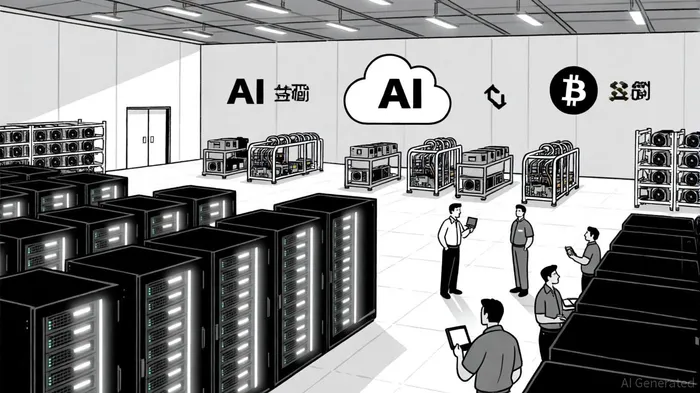
The cryptocurrency mining industry, once a speculative frontier, is undergoing a transformative shift. Faced with declining block rewards, regulatory uncertainty, and volatile energy costs, miners are repurposing their infrastructure into AI and high-performance computing (HPC) data centers. This pivot is not merely a survival tactic but a calculated move to align with the surging demand for compute-intensive workloads. Central to this transition is the strategic use of debt financing, which is enabling miners to scale infrastructure, secure long-term revenue streams, and attract institutional capital.
Strategic Infrastructure Diversification: Debt as a Catalyst
Bitcoin miners are leveraging their existing power-dense facilities and GPU expertise to enter the AI data center market. For instance, CoreWeave secured a $29 billion loan to expand its GPU-based infrastructure, positioning itself as a key player for AI giants like Microsoft and OpenAI [1]. Similarly, IREN Limited reported a 226% year-on-year revenue surge after integrating AI cloud services, while American Bitcoin launched a 50MW AI data center to capitalize on its energy infrastructure [5]. These examples highlight how debt financing allows miners to bypass the five-year lead time typically required for new data center development, leveraging pre-existing grid connections and cooling systems [3].
The shift is also driven by institutional demand. A 10-year, 168MW AI hosting agreement between Cipher Mining and Fluidstack, backed by a $1.4 billion Google guarantee, underscores the appeal of long-term contracts for revenue stability [4]. Such partnerships mitigate financial risks while aligning with the compute needs of AI startups and enterprises.
Institutional Investor Confidence: A Market Realignment
Institutional investors are increasingly viewing repurposed mining facilities as viable assets. A 2024 survey revealed that 97% of institutional investors plan to boost capital deployment in data centers, citing strong fundamentals and AI-driven demand [4]. This confidence is mirrored in the broader digital asset sector, where 83% of investors anticipate increased allocations to crypto-related innovations [3].
The debt-to-equity dynamics, however, tell a nuanced story. While some miners, like IREN, have turned to convertible debt (e.g., a $500 million offering) to balance flexibility and capital needs [6], others have shifted toward equity financing post-2022's crypto winter. By Q2 2024, miners raised $4.9 billion in equity—a 300% increase from prior quarters—reflecting a broader industry deleveraging [1]. This duality highlights the sector's maturation: debt remains a tool for aggressive expansion, while equity ensures resilience against market volatility.
Financial Strategies and Risks: Balancing Growth and Prudence
The pivot to data centers is not without challenges. Competing with industry giants like AWS and Microsoft, which control 63% of the cloud market, requires miners to innovate in cost efficiency and service differentiation [1]. Debt financing, while enabling rapid scaling, also demands careful risk management. For example, TeraWulf and Hut 8 have converted mining operations to HPC, achieving 25% stock gains year-to-date—outperforming traditional miners [2].
Innovative financing models, such as Bitcoin-backed loans and green bonds tied to energy efficiency, are emerging to address these risks. Developers are also adopting securitization packages and hybrid capital structures to optimize costs [5]. These strategies reflect a broader trend toward institutional-grade financial engineering, where sustainability and scalability are prioritized.
Long-Term Value Creation: Beyond the Hype
The long-term viability of this pivot hinges on three factors: sustainability, revenue diversification, and market positioning. Repurposed mining facilities often boast lower operational costs due to existing power infrastructure, making them ideal for energy-intensive AI workloads [3]. Additionally, the shift aligns with global trends like “AI factories”—specialized data centers for training large models—positioning miners as critical infrastructure providers [4].
From an environmental perspective, the reuse of mining hardware and facilities reduces e-waste and energy waste, enhancing ESG credentials [3]. This is particularly appealing to institutional investors prioritizing green finance.
Conclusion: A New Era of Institutional Viability
The transition from crypto mining to data centers marks a pivotal moment for the industry. By leveraging debt financing to scale infrastructure, secure institutional partnerships, and diversify revenue streams, miners are transforming into resilient, multi-use infrastructure providers. While challenges remain—ranging from competition to regulatory scrutiny—the alignment with AI demand and institutional capital suggests a durable shift. For investors, this evolution offers a compelling case: a sector once defined by volatility is now building the backbone of the digital economy.







Comentarios
Aún no hay comentarios