
U.S. Crypto Market Weakness: What Coinbase's Prolonged Bitcoin Premium Index in Negative Territory Reveals About Capital Flight and Investor Sentiment
The U.S. crypto market has entered a period of pronounced weakness, as evidenced by the CoinbaseCOIN-- BitcoinBTC-- Premium Index's sustained negative territory. This metric, which measures the price disparity between Bitcoin on Coinbase and the global average, has remained negative for 19 consecutive days as of January 2, 2026, hitting a low of -0.1092%. Such a prolonged negative trend is a critical signal for institutional capital flows and risk sentiment dynamics, reflecting a shift in investor behavior and capital allocation patterns.
Institutional Outflows and Risk-Off Dynamics
The negative premium index aligns with broader institutional outflows observed in Q4 2025. VanEck's mid-December ChainCheck report revealed that Bitcoin ETP investors reduced holdings by 1.308 million BTC during the period, signaling a retreat from crypto assets. This contrasts with Digital Asset Treasuries (DATs), which accumulated 42,000 BTC-the largest accumulation since July 2025-highlighting a divergence in institutional strategies. The sell-off by ETP investors suggests a risk-off posture, driven by macroeconomic uncertainties such as Federal Reserve policy shifts and geopolitical tensions, including Trump-era tariff announcements.
Meanwhile, Bitcoin's price action has increasingly mirrored traditional markets. In late 2025, its underperformance relative to the S&P 500 became stark: Bitcoin fell over three standard deviations from its 90-day average, while the S&P 500 declined by only one standard deviation.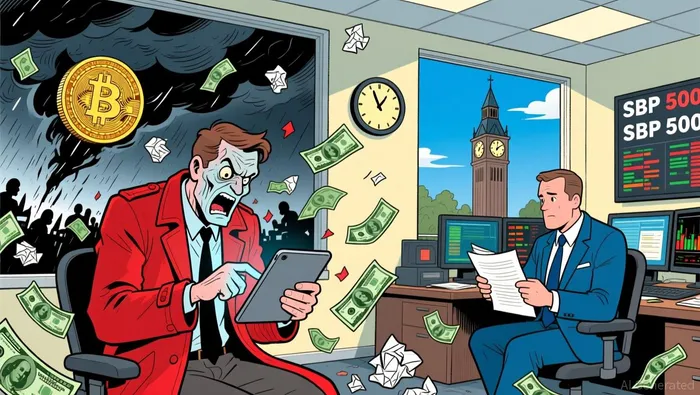 This divergence underscores a bifurcation in asset performance, with crypto investors prioritizing liquidity and safety amid macroeconomic volatility.
Capital Flight and Investor Sentiment
The negative premium index also reflects capital flight from the U.S. market. A negative value indicates weak buying pressure on Coinbase, where U.S. investors are offloading Bitcoin at a discount to global prices. This trend is exacerbated by reduced risk appetite, particularly among medium-term holders (1–5 years), who have begun selling tokens, while long-term holders (>5 years) remain stable. According to VanEck's analysis, such behavior suggests a shift in sentiment from speculative trading to defensive positioning.
However, institutional optimism persists. A Coinbase Institutional survey found that 67% of institutional investors anticipate a major Bitcoin rally within 3–6 months, driven by expectations of Fed rate cuts and the potential deployment of $7 trillion in money market funds into regulated BTC vehicles. This optimism contrasts with the short-term selling pressure, revealing a complex interplay between immediate risk-off dynamics and long-term bullish expectations.
Risk-On/Risk-Off Dynamics and Generational Shifts
The U.S. market's risk-off stance is further amplified by broader crypto market trends. Younger investors, as highlighted in the State of Crypto Q4 2025 report, are increasingly allocating capital to non-traditional assets like derivatives and NFTs, viewing crypto as a core part of their portfolios. This generational shift contrasts with institutional caution, creating a duality in market behavior: while older investors retreat, younger participants embrace innovation.
The negative premium index also signals miner capitulation, with Bitcoin's network hash rate declining by 4% in late 2025-a historically bullish contrarian signal. This suggests that while short-term selling pressure persists, the ecosystem's fundamentals remain resilient, supported by record non-empty wallet growth and institutional adoption. According to Santiment analysis, this resilience persists despite macroeconomic headwinds.
Conclusion: Navigating the Weakness
The prolonged negative Coinbase Bitcoin Premium Index is a multifaceted indicator of U.S. crypto market weakness. It reflects institutional outflows, risk-off dynamics, and capital flight, yet it also reveals underlying resilience and long-term optimism. As macroeconomic signals stabilize and Fed policy evolves, the market may see a reversal in sentiment, particularly if DATs continue to act as a demand anchor and money market funds reallocate capital. For now, however, the index serves as a stark reminder of the fragility of investor confidence in a volatile, macro-driven environment.





Comentarios
Aún no hay comentarios