
Crypto Market Volatility and Systemic Risk: Geopolitical Threats vs. Market Manipulation
The cryptocurrency market's volatility has long been a double-edged sword for investors. While its decentralized nature promises resilience, the interplay of geopolitical threats and market manipulation has created a landscape where systemic risk looms large. This article dissects the drivers of crypto devaluation between 2023 and 2025, analyzing whether geopolitical instability or human-driven market forces have had a more profound impact on asset prices.
Geopolitical Threats: A Macroeconomic Catalyst
Geopolitical events have historically acted as a wildcard in crypto markets. During the Russia-Ukraine war, for instance, BitcoinBTC-- initially plummeted but later rebounded as individuals in conflict zones turned to stablecoins like TetherUSDT-- to circumvent sanctions and preserve capital, according to an InsideCryptoCoins analysis. Similarly, the Israel-Hamas conflict in June 2025 triggered a $140 billion market cap decline, with Bitcoin falling below $103,000 as investors fled to safer assets, as reported by MarketClutch.
Studies reveal a non-linear relationship between geopolitical risk and crypto volatility. In normal times, cryptocurrencies appear uncorrelated with global tensions. However, during extreme events-such as trade wars or missile exchanges-volatility spikes sharply, mirroring patterns in stocks and bonds but diverging from traditional safe-haven assets like gold, according to a Taylor & Francis paper. For example, during the U.S.-China trade war, Bitcoin saw short-term surges as investors sought alternatives to traditional markets, yet its speculative nature led to rapid reversals when central banks raised interest rates, as detailed in a OneSafe analysis.
Economic sanctions further complicate the picture. In Iran and Argentina, cryptocurrencies became lifelines for individuals hedging against hyperinflation and financial isolation, as noted in a Stanford Economic Review article. Yet, regulatory responses to these events-such as U.S. Treasury sanctions on Russian crypto wallets-have amplified volatility. After sanctions were imposed in March 2022, Bitcoin dropped 8% in a single day, a decline also discussed in the OneSafe analysis.
Market Manipulation: The Invisible Hand
While geopolitical events create macroeconomic uncertainty, market manipulation-driven by regulatory actions, media sentiment, and speculative behavior-exerts a more immediate and often amplified effect on crypto prices.
Regulatory actions by the U.S. Securities and Exchange Commission (SEC) have been particularly impactful. Legal battles against exchanges like Ripple and Coinbase in 2023 triggered widespread sell-offs, with Bitcoin losing 12% of its value in a week, as outlined in an Altrady analysis. Conversely, pro-crypto policies-such as El Salvador's adoption of Bitcoin as legal tender-have spurred growth, illustrating how regulatory clarity can stabilize markets, a point also highlighted in the Stanford Economic Review article.
Media-driven sentiment also plays a critical role. Fear of Missing Out (FOMO) and Fear, Uncertainty, and Doubt (FUD) narratives amplify short-term price swings. For instance, delays in Bitcoin ETF approvals in early 2024 caused a 15% drop in Ethereum's price, despite no fundamental change in the asset's value, a dynamic discussed in the Altrady analysis. Similarly, the $19 billion liquidation event in 2023 was largely attributed to panic selling triggered by geopolitical tensions and regulatory FUD, as covered by MarketClutch.
Comparative Analysis: Which Factor Dominates?
Quantitative studies offer a nuanced view. While geopolitical events drive long-term adoption of cryptocurrencies as alternative financial tools, market manipulation often dictates short-term devaluation. For example, during the Russia-Ukraine war, crypto adoption surged in sanctioned economies, yet prices remained volatile due to regulatory uncertainty, as the InsideCryptoCoins analysis documents.
Traditional safe-haven assets like gold outperform cryptocurrencies in hedging geopolitical risk. Bitcoin's volatility-averaging 30–40% during crises-makes it less reliable than gold's 5–10% swings, as observed in the Taylor & Francis paper. However, crypto's borderless utility in crisis scenarios (e.g., Tether usage in Ukraine) underscores its unique role in decentralized finance, a theme explored by the Stanford Economic Review article.
Market manipulation, meanwhile, has a direct and immediate impact. The designation of Bitcoin as a commodity in early 2024 led to a 35–50% price increase over six months, while DeFi tokens collapsed under SEC scrutiny, a pattern described in the Altrady analysis. Regulatory clarity in the EU (via MiCA) further illustrates how policy can reshape market dynamics, with compliant tokens appreciating and unregulated ones declining-another point the Altrady analysis examines.
Conclusion: Navigating the Dual Forces
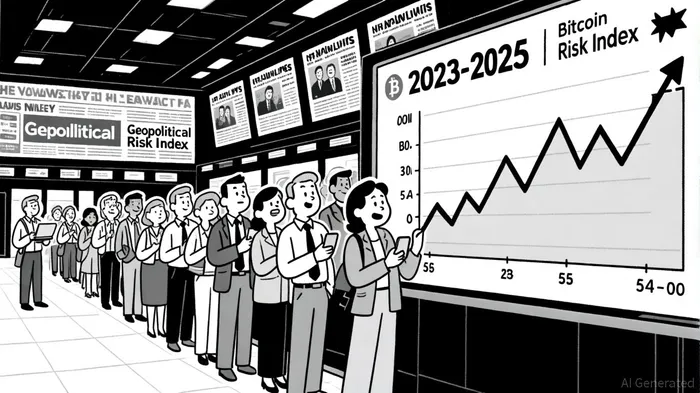
The crypto market's volatility stems from a dual interplay of geopolitical threats and market manipulation. Geopolitical events create structural shifts in adoption and utility, while regulatory actions and speculative behavior drive immediate price swings. Investors must monitor both geopolitical risk indices (GPR) and crypto-specific uncertainty metrics (UCRY) to anticipate market shifts, as noted in the Taylor & Francis paper.
As the market matures, the line between these forces will blur. For now, the lesson is clear: diversification and vigilance are key. Cryptocurrencies may not yet rival gold as a safe haven, but their role in a decentralized, crisis-resilient financial system is undeniable.







Comentarios
Aún no hay comentarios