
Crypto Market Volatility and Systemic Risk in 2025: Institutional Risk Management and Rebalancing Opportunities in a Post-Liquidation Environment
The 2025 crypto market has been defined by unprecedented volatility, with cascading liquidations exposing systemic vulnerabilities in leveraged trading ecosystems. A $1.5 billion liquidation wave in September 2025-triggered by overleveraged long positions, the NovaTrade security breach, and AxiomUSD's de-pegging-highlighted the fragility of interconnected DeFi-CeFi systems, according to a Wedbush report. This event, coupled with an August $161 million liquidation, underscored the risks of 100x leverage and self-reinforcing volatility cycles, according to a Bitget report. For institutional investors, these shocks have accelerated the adoption of robust risk management frameworks and rebalancing strategies to navigate a landscape where retail traders in the U.S. increased liquidation checks by 40% while Asian counterparts aggressively rebuilt exposure, according to CoinLaw data.
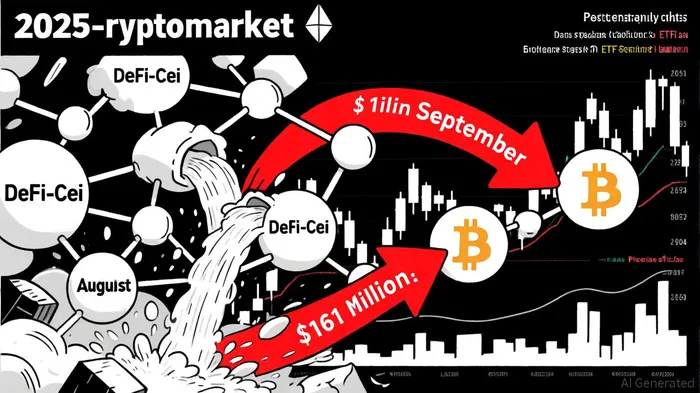
Systemic Risk: The Interconnectedness of DeFi and CeFi
The collapse of leveraged positions in EthereumETH-- and BitcoinBTC-- during 2025 revealed a critical flaw: the cross-market dependencies between DeFi and CeFi. Ethereum's dominance in DeFi deposits and its role as collateral for leveraged positions created a feedback loop where price declines in one ecosystem amplified losses in the other, as reported by Bitget. For instance, the $500 million wipeout of leveraged Ethereum positions in a single day demonstrated how liquidity crunches in perpetual futures markets could cascade into broader market instability, as documented by Wedbush.
Quantitative models like the GE CoVaR approach, which measures risk when assets exceed their Value-at-Risk thresholds, have become essential tools for institutions. These models identified Bitcoin and Ethereum as primary systemic risk "givers," while assets like SolanaSOL-- and Binance Coin emerged as "absorbers" during extreme volatility, according to the Wedbush analysis. Such insights are critical for rebalancing portfolios to mitigate tail risks.
Institutional Risk Management: From Frameworks to AI-Driven Tools
By 2025, 78% of global institutional investors had formal crypto risk management frameworks, up from 54% in 2023, according to CoinLaw data. These frameworks now prioritize three pillars:
1. Custodial Security: Institutions require full on-chain segregation of assets via dedicated wallets and off-chain ring-fenced accounts, reducing operational risks, as noted in the Wedbush report.
2. Counterparty Due Diligence: With 90% of institutional investors identifying counterparty risk as their top concern, contractual safeguards and insurance coverage have surged. In 2025, $6.7 billion in insurance policies were issued for crypto assets, a 52% year-on-year increase, according to CoinLaw data.
3. Regulatory Compliance: The EU's Markets in Crypto-Assets (MiCA) regulation has become a benchmark, aligning crypto service providers with traditional financial institutions and reducing systemic blind spots, per Wedbush.
AI-driven risk assessment tools, adopted by 60% of institutions by early 2025, now monitor intraday price movements and network-based dependencies in real time, according to CoinLaw data. For example, partial correlation-based networks isolate tail-specific transmission channels, enabling institutions to identify systemic risks during events like Bitcoin's halving cycle.
Rebalancing Strategies: Diversification and Inverse Instruments
Post-liquidation, institutions are pivoting toward stable strategies to hedge volatility. Inverse ETFs, which profit from declining crypto prices, have gained traction as a counterbalance to leveraged long positions, as reported by Bitget. Diversified collateral strategies-spreading risk across stablecoins, gold-backed tokens, and low-correlation assets-have also emerged as a defense against liquidity shocks, noted by Bitget.
Quantitative approaches further refine these strategies. High-frequency CoVaR models, for instance, allow institutions to dynamically adjust exposure based on real-time systemic risk metrics, a capability highlighted in the Wedbush analysis. Stress testing and scenario simulations, now standard practice, prepare portfolios for geopolitical shocks and environmental volatility, according to a Risk Insights Hub analysis.
The Road Ahead: Balancing Innovation and Caution
While the 2025 liquidations exposed vulnerabilities, they also catalyzed innovation. Institutions are now allocating 59% of their AUM to crypto, but with a focus on risk-adjusted returns, according to an SQ Magazine piece. Blockchain analytics tools, adopted by 35% of institutions, provide transparency into on-chain risks, while AI-driven interdependencies help model cross-asset contagion, per CoinLaw data.
For investors, the lesson is clear: in a market where $1.5 billion can vanish in days, resilience lies in proactive risk management and adaptive rebalancing. As one industry expert notes, "The 2025 crisis wasn't just a wake-up call-it was a blueprint for building systems that can withstand the next shock." as observed by Bitget.







Comentarios
Aún no hay comentarios