
Crypto Market Volatility: A Strategic Entry Point Amid $1 Billion in Liquidations
The cryptocurrency market in September 2025 has been a rollercoaster of volatility, with over $1.5 billion in leveraged positions liquidated within a single 24-hour period. BitcoinBTC--, EthereumETH--, and DogecoinDOGE-- all experienced sharp corrections, driven by cascading margin calls and excessive leverage in futures markets[1]. While these events have rattled short-term sentiment, they also present a compelling case for contrarian investors willing to navigate the turbulence.
Bitcoin: A Foundation of Resilience
Bitcoin's recent dip below $112,000—a 3% decline—has reignited debates about its long-term value proposition. Despite the selloff, Bitcoin remains up 77% year-to-date, underscoring its resilience amid macroeconomic headwinds[2]. Institutional adoption is a key driver here: the approval of multi-asset ETFs, including Grayscale's GDLC and BlackRock's offerings, has injected $524 million in daily inflows, absorbing selling pressure and signaling growing legitimacy in traditional finance[3].
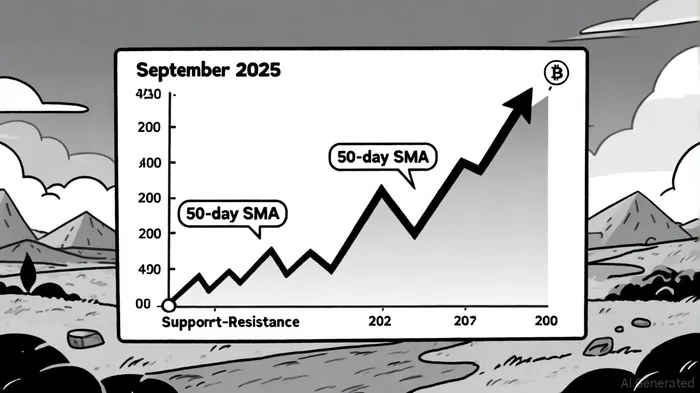
Technically, Bitcoin is testing critical support levels, including the 50-day moving average at $115,035. Historically, Bitcoin has led market recoveries, and its current position below this level suggests a potential rebound if institutional demand stabilizes[4]. Analysts like Standard Chartered and Bitwise have raised price targets to $200,000 by year-end, citing the post-halving supply shock and regulatory clarity as catalysts[5].
Ethereum: The Contrarian's Bet
Ethereum's 9% drop to $4,075 in late September has exposed its vulnerability to liquidation risks, with $8.8 billion in long positions at stake if prices fall below $4,046[1]. Yet, this volatility masks Ethereum's structural advantages. As the dominant platform for DeFi and Layer 2 solutions, Ethereum's decentralized infrastructure and robust developer ecosystem position it as a “contrarian bet” into 2025, according to Bitwise's Matt Hougan[2].
The Dencun upgrade, aimed at reducing transaction costs, has temporarily depressed network fees, but this is viewed as a short-term headwind rather than a fundamental flaw[4]. Ethereum's ability to retest key support levels—such as the $3,550–$3,750 range—could signal a consolidation phase before a potential rally in late 2025[6].
Dogecoin: Volatility as an Opportunity
Dogecoin's 10% slump to $0.2403 has drawn both skepticism and intrigue. While its price action is more erratic than Bitcoin or Ethereum, Dogecoin's alignment with the 50 EMA and retests of the $0.26 level suggest a possible breakout toward $1 or higher[3]. The approval of Grayscale's DOGE ETF (GDOG) has added institutional credibility, attracting speculative flows that could drive short-term gains[7].
However, Dogecoin's high long positioning and mixed whale activity necessitate caution. A breakdown below $0.1781 could trigger deeper corrections, making options trading or leveraged shorting viable strategies during overbought conditions (e.g., RSI above 70)[3].
Risk Management: The Contrarian's Edge
Contrarian investing in crypto demands discipline. Dollar-cost averaging, stop-loss orders, and portfolio diversification are critical to mitigating the risks of excessive leverage and panic selling[8]. For instance, Bitcoin's recent stabilization above $82,000—despite a 25% drop from January—demonstrates the importance of holding key support levels[5].
Institutional strategies, such as soft staking and exposure to DeFi and AI-driven protocols, offer additional avenues to balance volatility[3]. Meanwhile, macroeconomic factors—like the U.S. GENIUS Act's potential to formalize stablecoin rules—could further reduce regulatory uncertainty[1].
Conclusion: Navigating the Storm
The September 2025 liquidation events are not a crypto winter but a correction within a broader bull market cycle. For investors with a long-term horizon, Bitcoin's institutional adoption, Ethereum's foundational role in DeFi, and Dogecoin's speculative potential present strategic entry points. As always, the key lies in balancing optimism with risk management—a lesson the market has etched in blood this year.





Comentarios
Aún no hay comentarios