
Crypto Market Volatility and the Risks of Leverage in 2025: A Post-Liquidation Analysis
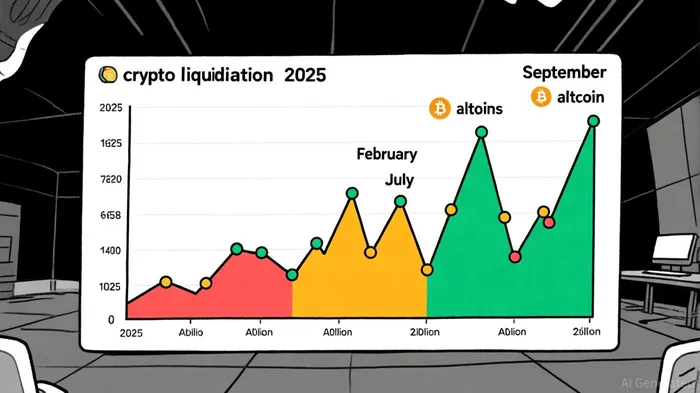
The cryptocurrency market in 2025 has been a case study in volatility, with mass liquidations reshaping investor strategies and testing the resilience of market infrastructure. According to data from OKX and Coinpedia, over $6.5 billion in leveraged positions were liquidated across key events in early 2025, with September's crash alone wiping out $1.65 billion in long positions, according to a Cointribune report. These events underscore the systemic risks of leverage in a market already prone to sharp corrections, while also revealing patterns that could inform more robust investment frameworks.
The 2025 Liquidation Cycle: Catalysts and Consequences
The year began with a geopolitical shockwave: U.S. President Donald Trump's announcement of sweeping trade tariffs in early February triggered a $2.2 billion liquidation wave, with 88% of losses attributed to overleveraged long positions, the Cointribune report noted. This was followed by a more nuanced reversal in April, where $600 million in short liquidations hinted at a tentative recovery, according to a Wedbush report. However, the most telling event came in September, when Ethereum's 12% price drop-amid fears of a U.S. government shutdown and a hawkish Federal Reserve-sparked the largest liquidation wave of the year, with $309 million in ETH-related losses alone, the Cointribune report added.
These events were not isolated. DeFi protocols and leveraged futures platforms bore the brunt of cascading liquidations, as margin calls triggered further selling, as reported by a Coinpedia report. The result was a self-reinforcing cycle: falling prices → forced liquidations → deeper price declines. By September 22, the total crypto market cap had fallen below $4 trillion, with BitcoinBTC-- dominance rising as investors fled riskier altcoins, the Wedbush report found.
Leverage: A Double-Edged Sword
Leverage, while a tool for amplifying gains, proved catastrophic in 2025's volatile environment. Gate.io data shows that leveraged futures positions accounted for 72% of liquidation volumes during major selloffs. This overreliance on borrowed capital created a fragile ecosystem where even moderate price swings could trigger systemic defaults. For example, the July 23 liquidation event-driven by XRPXRP-- and Ethereum-highlighted how altcoins, with their lower liquidity and higher volatility, are particularly susceptible to margin calls, as noted in a CapaLearning report.
The contrarian signal of liquidations also emerged as a key theme. As noted by CapaLearning, extreme liquidation volumes often precede market reversals, with April's short liquidations coinciding with a 15% rebound in Bitcoin's price, according to Gate.io data. However, this pattern is far from reliable, and retail investors who mistook panic selling for a buying opportunity often found themselves caught in further declines.
Investor Behavior and the Psychology of Fear
The 2025 liquidation cycle exposed deep fissures in investor psychology. The Crypto Fear & Greed Index, which had spent much of early 2025 in "Greed" territory, plummeted into "Extreme Fear" by September, reflecting a shift from speculative euphoria to risk aversion, the Wedbush report observed. Retail traders, particularly those using platforms like Bybit and Binance, faced margin calls that wiped out years of gains, while institutional players retreated to cash or Bitcoin as a "safe haven" within crypto.
This behavioral shift had lasting implications. Post-liquidation, Bitcoin's dominance rose to 58% from 42%, as investors prioritized liquidity and stability over speculative altcoins, the Wedbush report noted. Meanwhile, the DeFi sector, already reeling from regulatory scrutiny, saw a 30% drop in TVL (total value locked) as users withdrew funds to avoid further exposure, Coinpedia reported.
Market Stability and the Road Ahead
The 2025 liquidation events serve as a cautionary tale for market stability. While the crypto ecosystem has grown in size and sophistication, its reliance on leveraged positions and algorithmic trading models remains a vulnerability. The September crash, for instance, was exacerbated by automated liquidation bots, which executed trades at a speed and scale that human traders could not counter, the Cointribune report observed.
Looking ahead, the industry must grapple with two competing forces: the demand for higher returns through leverage and the need for systemic safeguards. As one analyst noted, "The 2025 liquidations were not just a technical failure-they were a failure of risk management," a point raised in the Wedbush coverage. This has already spurred a shift toward regulated custody solutions and lower-leverage products, but adoption remains uneven.
Conclusion: Lessons for 2026 and Beyond
The 2025 liquidation cycle is a microcosm of crypto's broader challenges. For investors, the takeaway is clear: leverage magnifies both gains and losses, and in a market where black swan events are routine, prudence often trumps ambition. For the industry, the path forward lies in balancing innovation with stability-whether through improved margin requirements, circuit breakers, or stricter oversight of DeFi protocols.
As the market digests these lessons, one thing is certain: the days of treating crypto as a "risk-free" leveraged play are over. The 2025 carnage has etched a new rule into the playbook-volatility is inevitable, but survival is optional.






Comentarios
Aún no hay comentarios