
Crypto Market Volatility and the Risks of Compounding Liquidation Events
The cryptocurrency market has long been a theater of extremes-volatility, leverage, and systemic fragility. However, the compounding liquidation events of 2025 have exposed a new era of risk, where macroeconomic pressures, geopolitical tensions, and structural vulnerabilities converge to create cascading collapses. For investors, understanding these dynamics is no longer optional; it is existential.
The Anatomy of 2025's Crashes
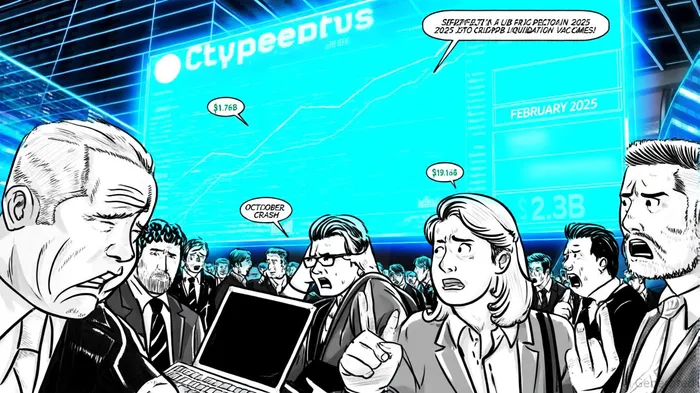
The October 2025 liquidation event—nicknamed "Black Saturday"—serves as a case study in compounding fragility. Triggered by former U.S. President Donald Trump's 100% tariff announcement on Chinese imports, the crash erased $19.16 billion in leveraged positions within 24 hours, surpassing even the FTX collapse in scale, according to ChainUp's analysis. BitcoinBTC-- plummeted below $110,000, while altcoins like SolanaSOL-- and CardanoADA-- lost 6–10% in hours, per Millionero's analysis. This was not an isolated shock but the culmination of pre-existing conditions: a 374% surge in Bitcoin's open interest since January 2025, excessive leverage in altcoin markets, and the unwinding of the yen carry trade, as noted by ChainUp's analysis.
Earlier in September 2025, a $1.7 billion liquidation event—driven by "triple witching" options expiries and rising Treasury yields—previewed the fragility, in a TalkMarkets article. These events highlight a critical insight: volatility is not the enemy; leverage is. As CoinDesk noted, "The crypto market's 24/7 nature and algorithmic trading infrastructure amplify forced liquidations into self-fulfilling prophecies."
Structural Vulnerabilities and Market Psychology
The October 2025 crash also revealed deeper structural flaws. On-chain data exposed a $1.1 billion short position opened minutes before the tariff announcement, raising suspicions of insider knowledge, as Millionero's analysis observed. Meanwhile, oracleADA-- mechanism failures caused stablecoins like USDeUSDe-- and wBETHWBETH-- to collapse on specific exchanges, exposing the market's susceptibility to targeted attacks, as CCN reported. These vulnerabilities are not theoretical—they are operational realities for leveraged traders.
Investor psychology further compounds the risk. As ChainUp's analysis shows, the 2025 liquidations were preceded by a "risk-on" environment where retail traders overextended bullish positions, creating a fragile equilibrium. When external shocks hit, the market's leverage acted as a multiplier, turning panic into a feedback loop.
Strategic Risk Management in a Fractured Market
For investors, the lesson is clear: position sizing, hedging, and liquidity management are non-negotiable. Here's how to navigate the new normal:
1. Leverage Discipline: Avoid over-leveraging in altcoins, where liquidity is thin. ChainUp's research underscores that altcoin liquidations during October 2025 were disproportionately severe due to low market depth.
2. Geopolitical Hedging: Given the market's sensitivity to trade wars, investors should diversify across fiat pairs and hedge against U.S. dollar strength. The yen carry trade's collapse in 2025 demonstrates how currency shifts can trigger cascading liquidations, as Millionero's analysis details.
3. Algorithmic Resilience: Use stop-loss orders and trailing stops to mitigate forced liquidations. CoinDesk's analysis of the September 2025 crash shows that automated margin calls exacerbated price declines.
4. Oracle and Stablecoin Caution: Avoid protocols reliant on centralized oracles. The October 2025 stablecoin collapses highlight the risks of assuming "stable" assets are immune to volatility, as CCN reported.
The Path Forward: Lessons from 2025
The October 2025 crash was a wake-up call. As ChainUp's post-mortem notes, "The market's reliance on leverage and its exposure to geopolitical triggers have created a system where small shocks can become existential crises." For institutional investors, this means treating crypto as a high-beta asset class with unique systemic risks. For retail traders, it means rethinking the "HODL" mentality in favor of dynamic risk management.
Conclusion
The 2025 liquidation events are not outliers but symptoms of a market still grappling with its own complexity. As volatility persists and geopolitical tensions escalate, investors must prioritize resilience over speculation. In crypto, as in life, the only constant is uncertainty—and those who fail to prepare will be the first to fall.






Comentarios
Aún no hay comentarios