
Crypto Market Volatility: Opportunities Amid $800 Billion in Liquidations
The cryptocurrency market's recent $800 billion in liquidations-triggered by a confluence of geopolitical tensions, macroeconomic uncertainty, and high leverage-has left a trail of panic and opportunity. For long-term investors, this volatility represents a chance to reassess risk, identify undervalued assets, and position for a potential rebound. But navigating this landscape requires a disciplined approach rooted in historical patterns and strategic foresight.
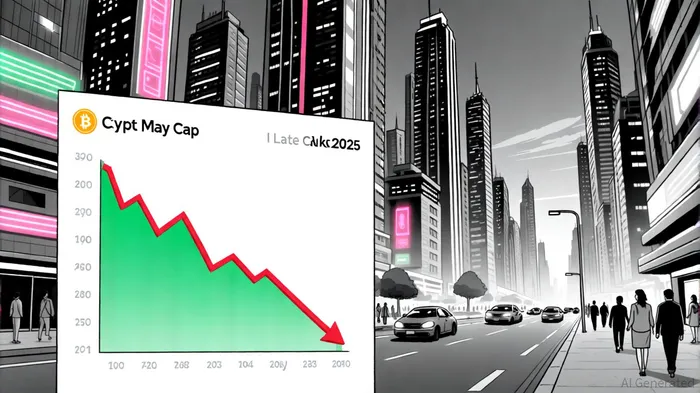
The Catalysts Behind the Liquidations
The collapse began in late May 2025, as a heated Twitter exchange between Donald Trump and Elon Musk ignited a sell-off. BitcoinBTC-- plummeted below $101,000, while EthereumETH-- and DogecoinDOGE-- faced double-digit declines, according to a CoinDesk report. Underlying this was a broader risk-off sentiment driven by U.S.-China trade tensions and Trump's 100% tariff announcements, as reported in an FXLeaders report. Technical factors, such as the market cap falling below the $3.35 trillion support level and outflows from Spot Bitcoin ETFs, compounded the sell-off, according to a Metapress guide.
The liquidations were heavily skewed toward long positions, with $747 million in leveraged bets wiped out-highlighting the fragility of overleveraged portfolios, a point underscored in the Metapress guide. Bitcoin alone accounted for $222 million in liquidated futures, while altcoins like SolanaSOL-- (SOL) and XRPXRP-- saw significant forced closures, as noted in the Metapress analysis. This event underscores a recurring theme in crypto: leverage amplifies both gains and losses, often leading to cascading failures during downturns.
Strategic Entry Points for Long-Term Investors
For investors seeking to capitalize on the post-liquidation landscape, three principles emerge from historical data and current market dynamics:
Diversification and DCA (Dollar-Cost Averaging)
Diversifying across blue-chip assets (Bitcoin, Ethereum), mid-cap tokens (Solana, Polkadot), and emerging DeFi/NFT projects can mitigate risk while capturing growth potential, as the Metapress guide recommends. Stablecoins also serve as a buffer during volatile periods, another point discussed in the Metapress piece. Dollar-cost averaging-systematically buying assets at regular intervals-reduces the impact of timing errors and emotional decision-making, as noted in a CeloLaser report. This approach is particularly effective in markets prone to sharp corrections, as seen in 2025.Identifying Undervalued Assets
ChainlinkLINK-- (LINK) and Polygon (POL) stand out as undervalued plays. Despite their foundational roles in DeFi and Ethereum scaling, both trade at significant discounts to their 2021 highs, as reported by CoinDesk. Metrics like the Network Value to Transactions (NVT) ratio and Market Value to Realized Value (MVRV) suggest these tokens are trading below intrinsic value, according to CoinDesk's analysis. Investors should prioritize projects with strong on-chain fundamentals, such as Total Value Secured (TVS) and whale accumulation, as the CeloLaser report advises.Leveraging Recovery Patterns
Historical recoveries post-liquidation follow a three-phase model:- Phase 1: Market "bleeding out," where leveraged positions are liquidated, and liquidity dries up, a pattern described by CoinDesk.
- Phase 2: Market makers absorb sell orders, stabilizing prices and creating local maxima, another stage noted by CoinDesk.
- Phase 3: Consolidation and gradual re-entry by institutional and retail investors, as highlighted by the Metapress guide.
Investors should avoid panic selling during Phase 1 and instead use Gate's liquidation data to identify overleveraged positions that may signal reversals.
Geopolitical Risks and Institutional Adoption
While geopolitical tensions remain a wildcard-such as Trump's tariffs-2025 also marks a turning point in institutional adoption. Layer-2 solutions and blockchain infrastructure are gaining traction, improving scalability and reducing transaction costs, as the CeloLaser report observes. The Federal Reserve's anticipated rate cuts and increased liquidity could further bolster recovery efforts, another scenario explored in the CeloLaser analysis. However, investors must remain cautious about regulatory shifts, particularly in DeFi, where undercollateralized positions could trigger secondary liquidations-a risk the CeloLaser report flags.
Conclusion: Balancing Caution and Opportunity
The $800 billion liquidation event of 2025 is a stark reminder of crypto's volatility. Yet, for long-term investors, it also presents a rare opportunity to acquire undervalued assets at discounted prices. By adhering to disciplined strategies-diversification, DCA, and a focus on fundamentals-investors can navigate the chaos and position themselves for the next bull cycle. As always, patience and risk management will be the difference between survival and success in this high-stakes market.






Comentarios
Aún no hay comentarios