
Crypto Market Volatility and Institutional Adoption in Uptober 2025: Strategic Entry Points for Risk-Aware Investors
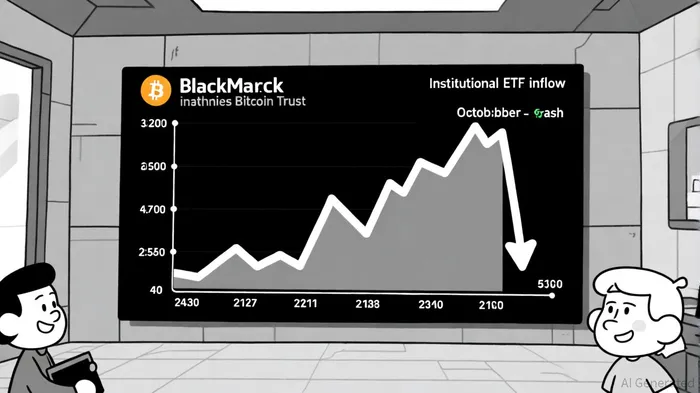
The crypto market in October 2025 was a theater of extremes. A historic crash, triggered by geopolitical tensions and exacerbated by excessive leverage, wiped out $19 billion in leveraged positions within 24 hours, sending BitcoinBTC-- below $105,000 and EthereumETH-- into double-digit declines [1]. Yet, amid the chaos, institutional adoption surged, with ETFs and corporate treasuries acting as both catalysts and stabilizers. For risk-aware investors, this duality-volatility and institutional validation-presents a unique opportunity to identify strategic entry points while mitigating downside risks.
Institutional Adoption: A Catalyst for Mainstream Legitimacy
Q3 2025 marked a turning point in institutional crypto adoption. Public companies holding Bitcoin increased by 38%, with 172 firms collectively staking $117 billion in the asset, or 4.87% of the total supply [2]. Simultaneously, U.S. spot Bitcoin ETFs recorded $7.8 billion in net inflows, with BlackRock's iShares Bitcoin Trust amassing $87.2 billion in assets under management [3]. These figures underscore a shift from speculative fervor to institutional-grade infrastructure.
Regulatory clarity further accelerated adoption. The U.S. SEC's delayed approval of altcoin ETFs (e.g., SolanaSOL--, XRP) highlighted custody and classification challenges [4], but frameworks like the EU's MiCAR and the U.S. GENIUS Act provided a roadmap for compliance, enabling pension funds and banks to allocate 1–3% of portfolios to digital assets [5]. JPMorgan and Standard Chartered now offer spot trading in Bitcoin and Ethereum, signaling a normalization of crypto as a tradable asset class [6].
October 2025 Crash: A Stress Test for Market Resilience
The October crash, however, exposed vulnerabilities. A 100% tariff threat on Chinese imports by former U.S. President Donald Trump reignited trade war fears, triggering a cascade of liquidations. Bitcoin's 14% drop and Ethereum's 12% plunge were amplified by a 374% year-on-year increase in Bitcoin's open interest and 205% for Solana [7]. Synthetic stablecoins like USDEUSDe-- depegged to as low as $0.60–$0.65, while altcoins such as XRPXRP-- and DOGEDOGE-- lost over 80% of their value in minutes [8].
Yet, the crash also revealed institutional resilience. ETF inflows and strategic reserve allocations by banks and pension funds cushioned the fall, stabilizing the market within weeks [9]. This duality-systemic fragility and institutional fortitude-highlights the importance of risk-adjusted strategies for new entrants.
Strategic Entry Points: Balancing Volatility and Institutional Signals
For risk-aware investors, October's turmoil created asymmetric opportunities. Institutional buying patterns post-crash suggest a preference for large-cap assets (Bitcoin, Ethereum) and Ethereum-integrated projects (e.g., Solana, Cardano) [10]. A typical institutional allocation strategy now allocates 50% to large-cap assets, 20% to mid-cap altcoins, 10% to high-risk low-cap coins, and 20% to stablecoins [11].
Key entry strategies include:
1. Dollar-Cost Averaging (DCA): Institutions are favoring DCA for Bitcoin and Ethereum to mitigate volatility [12].
2. Thematic ETFs: Products like BlackRock's Web3 infrastructure and DeFi ETFs offer diversified exposure to institutional-grade projects [13].
3. Regulatory Timelines: The CLARITY Act and MiCAR framework provide windows for altcoin investments, particularly Ethereum-based tokens .
4. Core-Satellite Portfolios: Allocating 60–70% to Bitcoin/Ethereum and 30–40% to high-utility altcoins (e.g., SUI, ADA) with yield-generating mechanisms .
Risk Management: Frameworks for Institutional-Grade Compliance
Post-crash, institutions are adopting robust risk frameworks. The BCG-developed asset-class agnostic model emphasizes legal certainty, regulatory compliance, and operational scalability . In the U.S., the repeal of SEC's SAB 121 and SPBD framework has streamlined custody practices, while the GENIUS Act supports institutional-grade altcoin investments .
For individual investors, this means prioritizing regulated vehicles (ETFs, staking platforms) and avoiding over-leveraged positions. The October crash demonstrated that liquidations disproportionately affect retail traders, whereas institutions use hedging and reserve allocations to navigate turbulence .
Conclusion: Navigating the New Normal
The October 2025 crash was a watershed moment. It exposed the market's fragility but also validated crypto's institutional potential. For risk-aware investors, the path forward lies in aligning with institutional strategies: leveraging ETFs for liquidity, adopting DCA for long-term accumulation, and prioritizing projects with regulatory and technological moats. As the market matures, volatility will persist-but so will opportunities for those who approach it with discipline and a focus on fundamentals.





Comentarios
Aún no hay comentarios