
Crypto Market Structure Legislation Delays and Implications for Stablecoin Firms
The U.S. crypto market is at a crossroads, with regulatory uncertainty casting a long shadow over stablecoin firms and exchanges. The delayed passage of the CLARITY Act-a landmark piece of legislation intended to clarify the regulatory status of digital assets-has exacerbated volatility and created operational risks for companies like CoinbaseCOIN-- and CircleCRCL--. As the Senate postpones final consideration of the bill until January 2026, some analysts speculate delays could extend into 2027, the industry faces a precarious balancing act between innovation and compliance.
Regulatory Uncertainty and Market Volatility
The CLARITY Act, passed by the House in July 2025, seeks to define jurisdictional boundaries between the SEC and CFTC by categorizing digital assets into three tiers: digital commodities, investment contract assets, and permitted payment stablecoins. However, Senate negotiations have stalled due to disagreements over DeFi oversight, consumer protections, and the role of the CFTC in spot markets. This delay has already triggered a $952 million net outflow from U.S.-focused digital asset investment funds in the week following the latest delay announcement, with Ethereum investment products accounting for $555 million of that loss. The market's sensitivity to regulatory news underscores the fragility of investor confidence in an environment lacking clear rules.
The GENIUS Act and Stablecoin Revenue Models
The GENIUS Act, signed into law in July 2025, introduced a critical regulatory shift for stablecoin firms. By prohibiting stablecoin issuers from paying interest or yield to token holders, the law directly impacts business models reliant on revenue-sharing agreements. For example, Circle's arrangement with Coinbase-where the exchange receives a portion of reserve income from USDCUSDC-- custodial holdings-has drawn scrutiny. Critics argue that Coinbase, as the legal "holder" of stablecoins in custodial wallets under its user agreement, may be violating the spirit of the GENIUS Act. In 2024 alone, Circle paid Coinbase $907.9 million in distribution fees derived from USDC reserves, a revenue stream now at risk if regulators enforce the prohibition strictly.
Coinbase has pushed back, arguing that such rewards are essential for maintaining the dollar's global dominance and fostering competition with China's interest-bearing digital yuan. The firm is even considering withdrawing support for the Senate's version of the CLARITY Act if its ability to offer stablecoin rewards is curtailed. This tension highlights a broader debate: Should stablecoin platforms be allowed to innovate with yield-bearing products, or must they adhere to traditional banking regulations to prevent systemic risks?
CLARITY Act's Three-Tier Framework and Operational Risks
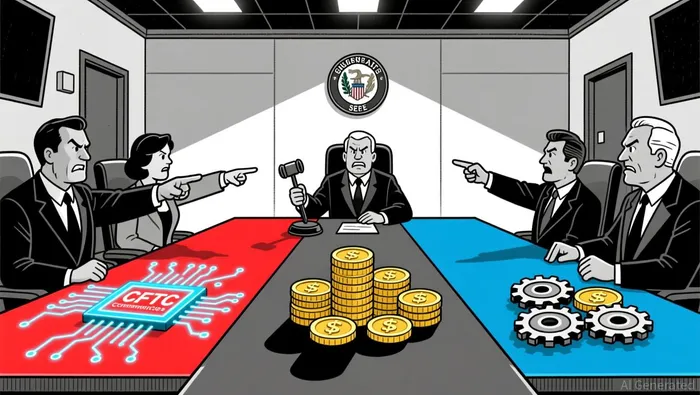
The CLARITY Act's proposed three-tier classification system aims to resolve jurisdictional ambiguities by assigning digital commodities to the CFTC, investment contracts to the SEC, and permitted payment stablecoins to a separate regulatory framework under the GENIUS Act. For firms like Circle and Coinbase, this framework could redefine compliance obligations. If the Senate's competing draft-which grants the CFTC exclusive jurisdiction over spot markets-prevails, it could create a fragmented regulatory environment. Such a scenario would force companies to navigate conflicting requirements, increasing compliance costs and operational complexity.
For instance, Coinbase's custodial model, where it acts as the legal holder of stablecoins, may clash with the GENIUS Act's prohibition on interest-sharing if the CFTC's jurisdiction expands. This ambiguity has already prompted Coinbase to advocate for legislative clarity, even as it faces pressure from regulators to halt reward programs. The lack of a unified regulatory approach also raises concerns about market fragmentation, as firms may seek to operate in states with more favorable laws (e.g., Wyoming or Texas) to avoid federal overreach according to regulatory analysis.
Financial and Strategic Implications
The financial stakes for stablecoin firms are immense. Circle's revenue-sharing model with Coinbase not only funds the exchange's operations but also incentivizes users to hold USDC. If this model is deemed non-compliant with the GENIUS Act, Coinbase could face a significant revenue shortfall, potentially forcing it to pivot to alternative income streams or reduce its competitive edge against traditional banks and foreign digital currencies. Meanwhile, Circle may need to restructure its reserve management to avoid regulatory penalties, which could reduce the efficiency of its liquidity operations.
Investors should also consider the broader market implications.
The Senate's delay in passing the CLARITY Act has already triggered outflows from crypto funds, and further delays could exacerbate this trend. If the bill is passed in 2026 with provisions that restrict stablecoin rewards, it could accelerate the migration of capital to more regulated assets or foreign markets where regulatory frameworks are clearer. Conversely, a timely and well-crafted CLARITY Act could stabilize the market by providing a predictable regulatory environment, encouraging institutional adoption and long-term investment.
Conclusion
The U.S. crypto market is at a pivotal juncture, with the CLARITY Act and GENIUS Act shaping the future of stablecoin firms and exchanges. While regulatory clarity is essential for long-term growth, the current delays and ambiguities pose significant risks to companies like Coinbase and Circle. Investors must closely monitor legislative developments in early 2026, as the outcome of Senate negotiations will determine whether the U.S. maintains its leadership in digital assets or cedes ground to more agile regulatory regimes. For now, the message is clear: in the absence of clear rules, the market will continue to price in uncertainty.





Comentarios
Aún no hay comentarios