
Crypto Market Structure and Catalysts for a 25,000% Surge: Macro Conditions and Institutional Adoption as Game-Changers
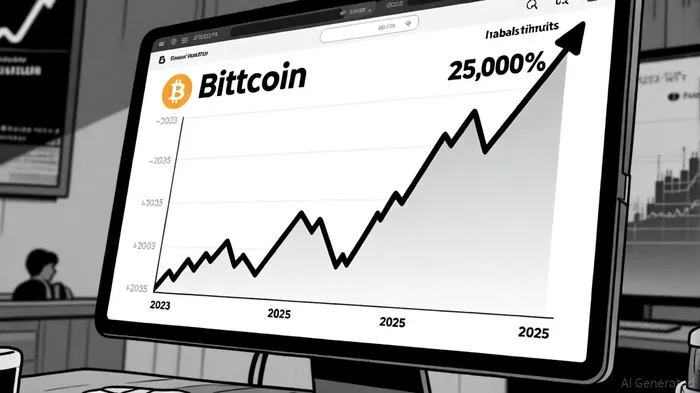
The cryptocurrency market in 2025 is no longer a speculative frontier but a recalibrated asset class, reshaped by macroeconomic tailwinds and institutional adoption. A confluence of unprecedented fiscal stimulus, regulatory clarity, and institutional infrastructure has created a fertile ground for crypto assets to surge-potentially by 25,000%-as traditional finance integrates digital assets into its core. This analysis unpacks the structural shifts and catalysts driving this transformation.
Macroeconomic Drivers: Liquidity, Inflation, and Rate Cycles
Global fiscal expansion has injected trillions into the financial system, creating a liquidity wave that extends to crypto. The U.S. FY 2025 deficit reached $1.9 trillion, while China's $4.3 trillion fiscal stimulus further amplified money creation, according to an Optima report. These deficits, coupled with sustained bank credit growth, have increased private-sector liquidity, with debt service payments flowing into risk assets like BitcoinBTC--. The Federal Reserve's maintained rates of 4.25%-4.50% through 2024-2025 have also supported this dynamic, as higher rates increase government borrowing costs, indirectly funding crypto demand, a point the Optima report highlights.
Inflation remains a critical factor. The U.S. inflation rate stabilized at 3.1%, while the Eurozone reported 3.4%, prompting investors to seek hedges against purchasing power erosion in the Crypto Market Overview 2025. Bitcoin and EthereumETH-- ETFs have attracted over $28 billion in net inflows in 2025, reflecting a shift from speculative trading to strategic allocation, as reported by JPMorgan and Citi. This trend mirrors historical patterns, such as the 2021 bull run driven by Ethereum's utility in DeFi and NFTs, but with a new institutional layer noted in the Coinbase Institutional outlook.
Institutional Adoption: From ETFs to Strategic Reserves
The approval of spot Bitcoin ETFs in 2024 marked a watershed moment. Since their launch, these products have drawn $14.8 billion in inflows, with BlackRock's iShares Bitcoin Trust reaching $10 billion in assets under management within seven weeks, a statistic detailed in the Optima report. Public companies now hold over 850,000 BTC ($73 billion), with MicroStrategy leading corporate treasury allocations, as the Optima report also documents. By 2029, corporate Bitcoin holdings are projected to reach $330 billion, signaling a long-term shift in capital allocation (Optima).
Regulatory clarity has accelerated this adoption. The removal of the "reputational risk" clause by U.S. agencies like the OCC and FDIC has allowed banks to engage with crypto firms, as reviewed in the Crypto Market Overview 2025. The U.S. Strategic Bitcoin Reserve, holding over 200,000 BTC, and Europe's MiCA framework further legitimize crypto as a national and institutional asset, trends that align with broader institutional risk frameworks identified in Institutional Crypto Risk Management Statistics.
Market Structure Changes: Liquidity, Volatility, and Order Books
Institutional participation has fundamentally altered crypto's market structure. During active trading hours, deeper order books and tighter bid-ask spreads reflect institutional and algorithmic activity, a dynamic the Optima report describes. For example, liquidity layers formed by high-frequency trading stabilize price movements, reducing short-term volatility. However, weekends and off-peak hours reveal fragmented liquidity, with altcoins experiencing double-digit swings from single large trades, a pattern JPMorgan and Citi analysts have discussed.
The interplay of market and limit orders also shapes volatility. Institutional-heavy periods see limit orders dominating, creating gradual price levels, while aggressive market orders during low liquidity trigger sharp adjustments, another observation highlighted by JPMorgan and Citi. This duality underscores crypto's evolving maturity: it is no longer a retail-driven market but one influenced by institutional-grade risk management frameworks, including multi-party computation and hybrid custody models described in the Institutional Crypto Risk Management Statistics.
Expert Projections: A 25,000% Surge in 2025?
Bullish forecasts hinge on macroeconomic and institutional tailwinds. JPMorgan targets $165,000 for Bitcoin by year-end, citing ETF inflows and its volatility relationship with gold, while Citi projects $133,000 and Standard Chartered predicts $200,000, attributing this to a weakening U.S. dollar and global liquidity expansion (JPMorgan, Citi, Standard Chartered coverage). Conservative estimates range from $69,550 to $90,000, but optimistic scenarios suggest Bitcoin could reach $228,245 by 2030, per institutional risk analyses.
These projections align with historical precedents. The 2024 halving event, combined with ETF approvals, created a "perfect storm" of scarcity and demand, an interaction explored in CoinbaseCOIN-- Institutional's research. If global liquidity continues to expand and regulatory clarity persists, Bitcoin's role as a hedge against inflation and economic uncertainty could drive sustained growth beyond traditional cycles, as argued by Arthur Hayes.
Conclusion: A New Paradigm for Crypto
The 2025 crypto market is no longer defined by speculation but by macroeconomic fundamentals and institutional infrastructure. Government deficits, regulatory clarity, and ETF-driven liquidity have created a self-reinforcing cycle of demand. While volatility persists, the structural shifts-deepened order books, tokenized assets, and strategic reserves-signal a maturing market. For investors, the question is no longer if crypto will surge, but how to position for a 25,000% trajectory.







Comentarios
Aún no hay comentarios