
Crypto Market Stability Amidst Flash Crashes: Analyzing the Role of Market Makers and Exchange Mechanics
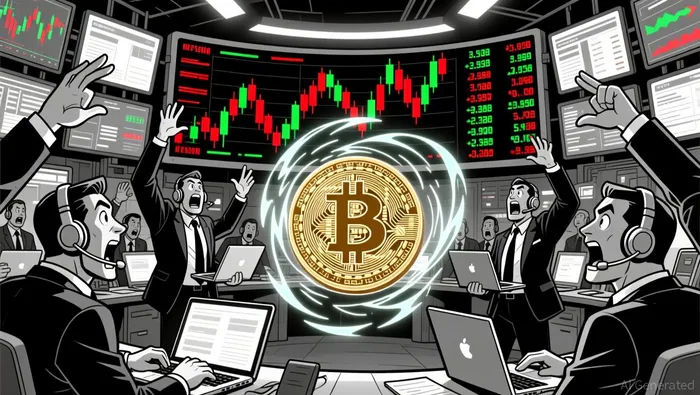
The October 2025 crypto flash crash, triggered by U.S. tariff threats on Chinese software imports, exposed profound vulnerabilities in the crypto ecosystem. Within hours, nearly $20 billion in positions were liquidated across exchanges like Hyperliquid, Bybit, and Binance, while Bitcoin's price diverged by as much as $10,000 between Kraken and CoinbaseCOIN-- according to Solidus Labs analysis. This event underscores the critical need to reassess systemic risk in crypto markets, particularly the interplay between market makers, exchange mechanics, and algorithmic trading strategies.
Market Makers and Liquidity Fragmentation
Market makers play a pivotal role in maintaining liquidity, but their behavior during flash crashes can exacerbate volatility. During the October 2025 crash, liquidity providers withdrew capital en masse, creating stark price discrepancies across exchanges. For instance, Bitcoin's price on Kraken surged $10,000 above Coinbase's, highlighting the lack of cross-venue price discovery mechanisms. Traditional markets rely on circuit breakers and centralized surveillance to mitigate such fragmentation, but crypto's decentralized, fragmented structure lacks these safeguards. This absence of consistent execution mechanisms leaves the market prone to cascading liquidations and extreme volatility.
Exchange Mechanics and Auto-Deleveraging
Exchange mechanics, particularly Auto-Deleveraging (ADL) protocols, further complicate stability. ADL is designed to liquidate undercollateralized positions, but during the 2025 crash, it disproportionately impacted profitable traders. Insolvent counterparties forced liquidations on solvent traders, eroding trust in market fairness. This dynamic reveals a critical flaw: exchanges prioritize capital preservation over equitable outcomes, often at the expense of retail and institutional participants.
Systemic Risk and Regulatory Gaps
The 2025 crash amplified systemic risks inherent in crypto's algorithmic trading environment. Over-leveraged perpetual futures markets, coupled with fragmented infrastructure, created a perfect storm for cascading liquidations. Unlike traditional markets, crypto lacks robust stress-testing frameworks or real-time surveillance tools to detect manipulation or spoofing. Regulatory proposals like the EU's Markets in Crypto-Assets (MiCA) and the U.S. GENIUS Act aim to address these gaps. MiCA mandates reserve requirements for stablecoins and enhanced market abuse monitoring, while the GENIUS Act enforces monthly audits and transparency for USD-backed stablecoins. However, implementation challenges persist, particularly in harmonizing cross-jurisdictional standards.
Algorithmic Trading and Market Maker Interactions
Algorithmic trading strategies, when combined with market maker behaviors, can amplify flash crash risks. During periods of stress, algorithms may exacerbate liquidity crunches by accelerating sell-offs or triggering stop-loss orders. The UK's Financial Conduct Authority (FCA) has emphasized the need for rigorous governance, including inventory controls, simulation testing, and real-time surveillance according to Nasdaq analysis. Yet, crypto exchanges remain fragmented in their approach, with some prioritizing speed over stability.
The Path Forward: Regulatory Clarity and Global Coordination
Addressing systemic risk requires a dual focus on regulatory clarity and global coordination. The EU's MiCA and DORA (Digital Operational Resilience Act) frameworks represent progress, mandating operational resilience and cyber risk management for crypto platforms. Similarly, the U.S. SEC's 2025 priorities highlight algorithmic trading oversight, emphasizing fairness and investor protection. However, regulatory divergence-such as the U.S. and EU's differing stablecoin reserve rules- creates arbitrage opportunities and complicates systemic risk management.
Investors must also adopt disciplined risk management. Assets with durable fundamentals and strong liquidity, like BitcoinBTC--, tend to stabilize faster during crises. Altcoins, often reliant on speculative liquidity, face greater volatility when market makers withdraw.
Conclusion
The October 2025 flash crash serves as a wake-up call for the crypto industry. Systemic risks are not abstract-they are embedded in the mechanics of market makers, exchange protocols, and algorithmic strategies. Regulatory frameworks like MiCA and the GENIUS Act are steps in the right direction, but global coordination and adaptive oversight are essential to prevent future meltdowns. For investors, the lesson is clear: prioritize assets with robust fundamentals, demand transparency from exchanges, and advocate for a regulatory environment that balances innovation with stability.







Comentarios
Aún no hay comentarios