
Crypto Market Sentiment and Positioning: Lessons from a $1.39M ETH Loss
Whale Behavior and Market Sentiment: A Volatile Symbiosis
Whales-large holders of crypto assets-exert disproportionate influence over market sentiment. In 2025, the TronTRX-- blockchain saw a surge in memecoinMEME-- activity driven by platforms like SunPump, which enabled rapid coin creation and deployment. This led to a $1.4 billion whale cash-out on the network, exacerbating fee surges and creating a feedback loop of speculative frenzy. Such behavior underscores how whale activity can amplify market sentiment, particularly in low-liquidity environments where retail investors are vulnerable to sudden price swings.
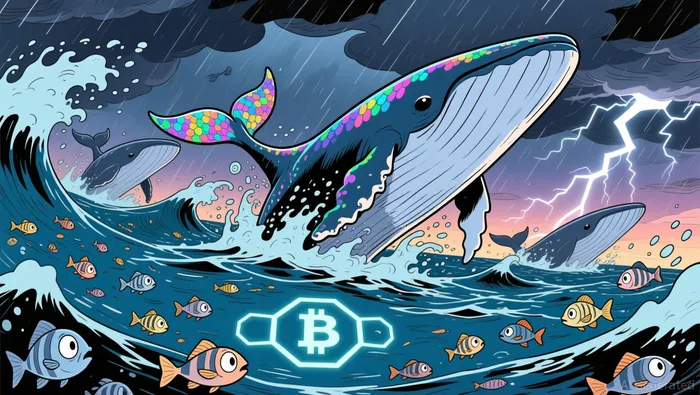 Ethereum's whale activity further illustrates this dynamic. According to CryptoQuant data, EthereumETH-- whales holding 10K–100K ETH reduced their balances by over 150K ETH in four days as the price approached their realized cost basis of $2,900. This selling pressure reflects a psychological threshold: when prices near cost bases, whales often liquidate to mitigate losses or lock in gains. Conversely, a notable Ethereum whale recently accumulated $1.6277 billion worth of ETH on Binance, depositing it into AaveAAVE-- V3-a strategic move suggesting confidence in Ethereum's long-term value despite short-term volatility. These contrasting behaviors reveal how whale positioning can both destabilize and stabilize markets, depending on their risk appetite and timing.
Risk Management Failures: Leverage, Martingale Strategies, and Liquidations
The $1.39M ETH loss incident also exposes systemic flaws in risk management practices. A high-profile Ethereum whale suffered a $51.5 million liquidation after employing a martingale long strategy-a high-risk approach where positions are doubled down on after losses in hopes of recouping capital. This strategy, while occasionally profitable in stable markets, is catastrophic in volatile environments. The whale's losses, which exceeded $10 million since September 2025, demonstrate the dangers of over-leveraging and inadequate position sizing.
Such failures are not isolated. The same whale had previously borrowed to short 66,000 ETH, a move that initially capitalized on bearish sentiment but later backfired as market conditions shifted. This highlights a critical lesson: in crypto's unpredictable cycles, rigid strategies-whether bullish or bearish-can lead to ruin if not dynamically adjusted.
Lessons for Investors: Balancing Sentiment and Strategy
For investors, the $1.39M ETH loss serves as a cautionary tale. First, understanding whale behavior is essential. Tools like on-chain analytics (e.g., OnchainLens) can track whale movements, offering early warnings of potential sell-offs or accumulation phases. Second, risk management must prioritize flexibility. Martingale strategies and other rigid approaches are incompatible with crypto's volatility; instead, investors should employ stop-loss orders, diversification, and hedging mechanisms.
Third, market sentiment is a self-fulfilling prophecy. As academic research notes, social media sentiment and whale activity often create reinforcing cycles of fear or greed. Investors must remain vigilant against herd behavior, using data-driven analysis rather than emotional responses to navigate these cycles.
Conclusion
The $1.39M ETH loss is not an anomaly but a symptom of broader systemic risks in crypto markets. Whale behavior, while influential, is only one piece of the puzzle. Effective risk management requires a nuanced understanding of market dynamics, leverage discipline, and adaptive positioning. As the industry matures, investors who internalize these lessons will be better equipped to thrive in an environment where volatility is the norm.






Comentarios
Aún no hay comentarios