
Crypto Market Sentiment and Institutional Reentry: Analyzing Whale Activity as a Leading Indicator for Institutional Adoption and Market Recovery
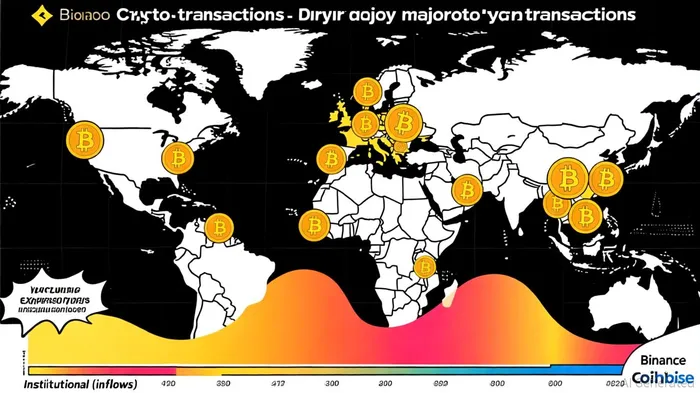
The crypto market in 2025 is at a pivotal inflection point. After a year marked by extreme volatility—Bitcoin hitting an all-time high of $111,842.71 on August 27, 2025 [5]—investors are scrambling to decode signals of institutional reentry and market recovery. While retail sentiment often drives short-term noise, a subtler, more predictive narrative emerges from the movements of crypto whales: large-scale actors whose transactions act as a canary in the coal mine for institutional capital.
Whale Activity: The Hidden Engine of Market Sentiment
Crypto whales are not just moving assets—they're signaling confidence. This week alone, whales purchased 44.52 million JasmyCoin (JASMY) tokens ($1.38 million) and added 150 million XRPXRP-- to their holdings [2]. These are not random trades; they're strategic bets. For instance, Polygon (MATIC) whales accumulated 5.11 million tokens this week, a 65% discount to its all-time high, suggesting opportunistic buying [2]. Such activity often triggers cascading effects in lower-liquidity altcoins, where whale movements can artificially inflate or deflate prices.
The PUMP token's 13% surge this month is another case study. While retail traders celebrated, the sustainability of the rally remains questionable—whale inflows are often followed by sharp corrections when large holders cash out [1]. This duality underscores the importance of distinguishing between speculative hype and genuine institutional interest.
Institutional Reentry: From BitcoinBTC-- ETFs to Derivatives Leverage
Institutional adoption in 2025 is no longer a question of if but how fast. The approval of U.S. Bitcoin ETFs in early 2024 catalyzed a shift, with BlackRockBLK-- and Fidelity legitimizing crypto as a financial asset class [3]. By Q1 2025, institutional investors held ~15% of Bitcoin's supply, and nearly half of hedge funds had allocated digital assets [3].
MicroStrategy's recent purchase of 11,000 BTC ($1.23 billion) exemplifies this trend [5]. But the real story lies in the derivatives market. Bitcoin's Open Interest (OI) in futures and options has ballooned to $52.8 billion, up from $7.7 billion in 2020 [4]. This leverage accumulation—driven by institutions and whales—reflects a strategic bet on Bitcoin's long-term trajectory. When OI rises alongside price, it signals coordinated buying; when it diverges, it warns of distribution.
On-Chain Signals: The Whale-Institutional Correlation
On-chain data reveals a clear pattern: large-value transactions now dominate the Bitcoin network, with retail trading activity declining [4]. The average transaction value has surged, while overall volume has dropped, indicating that the remaining activity is driven by whales and institutions. This shift mirrors traditional markets, where institutional orders move prices far more than retail noise.
For example, exchange inflows and outflows serve as critical whale indicators. In Q1 2025, significant BTC movements were observed between Binance and CoinbaseCOIN-- Institutional, suggesting institutional rebalancing [2]. Similarly, HYPE Token's recent self-transfer patterns—where whales move assets between wallets—signal market positioning ahead of potential volatility [4].
The Road Ahead: Whale Activity as a Leading Indicator
Whale movements are not just reactive—they're predictive. When whales accumulate altcoins like SolanaSOL-- or XRP, it often precedes broader institutional interest. For instance, XRP's 150 million-token whale accumulation coincided with renewed institutional discussions about its regulatory resolution [2]. Similarly, Bitcoin's institutional adoption is reinforced by its tokenization on blockchain platforms and regulated investment tools [3].
However, the market remains fragile. While whales and institutions drive momentum, macroeconomic headwinds (e.g., trade wars, fiscal stress) could trigger sudden reversals [1]. Investors must monitor whale activity not in isolation but as part of a broader tapestry of on-chain metrics, derivatives leverage, and regulatory developments.
Conclusion
Crypto market sentiment in 2025 is increasingly shaped by the interplay between whale activity and institutional reentry. Whales act as both participants and indicators, their transactions revealing the hidden mechanics of market recovery. As Bitcoin's price and OI reach historic highs, the question is no longer whether institutions will dominate crypto—it's how quickly they'll reshape it.





Comentarios
Aún no hay comentarios