
Crypto Market Resilience Amid Macroeconomic Shifts: Strategic Positioning in a Post-Dollar-Dominance Era
The global financial landscape is undergoing a seismic transformation. As macroeconomic uncertainties, regulatory shifts, and geopolitical tensions reshape traditional markets, the cryptocurrency sector has demonstrated remarkable resilience. From 2023 to 2025, the total crypto market capitalization surged from $1.4 trillion to over $7 trillion, driven by institutional adoption, regulatory clarity, and technological innovation, according to Crypto.com's 2023–24 review. This growth is not merely a function of speculative fervor but a reflection of strategic positioning in a world where the U.S. dollar's dominance is increasingly contested.
Macroeconomic Shifts and Crypto's Resilience
The crypto market's ability to thrive amid macroeconomic volatility is underscored by its role as a hedge against inflation and currency devaluation. In 2024, Bitcoin's price surpassed $100,000 amid U.S. Federal Reserve rate cuts and a weakening dollar, reinforcing its inverse correlation with the greenback, as discussed in a JU Blog analysis. Institutional adoption has accelerated, with 45% of high-value crypto transactions occurring in North America, driven by regulatory clarity and the approval of BitcoinBTC-- and EthereumETH-- spot ETFs, per the Chainalysis 2025 report. These ETFs alone generated $13.7 billion in net inflows in the first half of 2025, signaling a paradigm shift in how traditional finance views digital assets, as noted in Coinpaper's mid‑2025 report.
Technological advancements have further solidified crypto's resilience. Ethereum's Shapella hard fork and EIP-4895 enabled validator withdrawals, catalyzing the liquid staking market, as highlighted in Crypto.com's 2023–24 review. Meanwhile, Layer 2 scaling solutions and decentralized finance (DeFi) platforms have expanded use cases beyond trading, with total value locked (TVL) in DeFi reaching $151.5 billion by mid-2025, according to Binance Research charts.
The Post-Dollar-Dominance Era: Strategic Positioning
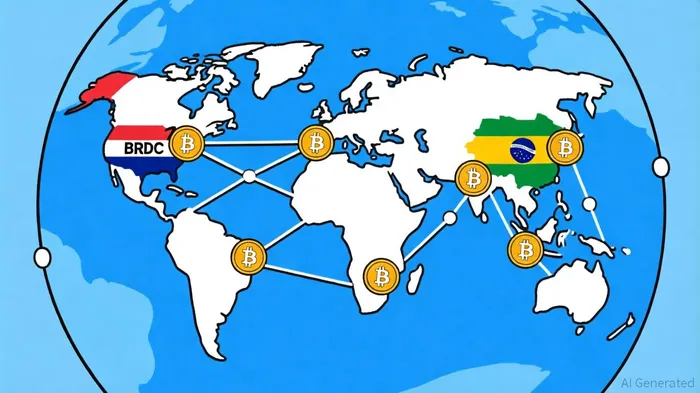
The decline of the U.S. dollar's hegemony has created fertile ground for cryptocurrencies to gain traction. BRICS nations-Brazil, Russia, India, China, and South Africa-are leading the charge, leveraging blockchain and central bank digital currencies (CBDCs) to reduce reliance on the dollar. At the 2024 BRICS Summit, leaders unveiled BRICS Pay, a blockchain-based payment system using CBDCs to facilitate cross-border transactions in local currencies, according to a BricsBridge report. China's digital yuan (e-CNY) is already being tested for 20% of its trade with Russia, while Russia plans to launch a digital ruble for energy transactions in 2025, as CBDC News reports.
The U.S., however, is not standing idly by. Under the Trump administration, the U.S. established a Strategic Bitcoin Reserve and a Digital Asset Stockpile, aiming to balance crypto innovation with dollar dominance, as detailed in a Forbes article. Regulatory reforms, including granting the CFTC authority over non-security digital assets and modernizing bank custody rules, have further institutionalized crypto within traditional finance, according to a White House fact sheet. Meanwhile, corporate adoption has surged, with over 200 U.S. public companies holding $115 billion in digital assets by September 2025, per Business Initiative data.
Case Studies: BRICS and the U.S. in Action
BRICS Pay exemplifies the coalition's ambition to create a multipolar financial system. By enabling 30–50% lower transaction costs compared to traditional systems, BRICS Pay could facilitate 15–20% of global trade settlements by 2030, according to the BricsBridge analysis. China's e-CNY, with $986 billion in 2024 transactions, is already being integrated into cross-border trade with Russia and Saudi Arabia, as detailed in a Forbes overview. Russia's digital ruble, set for a 2026 rollout, will operate via a universal QR code and anti-money laundering (AML) framework, ensuring compliance while bypassing Western financial infrastructure, per Global Government Fintech coverage.
The U.S. response is equally strategic. The President's Working Group on Digital Asset Markets released a 166-page report outlining a roadmap to maintain dollar dominance through dollar-backed stablecoins and regulatory clarity, summarized by a Coincatch summary. Platforms like BlackRock and CoinbaseCOIN-- now offer spot Bitcoin ETPs, attracting institutional inflows and cementing crypto's role in capital markets, as shown in the Chainalysis 2024 report.
Future Outlook: Trends and Investment Opportunities
As the post-dollar-dominance era unfolds, three structural forces will drive crypto's growth:
1. Institutional Adoption: With 75% of small businesses allocating 10% of net income to Bitcoin, corporate treasuries are becoming a significant demand driver, according to a DLA Piper analysis.
2. Regulatory Clarity: The EU's MiCA regulation and the U.S. SEC's Crypto Task Force are creating frameworks that will accelerate mainstream adoption, per a Cointelegraph explainer.
3. Tokenization of Real-World Assets: The tokenization of real estate, art, and commodities will unlock trillions in liquidity, with blockchain infrastructure providers like NEAR ProtocolNEAR-- leading the charge, as discussed in the Colossus Digital review.
Conclusion
The crypto market's resilience amid macroeconomic shifts is not accidental but a result of strategic positioning by institutions, governments, and innovators. As the U.S. dollar's dominance wanes and BRICS nations forge a new financial order, digital assets are becoming the bedrock of a decentralized, multipolar economy. For investors, the imperative is clear: allocate to crypto not as a speculative bet, but as a foundational asset class in a world redefining value, trust, and sovereignty.





Comentarios
Aún no hay comentarios