
Crypto Market Resilience Amid Geopolitical Uncertainty: Trump's Policy Impact on U.S.-China Relations and Digital Asset Investment Flows
The interplay between geopolitical uncertainty and digital asset markets has never been more pronounced than in the Trump 2.0 era. From 2023 to 2025, U.S.-China trade tensions-driven by escalating tariffs, rare earth export controls, and military posturing-have created a volatile macroeconomic environment. Yet, the crypto market has demonstrated remarkable resilience, adapting to shocks while attracting capital as a hedge against instability. This analysis explores how Trump's policies have shaped U.S.-China relations and, in turn, influenced digital asset investment flows, revealing both the fragility and fortitude of the crypto ecosystem.
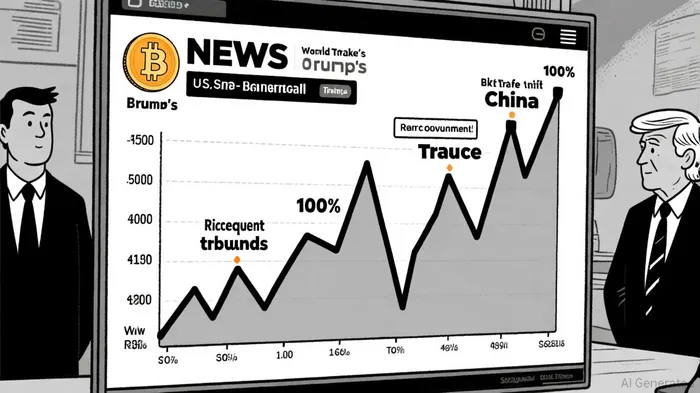
Trump's Policies and the Resurgence of U.S.-China Trade Tensions
President Trump's 2023-2025 administration has prioritized countering China's economic and technological influence, with tariffs serving as a central tool. In October 2025, the announcement of a new 100% tariff on Chinese imports-bringing total duties to 130% when combined with existing 30% levies-marked a dramatic escalation, according to NPR. This move followed China's export restrictions on rare earth minerals and refining technologies, which Trump labeled "hostile" and "unheard of in international trade," NPR reported.
Geopolitical tensions have further intensified, with the U.S. expanding military support for Taiwan and conducting freedom-of-navigation operations in the South China Sea, according to EconoTimes. These actions, coupled with U.S. export controls on AI and quantum computing technologies, reflect a broader strategy to curtail China's global ascendancy. However, the tit-for-tat approach has disrupted global supply chains and raised inflationary pressures, creating a climate of uncertainty that reverberates across asset classes, EconoTimes noted.
Crypto Market Volatility and Capital Flight
The crypto market's sensitivity to geopolitical events was starkly evident in 2025. Trump's tariff announcements triggered historic sell-offs, with BitcoinBTC-- plummeting to $76,000 in early 2025 and suffering another $19 billion in liquidations in October 2025-the largest such event in history, according to CNN. Leveraged positions in perpetual futures markets amplified volatility, as over 1.6 million traders faced forced liquidations within 24 hours, CNN reported.
Yet, the market's resilience emerged in its rapid rebounds. By mid-April 2025, Bitcoin had recovered to $85,000, and by late October, it rebounded to $113,000 following signals of de-escalation. China's openness to revisiting rare earth export policies and Trump's softer rhetoric in October 2025 provided temporary relief, according to CryptoWeekly. These swings underscore crypto's dual role as both a speculative asset and a hedge against geopolitical risk.
Policy-Driven Crypto Adoption in the U.S.
Amid the turbulence, U.S. crypto adoption has surged, driven by regulatory clarity and strategic policy initiatives. By 2025, 28% of American adults owned cryptocurrency, nearly double the 2021 rate, according to a Security.org report. Trump's administration has positioned the U.S. as the "crypto capital of the world" through measures like the Strategic Bitcoin Reserve, U.S. Digital Asset Stockpile, and the rescission of burdensome IRS rules for DeFi exchanges, CryptoWeekly reported. The bipartisan passage of the GENIUS Act further solidified institutional confidence, while 60% of crypto-aware Americans expressed optimism about price appreciation under Trump's leadership, the Security.org report found.
The Path Forward: Resilience and Strategic Hedging
While Trump's policies have introduced volatility, they have also accelerated crypto's integration into mainstream finance. The market's ability to rebound from shocks-despite institutional over-leverage and geopolitical headwinds-highlights its adaptive capacity. For investors, the key lies in balancing risk management with strategic exposure to digital assets, which increasingly serve as a counterweight to traditional markets during periods of uncertainty.
As U.S.-China tensions persist, the crypto sector's resilience will depend on continued regulatory innovation, global adoption trends, and the ability to navigate macroeconomic headwinds. The coming months will test whether the market can sustain its momentum or if further escalations will trigger another wave of capital flight.






Comentarios
Aún no hay comentarios